Henley shirts blend comfort, style, and utility—making them a staple for both casual and semi-formal wear. But not all Henleys are made the same.
Henley shirts stand out because of their collarless round neckline and button placket, offering a polished yet laid-back look ideal for layering or standalone wear.
Some shirts look similar, but they don’t wear the same. Henleys are in a category of their own. Let me show you why.
Classic Cotton Henley Shirt
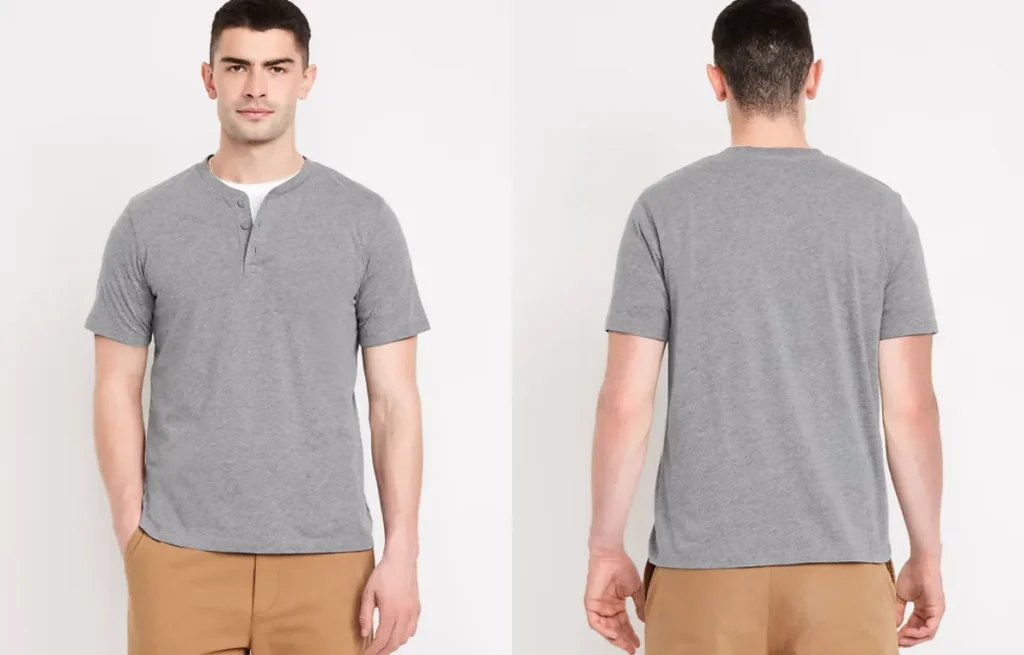
What defines a Classic Cotton Henley Shirt?
This is where the timeless Henley design began. Comfortable, breathable, and effortlessly stylish.
A classic cotton Henley is made from soft, midweight cotton with a traditional 3-button placket, making it an all-season essential that balances structure and comfort.
Cotton Henleys are all about reliability. They’re often the first Henley people own—and for good reason.
Fabric Construction and Feel
Cotton Henleys usually use combed or ring-spun cotton. These fibers are smoother and stronger, making the shirt feel soft but not too stretchy. Here’s what typically defines a high-quality classic cotton Henley:
- Weight: 180–220gsm midweight cotton
- Finish: Pre-shrunk or enzyme-washed for softness
- Structure: Ribbed cuffs or collar add shape retention
| Feature | Description |
|---|---|
| Fiber type | 100% Combed Cotton |
| Texture | Soft, breathable, structured |
| Common fit | Regular or relaxed |
| Color options | Mostly solid, classic tones |
Ideal Use and Styling
This style works best as a base layer or standalone with denim or chinos. The simple button placket adds dimension, making it ideal for:
- Layering under jackets in fall or spring
- Wearing solo in summer for breathable comfort
- Mixing into smart-casual outfits
The cotton version holds its shape better than modal or blended versions. That’s why it’s a go-to choice for everyday wear with a timeless edge.
Variations within Classic Cotton
There’s range even within this category. Slub cotton, for example, has slight texture variations, giving a vintage look. Pima or Supima cotton offers elevated softness and durability.
Some key distinctions:
- Slub Cotton – Textured look, vintage style
- Pima Cotton – Softer, silkier, more durable
- Organic Cotton – Eco-conscious but slightly rougher hand feel
By understanding these fabric subtleties, you can better match the Henley to your customer’s expectations—whether they want premium comfort or rugged style.
How does a Henley differ from a polo or crew neck tee?
It might look like a mix of both—but it wears differently.
A Henley shirt has a distinctive collarless neckline with a short button placket, unlike polos with collars or tees with a closed crew neck.
Henleys give the comfort of a tee and the versatility of a button-up. They don’t have the stiffness of polos or the simplicity of a basic crew neck.
Long Sleeve Henley Shirt
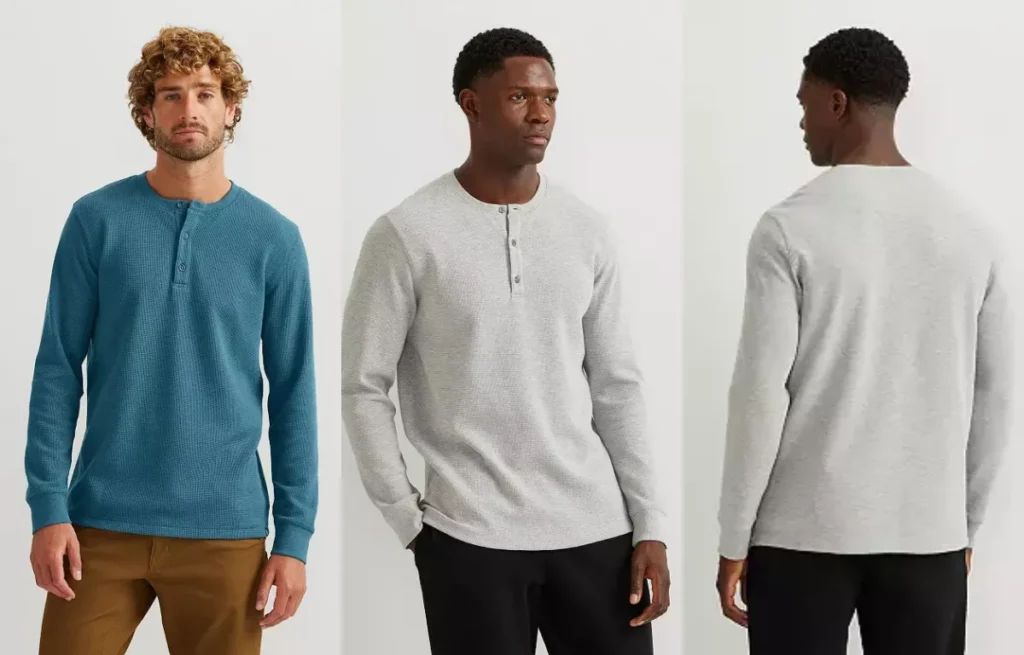
What defines a Long Sleeve Henley Shirt?
This is the version that makes Henleys functional year-round—especially during colder months.
A long sleeve Henley shirt combines the signature collarless neckline and button placket with full-length sleeves, offering more warmth and styling flexibility than short sleeve or tank variations.
It’s more than just extra fabric. The long sleeve Henley becomes a versatile layer—an essential for transitional weather and cooler seasons.
Fabric Types and Thermal Value
Long sleeve Henleys are made in a range of materials, depending on the purpose—casual, workwear, or athleisure. Here’s how different fabrics affect warmth, stretch, and comfort:
| Fabric Type | Features | Best Use |
|---|---|---|
| Cotton Jersey | Soft, breathable, medium warmth | Everyday casual wear |
| Thermal Waffle Knit | Textured, heat-retaining, flexible | Layering in cold weather |
| Cotton-Poly Blend | Slight stretch, wrinkle-resistant | Durable basics, travel wear |
| Ribbed Knit | Body-hugging, high recovery | Women’s fitted fashion styles |
In colder climates, waffle-knit or thermal cotton Henleys are especially popular. The honeycomb texture traps body heat and adds tactile visual appeal.
Fit and Silhouette Options
The long sleeves open up more possibilities for different fits:
- Slim Fit – Clean look for layering under jackets
- Relaxed Fit – More casual, suitable for lounging or streetwear
- Tapered Sleeves – Offers a modern look that hugs the forearm
- Dropped Shoulder – More relaxed and fashion-forward
For womenswear, there’s often added stretch and shorter hemlines to align with modern style trends. Some designs include subtle puff sleeves or flared cuffs to push the aesthetic even further.
Styling Versatility
The long sleeve Henley easily adapts across settings:
- Fall layering – Worn under a shacket or flannel
- Winter base layer – Under parkas or knit cardigans
- Office casual – Paired with chinos and loafers
- Home comfort – Styled with joggers or knit pants
This piece is especially popular with brands who want to target “elevated casual” or “urban utility” aesthetics.
Special Variants to Consider
Not all long sleeve Henleys follow the same rules. A few high-conversion designs include:
- Garment-dyed long sleeve Henleys – Rich, lived-in color depth
- Heavyweight cotton styles – Serve as light outerwear in mild winters
- Split hem and curved back – More refined silhouette, great for premium brands
- Henley hoodies – Combining comfort of loungewear with structure of Henleys
These small changes have a big impact on how the shirt fits into different collections—whether you’re appealing to basics buyers or trend-savvy boutiques.
Short Sleeve Henley Shirt
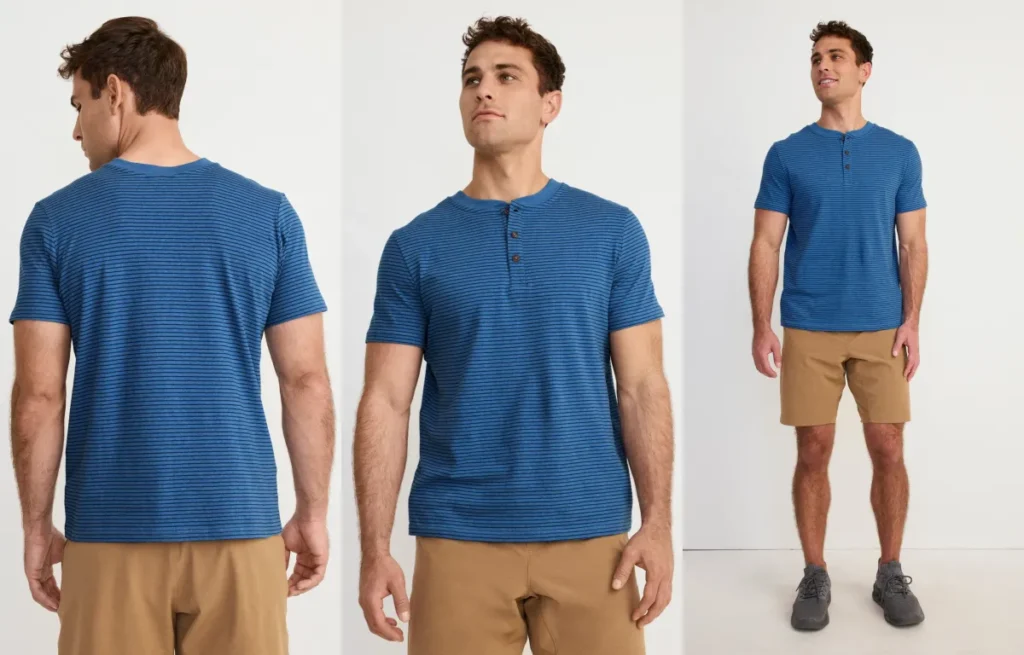
What makes a Short Sleeve Henley Shirt ideal for warm weather styling?
This is the summer-ready version of the classic Henley—light, breathable, and just as polished.
A short sleeve Henley shirt maintains the essential placket-front design but swaps long sleeves for a cooler, more relaxed fit, making it perfect for warm climates or casual days.
It’s often a go-to in resort wear, streetwear, and even workwear when temperatures rise.
Construction and Comfort Priorities
Short sleeve Henleys typically focus on maximum breathability without sacrificing structure. They often feature lighter-weight fabrics, smoother finishes, and shorter plackets. Here’s how the construction tends to differ:
| Feature | Typical Short Sleeve Henley Shirt |
|---|---|
| Fabric Weight | 140–180gsm |
| Placket Length | 2–3 buttons (shorter than long sleeve) |
| Sleeve Length | Mid-bicep to slightly longer |
| Hemline | Straight or slightly curved |
In terms of fabric, the focus shifts to cooler blends:
- 100% cotton jersey – Smooth and breathable for everyday use
- Linen-blend – Enhanced cooling and drape, ideal for coastal or summer brands
- Cotton-modal mix – Soft handfeel with slight stretch, often seen in premium or minimalist brands
Fit and Functional Design
Designers often play more with fit and silhouette in short sleeve versions. Some styles lean athletic, others lean fashion-forward. These are common directions:
- Boxy Fit – Looser cut for streetwear aesthetics
- Slim Fit – Closer to the body for layering or clean looks
- Curved Hem – Adds a subtle touch of styling, popular for elevated basics
- Side Vents – Improves movement and adds detail for men’s and unisex styles
Sleeve openings can also vary. Wider sleeves suggest a more relaxed or vintage vibe, while tighter sleeves suit gym or fitted looks.
Use Cases Across Fashion Categories
The short sleeve Henley is more versatile than most people realize. Its adaptability spans various niches:
- Activewear – Paired with joggers or gym shorts
- Casualwear – Tucked into chinos or denim shorts
- Streetwear – Oversized with layered jewelry or bucket hats
- Resortwear – Linen-blend with sandals or loafers
Popular Styling Strategies for Brands
The short sleeve Henley can be customized to match various brand identities. Here’s how:
| Brand Style Focus | Design Approach |
|---|---|
| Minimalist | Solid color, curved hem, tonal buttons |
| Vintage | Slub cotton, faded dye, contrast seams |
| Sporty | Slim fit, ribbed neck, reinforced seams |
| Boho/Relaxed | Linen blend, relaxed fit, wood buttons |
These details give brands the ability to align the Henley’s core structure with their customer base, whether it’s clean-cut or creatively styled.
For womenswear, cropped versions or cap sleeve variations can increase appeal to Gen Z customers, especially when paired with high-waisted bottoms.
3/4 Sleeve Henley Shirt
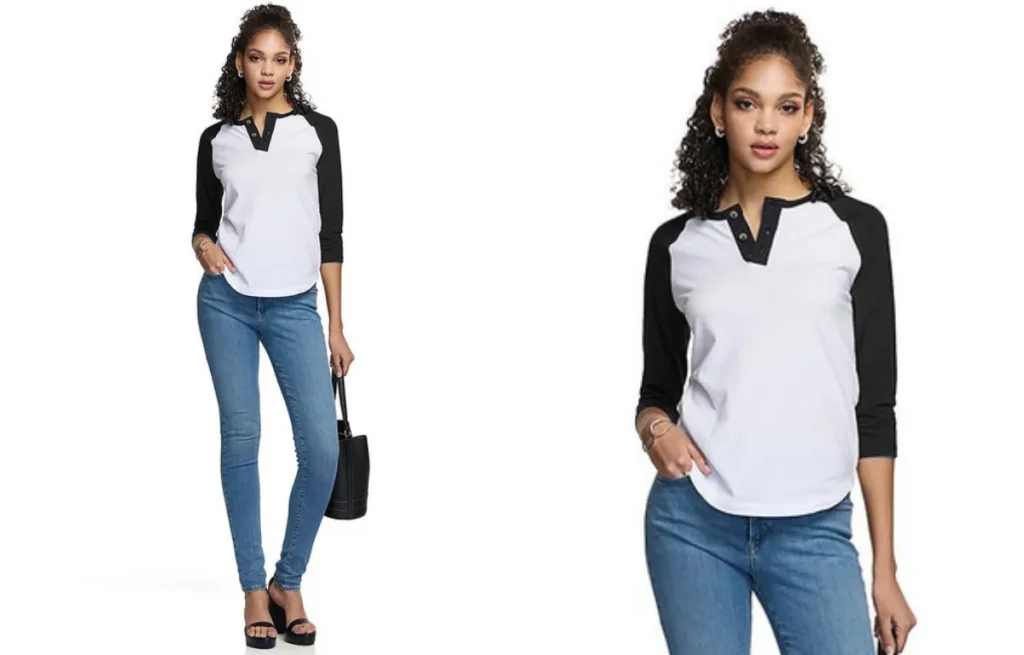
What makes the 3/4 Sleeve Henley Shirt a unique hybrid style?
It’s not quite short, not quite long—just the right length for versatility and visual interest.
A 3/4 sleeve Henley shirt features sleeves that end between the elbow and wrist, blending the casual comfort of a short sleeve with the coverage and layering appeal of long sleeves.
This version offers a slightly dressier look while staying breathable and functional, especially in transitional seasons like spring and fall.
Design Purpose and Core Construction
The 3/4 sleeve Henley isn’t just about looks—it solves a specific comfort and mobility issue. It gives more arm coverage than a short sleeve without the restriction of a full long sleeve.
| Feature | 3/4 Sleeve Henley Shirt Characteristics |
|---|---|
| Sleeve Length | Mid-forearm (just below elbow) |
| Ideal Season | Spring, early fall |
| Movement Flexibility | High |
| Visual Appeal | Strong contrast for layered looks |
These Henleys often feature raglan sleeves to enhance range of motion, especially in sportswear or streetwear styles. That makes them a favorite for active lifestyles, design-driven casualwear, and even unisex collections.
Fabric Strategy for Balanced Function
Because this Henley sits between seasons, the fabric must strike a balance:
- Midweight Cotton Jersey – Breathable but not too light
- Modal/Cotton Blend – Drapes well and stays cool
- Waffle Knit – For light warmth and structure
- Stretch Rib Knit – Often used in women’s fitted styles
Some brands use color blocking on the sleeves to add contrast—especially in baseball-style Henleys. Others stick to solid tones for minimalist appeal.
Fit Directions and Brand Applications
Depending on your customer, the 3/4 Henley can be fitted or relaxed. Below are common approaches:
| Target Look | Fit & Design |
|---|---|
| Sporty / Activewear | Slim fit, raglan sleeve, contrast cuffs |
| Casual Basics | Regular fit, tonal color, subtle texture |
| Fashion Forward | Oversized fit, curved hem, muted dyes |
| Womenswear | Slim cut, deep placket, ribbed fabric |
This format is especially effective for women’s fashion when styled with high-waisted jeans or skirts. In men’s fashion, it’s often used to add a layer of detail without being bulky.
Use Case Scenarios
The 3/4 sleeve Henley is most commonly worn in situations where short sleeves are too casual but long sleeves feel too warm:
- Transitional Weather – Ideal for spring/fall temperature swings
- Layering Base – Adds sleeve interest under denim or bomber jackets
- Light Sportswear – Freedom of movement with elbow coverage
- Indoor/Outdoor Hybrid – From office to patio to gym commute
For lifestyle brands, it allows you to differentiate from the more saturated short and long sleeve categories while staying rooted in classic silhouettes.
Common Style Enhancements
- Roll-tab sleeves – For adjustable styling
- Curved hems – For a more tailored finish
- Wooden or metal buttons – Elevate the front placket detail
- Garment dye treatments – Softens fabric, adds visual texture
These touches elevate the 3/4 Henley from a basic to a standout piece in curated collections.
Thermal Henley Shirt
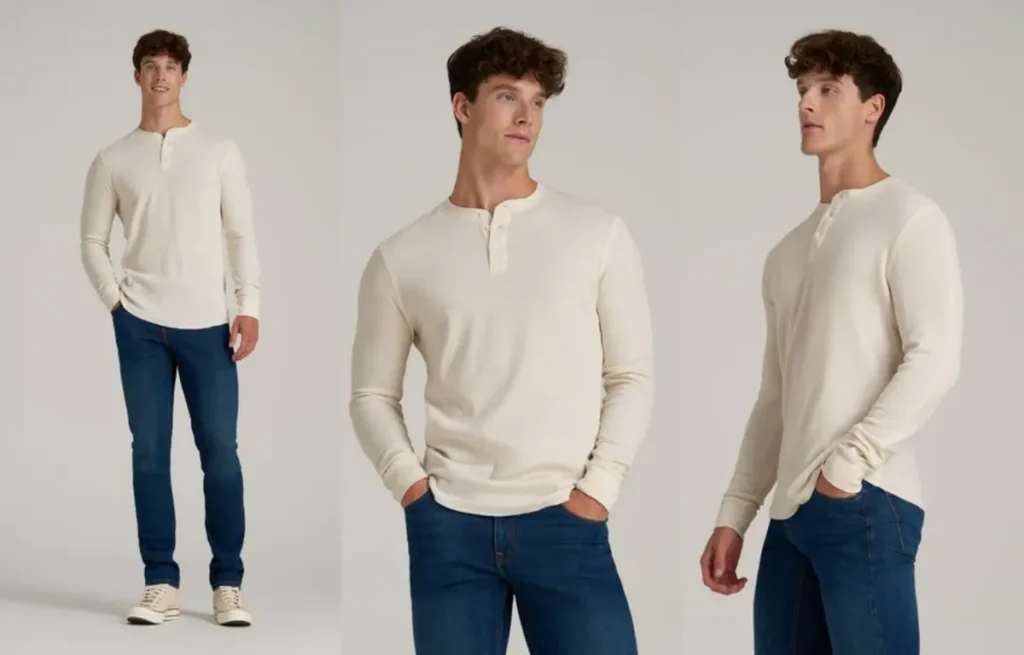
What defines a Thermal Henley Shirt and why is it ideal for colder weather?
This is the version built for warmth—functional, textured, and rugged.
A thermal Henley shirt is made from a waffle or honeycomb knit fabric designed to trap body heat while maintaining breathability, making it a practical yet stylish layering piece for cold seasons.
This type of Henley was originally used as a base layer for outdoor workers and athletes but has since evolved into a fashion staple.
Fabric Construction and Heat Retention
Thermal Henleys are unique because of their textured knit pattern, which creates small air pockets between the skin and the outer layer. These pockets trap warm air and improve insulation without adding bulk.
| Fabric Type | Key Characteristics | Thermal Benefit |
|---|---|---|
| Cotton Waffle Knit | Soft, breathable, medium warmth | Retains heat without overheating |
| Cotton-Poly Blend | Durable, moisture-wicking | Retains shape after washing |
| Thermal Spandex Mix | Stretchy, flexible, body-contouring | Better mobility and comfort |
| Recycled Polyester Knit | Lightweight, eco-friendly alternative | Quick-drying and warm |
High-quality thermal Henleys use double-knit structures, where the inner and outer layers trap warmth more effectively. Some modern designs even integrate brushed fleece interiors for added softness against the skin.
Fit and Functionality for Different Markets
Thermal Henleys serve two core functions—performance layering and everyday casual wear. How they’re cut and styled depends on the end market.
| Target Market | Common Fit | Design Focus |
|---|---|---|
| Outdoor/Workwear | Relaxed fit | Reinforced stitching, thicker fabric |
| Casualwear | Regular fit | Softer texture, classic 3-button placket |
| Athleisure | Slim fit | Stretch fabric, moisture-wicking |
| Womenswear | Fitted silhouette | Ribbed knit, deep placket, curved hem |
A looser fit allows for layering over base shirts, while slimmer silhouettes create a clean modern profile when worn alone.
Performance and Layering Capabilities
Thermal Henleys shine when used in layered styling. They can function as either a base or mid-layer, depending on fabric weight and intended use:
- Base Layer: Lightweight thermals (under 200gsm) designed to trap warmth close to the skin.
- Mid Layer: Heavier thermal knits (220–260gsm) work under jackets or shackets for added insulation.
Some brands also combine moisture management technologies with natural fibers, producing thermals that balance warmth and dryness—important for active lifestyles.
Typical Layering Combos:
- Under flannel shirts for outdoor or workwear looks
- Beneath puffer vests for a smart casual winter outfit
- With denim jackets or parkas for rugged urban wear
The thermal texture itself adds depth to outfits—an aesthetic bonus that enhances the perception of warmth and coziness.
Styling and Brand Applications
Because of their tactile surface and structured drape, thermal Henleys have become an anchor for various fashion directions:
| Style Segment | Key Aesthetic Elements |
|---|---|
| Heritage / Workwear | Heavy cotton waffle, wood buttons, natural hues |
| Minimalist / Premium | Fine waffle knit, tonal stitching, curved hem |
| Streetwear / Utility | Oversized fit, garment-dyed texture, side slits |
| Women’s Cozywear | Ribbed waffle blend, cropped or tunic length |
For brands, thermal Henleys offer an easy entry point into winter capsule collections, bridging performance and style. They perform exceptionally well in regions where consumers need layering pieces that look refined but still practical.
Emerging Innovations in Thermal Henley Design
The market has recently shifted toward sustainable and technical fabrics:
- Recycled waffle knits reduce waste while keeping insulation levels high.
- Hybrid fiber constructions (cotton + Tencel + spandex) create softness, elasticity, and thermoregulation.
- Overlock flat seams and tag-free interiors enhance comfort for all-day wear.
- Garment dyeing adds a vintage, washed effect that aligns with contemporary street and outdoor trends.
This continuous innovation ensures the thermal Henley remains relevant in both performance apparel and lifestyle fashion sectors.
Slim Fit Henley Shirt
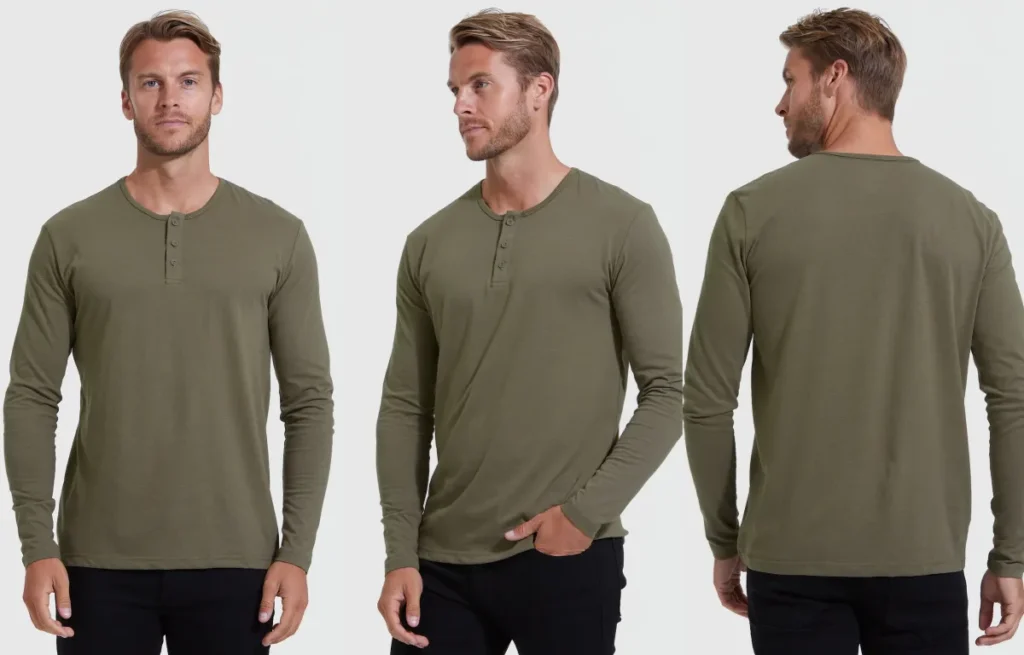
What defines a Slim Fit Henley Shirt and why is it a modern essential?
It’s the tailored version of the classic—sharper, sleeker, and made to enhance the silhouette.
A slim fit Henley shirt is designed to contour the chest, arms, and torso, offering a more modern, body-conscious look that aligns with today’s fitted fashion preferences.
It’s particularly popular among style-conscious customers who want elevated basics with a form-flattering edge.
Technical Design Features of Slim Fit Henleys
Slim fit isn’t just about tighter fabric—it’s about strategic pattern cutting. The design follows the natural shape of the body, with minimal excess fabric in key zones:
| Area | Slim Fit Henley Characteristics |
|---|---|
| Shoulder Width | Slightly narrower than regular fit |
| Chest and Waist | Tapered for a V-shape silhouette |
| Sleeve Fit | Close-fitting, often with elastic or ribbing |
| Length | Designed to hit mid-hip for a clean tuck-in |
Most slim Henleys use stretch-enhanced fabrics—especially cotton-spandex blends or modal-rich jerseys—to balance comfort and mobility with a fitted silhouette.
Fabric Choices That Enhance Fit and Drape
Fabric plays a critical role in how slim Henleys feel and wear. These are common choices:
- Cotton-Spandex Jersey – Soft with moderate stretch and shape retention
- Modal-Cotton Blend – Smooth drape, lightweight, perfect for premium basics
- Bamboo Viscose Mix – Sustainable, ultra-soft, slightly relaxed drape
- Rib Knit Fabrics – For ultra-close fit, often used in women’s lines
Heavier knits can make a slim fit feel too restrictive, while overly thin fabrics may highlight undergarment lines. Finding the right balance is key for comfort and style.
Visual Impact and Styling Flexibility
The slim fit Henley naturally emphasizes body definition. It’s often chosen for these reasons:
- Athletic appeal – Highlights shoulders and chest
- Minimalist wardrobe – Works with jeans, joggers, or blazers
- Layering – Thin profile fits under jackets without bulk
- Smart casual looks – Ideal for upscale streetwear or evening casual
Men often pair them with tailored trousers or dark denim, while women use them as layering tops under cropped jackets or with high-waisted bottoms.
Target Demographics and Market Fit
Slim fit Henleys resonate most with urban, fitness-forward, and minimalist audiences. Here’s how different brands use this fit:
| Brand Segment | Strategy for Slim Fit Henleys |
|---|---|
| Active Lifestyle | Moisture-wicking stretch fabric, raglan sleeves |
| Modern Minimalist | Solid tones, subtle placket, premium jersey |
| Street Fashion | Longline cuts, curved hems, oversized plackets |
| Women’s Contemporary | Rib knit, scoop neck, cropped versions |
This fit can also be optimized for layering under tailoring—especially in men’s capsule wardrobes where fewer but more versatile pieces are preferred.
Common Challenges and How Brands Solve Them
Slim fits can present production challenges—mainly due to tighter tolerances and fabric behavior. Here’s what to look out for:
- Shrinkage control – Pre-washed or enzyme-washed fabrics reduce distortion after wash
- Spec consistency – High variance in body shapes means a graded size chart is essential
- Seam durability – Overlocked or flatlock seams prevent stretching out over time
- Transparency – Lighter fabrics must be tested to avoid showing undergarments
For wholesale or private label buyers, offering both standard and slim fit options increases appeal across different customer profiles, without requiring complete new pattern development.
Relaxed Fit Henley Shirt
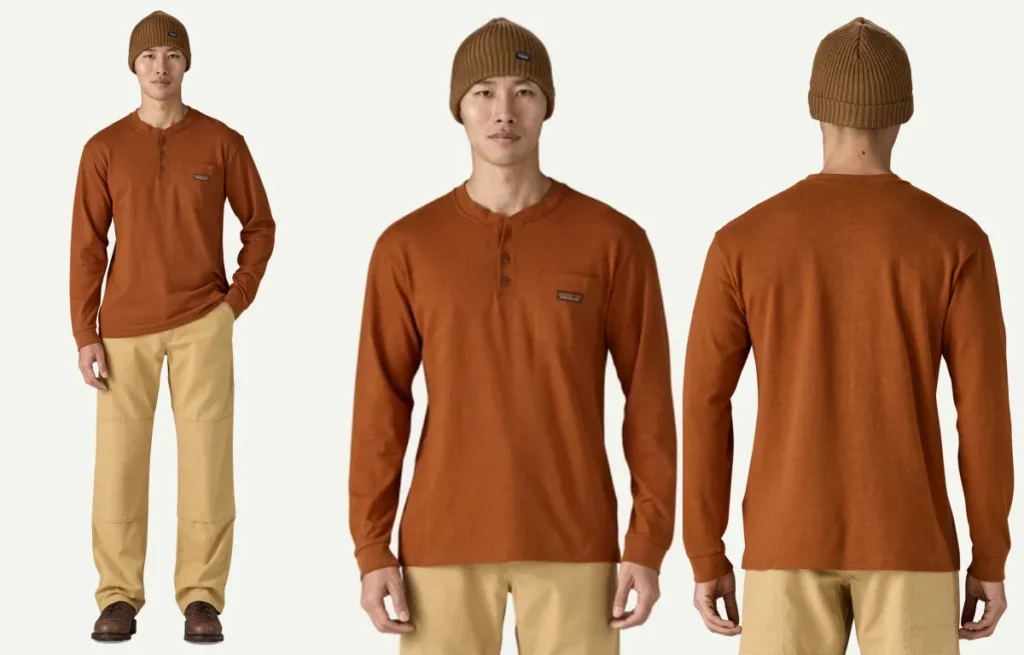
What makes the Relaxed Fit Henley Shirt a go-to for comfort-focused fashion?
It’s the most laid-back version of the classic—a fusion of ease, drape, and effortless styling.
A relaxed fit Henley shirt features a looser cut through the body and sleeves, designed for unrestricted movement and a more casual, oversized silhouette that fits today’s comfort-first fashion trends.
This fit works across gender-neutral, loungewear, and streetwear categories, making it one of the most flexible versions for modern fashion brands.
Construction Details and Fit Profile
The relaxed fit Henley isn’t just about sizing up. The entire garment is constructed with a different balance of width, shoulder drop, and length, allowing it to fall naturally without clinging.
| Fit Element | Relaxed Fit Henley Characteristics |
|---|---|
| Shoulder | Dropped or extended seams |
| Chest and Waist | Loose drape, no tapering |
| Sleeve | Wider and sometimes longer than standard |
| Length | Regular to longline, often curved or split hem |
Designers may exaggerate certain proportions for effect—especially in streetwear—or keep it subtly loose for loungewear or weekend essentials.
Fabric Selection for Structure and Flow
Because of the extra volume, fabric choice becomes even more critical. The wrong fabric can cause the garment to look bulky or shapeless. Popular materials include:
- Heavyweight Cotton Jersey – Offers body and structure, great for oversize styles
- Cotton Modal Blend – Adds drape and smooth texture, ideal for luxury basics
- French Terry or Loopback Knit – Adds comfort and weight for loungewear lines
- Organic or Slub Cotton – Creates a textured, lived-in feel for casual aesthetics
Some brands choose garment-dye or acid-wash techniques to give the shirt dimension and prevent the relaxed shape from looking too plain.
Styling Possibilities Across Markets
The relaxed Henley can be styled multiple ways depending on audience and intent:
| Market Segment | Styling Approach |
|---|---|
| Streetwear | Oversized, side-slit hem, raw edges |
| Athleisure | Pair with tapered joggers or compression shorts |
| Minimalist Basics | Mid-weight fabric, neutral colors, tonal buttons |
| Gender-Neutral Fashion | Straight cut, deep placket, no chest darts |
| Loungewear | Brushed finish, drop shoulder, raw hem |
In womenswear, it’s often styled with leggings, biker shorts, or worn as a tunic over slim pants. For men, it pairs effortlessly with cargos, relaxed denim, or sweatpants.
Practical Use Cases and Consumer Benefits
Relaxed fit Henleys are highly adaptable, making them excellent additions to seasonal drops or year-round capsules:
- Travel wear – Comfortable and wrinkle-tolerant for long hours
- Layering piece – Easy to throw over tanks or under light jackets
- Home-to-street outfits – Soft enough for home, styled enough for errands
- Plus-size inclusion – More inclusive sizing options with flatteringly loose profiles
For wholesale buyers or brand designers, offering this silhouette expands your customer base by appealing to audiences who value comfort without sacrificing aesthetics.
Key Features That Elevate the Relaxed Fit Henley
To avoid looking too basic or baggy, details matter:
- Deep or contrast plackets – Add vertical visual lines and structure
- Side vents or curved hems – Improve flow and movement
- Dropped shoulder seams – Create that slouchy, effortless drape
- Sleeve cuff variations – From wide hems to ribbed finishes for styling contrast
- Heavy garment wash treatments – Soften and break in the fabric for a premium feel
These finishing touches turn what could be an “oversized tee with buttons” into a thoughtful, well-engineered piece.
Athletic Henley Shirt
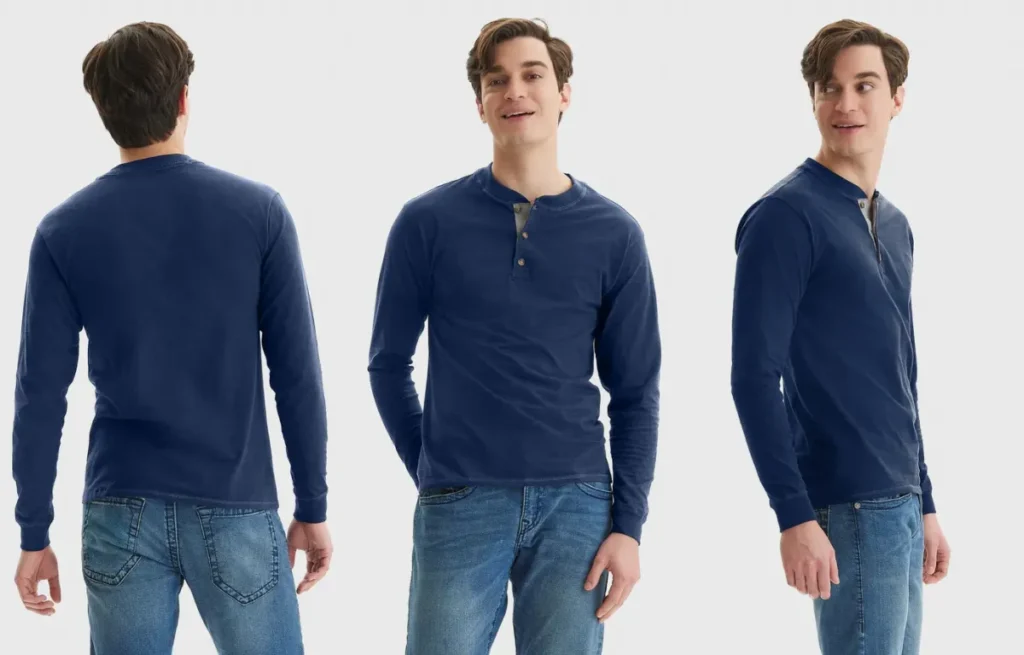
What makes the Athletic Henley Shirt different from other Henley styles?
It’s built to move, breathe, and perform—without losing style.
An athletic Henley shirt is engineered with performance-focused fabrics and a slim, ergonomic fit that supports movement, moisture control, and recovery—making it ideal for training, commuting, and active lifestyles.
Unlike traditional cotton Henleys, this one is made for motion, not just looks.
Key Design Features for Performance Fit
Athletic Henleys require more than just slim tailoring. They’re shaped to fit the human body in action, often featuring these tailored design elements:
| Design Element | Functional Purpose |
|---|---|
| Raglan Sleeves | Increases shoulder mobility and reduces seams |
| Gusseted Underarms | Prevents fabric pull during lifts or stretches |
| Slight Drop Hem | Keeps coverage during movement or workouts |
| Flatlock Stitching | Reduces friction and skin irritation |
They often use 4-way stretch fabrics that return to shape after use, supporting active wearers who demand durability with comfort.
Fabric Technology: Breathability and Sweat Management
The athletic Henley is defined by its technical fabric performance. Standard cotton gets replaced with blends designed for heat and sweat control:
- Poly-Spandex – Lightweight, stretchy, moisture-wicking
- Nylon-Elastane – Sleek, form-fitting, fast-drying
- Modal Performance Blend – Soft-touch with cooling properties
- Polypropylene Mixes – High-performance, odor-resistant, ultra-breathable
Some styles include mesh panel inserts or laser-cut venting zones for added airflow. Others apply anti-microbial treatments to reduce odor during long wear periods.
Fabric Comparison Table:
| Fabric Type | Benefits | Downsides |
|---|---|---|
| Poly-Spandex | Breathable, stretchy, light | Can retain odors if untreated |
| Nylon-Elastane | Strong, sleek, quick-drying | May feel synthetic to touch |
| Modal Blends | Ultra-soft, temperature regulating | Less durable in intense wear |
| Recycled Polyester | Eco-friendly, fast-drying | Slightly stiffer drape |
Application in Daily and Active Lifestyles
Athletic Henleys are built for hybrid use. They look polished enough for public wear but handle sweat like training gear.
| Scenario | Functional Advantage |
|---|---|
| Gym to Street | Flexible fabric, modern fit |
| Travel Wear | Wrinkle-resistant, breathable for long hours |
| Morning Runs | Moisture-wicking and quick drying |
| Weekend Casual | Stylish alternative to basic tees |
These shirts are especially effective for consumers who want multi-function wardrobe staples—something that looks good post-workout or on casual Fridays.
Ideal Target Audiences and Product Positioning
The athletic Henley is a high-conversion item for brands targeting:
- Fitness enthusiasts looking for gear that works in and out of the gym
- Commuters who bike or walk and need functional apparel
- Men’s minimalist wardrobes focused on utility and style
- Athleisure brands seeking alternatives to basic tech tees
They also work well for female consumers when cut with contoured seams, thumb-hole sleeves, or zip placket fronts for added utility and feminine detail.
Design Innovations and Competitive Differentiators
Modern athletic Henleys now include:
- UV protection fabrics for outdoor workouts
- Seamless knit bodies for zero-chafe performance
- Zippered media pockets or headphone loops
- Strategic compression zones for muscle support
Some brands blend in sustainably sourced fibers, such as recycled nylon or eucalyptus-based TENCEL™, to meet eco-conscious consumer demands.
Raglan Sleeve Henley Shirt
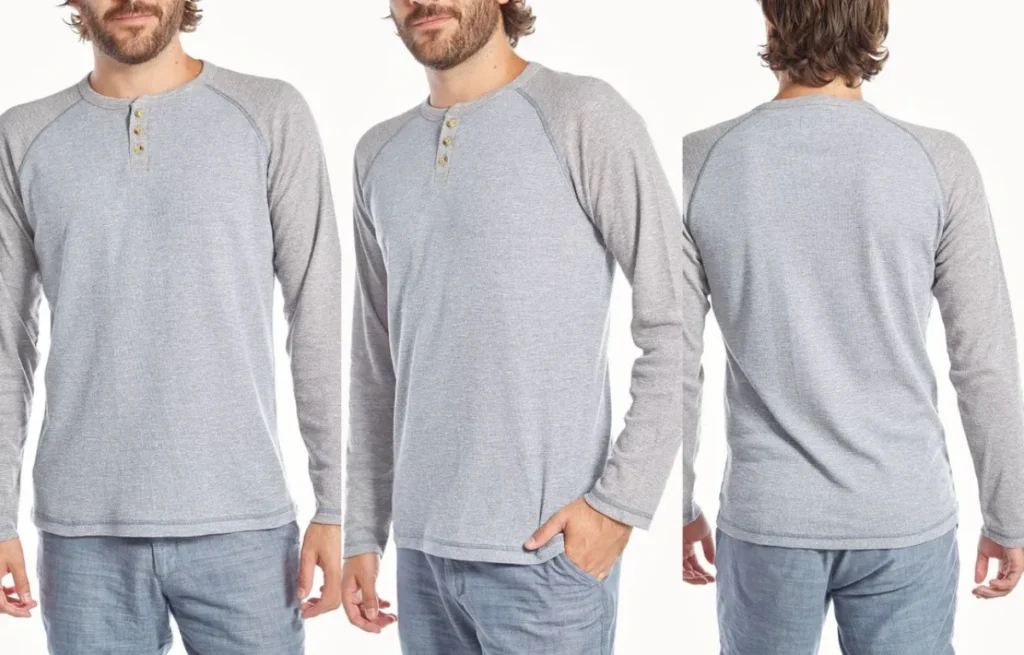
What defines a Raglan Sleeve Henley Shirt and how does it enhance mobility and design?
It’s where function meets edge—built for movement, known for its sporty visual contrast.
A raglan sleeve Henley shirt features sleeves that extend in one piece to the collar, creating a diagonal seam from underarm to neckline, which increases shoulder mobility and adds visual distinction.
This design isn’t just about comfort—it brings athletic structure and bold styling into the Henley silhouette.
Construction Advantages of the Raglan Cut
Unlike traditional set-in sleeves, raglan sleeves are cut as part of the shoulder panel. This creates smoother motion in the upper body and gives the Henley a sporty and slightly more aggressive shape.
| Feature | Raglan Sleeve Henley Characteristics |
|---|---|
| Shoulder Seams | Diagonal seam from underarm to collar |
| Fit Impact | Smoother shoulder line, broader upper body shape |
| Comfort Zone | Increased range of motion for arms and shoulders |
| Visual Identity | Often used in contrast-color designs |
It’s especially popular in athleisure, streetwear, and retro-inspired collections. The cut also complements both muscular and narrow shoulders, making it a flattering option for diverse body types.
Fabric Pairings and Style Variations
Most raglan Henleys are made with stretch-enhanced or midweight fabrics. The fabric should complement the active-friendly design of the sleeve, ensuring full movement without stiffness.
- Cotton-Spandex Blend – Adds flexibility and structure
- Tri-blend Jersey (Poly-Cotton-Rayon) – Lightweight, great drape, vintage texture
- Thermal Waffle Knit – Adds volume and warmth, perfect for cold seasons
- French Terry – Ideal for premium loungewear or transitional weather
To enhance the raglan effect, brands often color-block the sleeves or use different textures for body and sleeves. For example, pairing a slub cotton body with flat jersey sleeves increases tactile contrast.
Target Audiences and Market Fit
Raglan sleeve Henleys appeal to fashion-conscious and functional-focused buyers alike. Here’s how different market segments use them:
| Segment | Strategy |
|---|---|
| Activewear | Stretch knit, slim fit, moisture-wicking |
| Casualwear | Neutral tones, relaxed fit, textured fabrics |
| Vintage-inspired | Heather fabrics, contrast color sleeves, 3-button |
| Women’s fashion | Raglan crop Henleys with curved hems or rib knits |
This design also resonates well in gender-neutral collections, where a unisex silhouette and dynamic sleeve line can offer a more inclusive fit.
Versatility in Styling and Movement
Raglan Henleys are designed to move with the body. That makes them ideal for people who live actively—even if their day doesn’t include a workout.
- Weekend errands – Worn with joggers or cargo pants
- Home wear – Pairs well with sweat shorts or lounge pants
- Urban streetwear – Styled with beanies, flannels, or layered chains
- Fall layering – Sits comfortably under hoodies or vests without shoulder bunching
The extended shoulder cut also reduces seam friction—important for people with sensitive skin or high activity levels.
Design Enhancements That Elevate Raglan Henleys
Modern raglan Henleys go beyond basic construction. Popular premium upgrades include:
- Raw edge seams – For an unfinished, rugged look
- Extended button placket – More styling flexibility
- Curved hemline or side slits – Add motion and flair
- Flatlock stitching – Cleaner interior finish, especially for activewear
- Thumbhole sleeve cuffs – Especially in women’s and unisex performance pieces
For brands, the raglan sleeve Henley offers a sharp way to expand from traditional cuts while preserving the familiar comfort of the Henley form.
Buttonless Henley Shirt
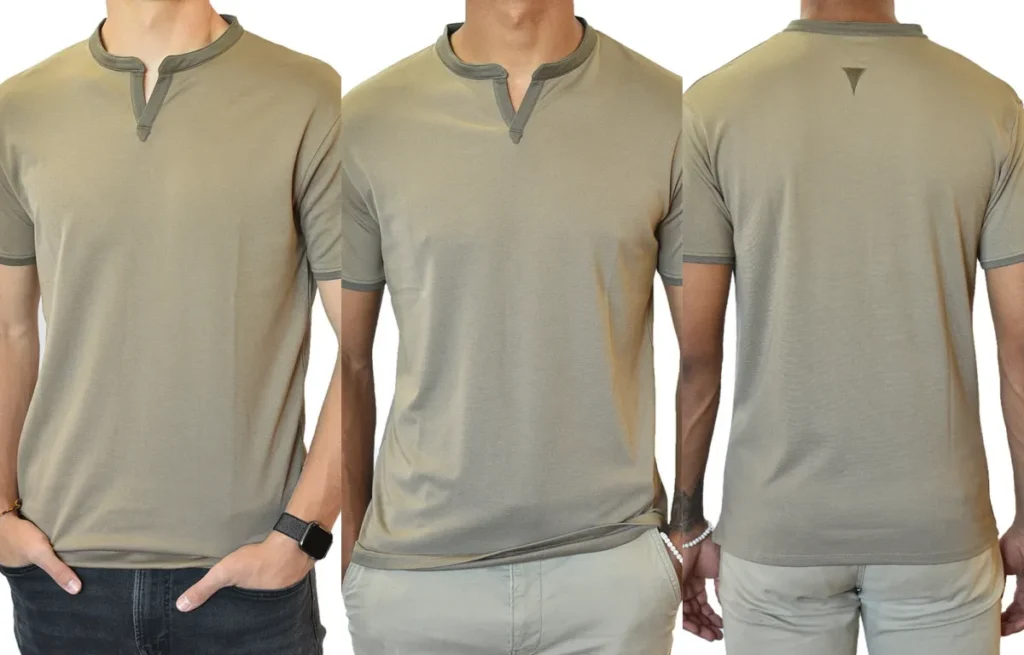
What is a Buttonless Henley Shirt and how does it redefine the classic design?
It’s the stripped-down version of a classic—simple, modern, and refreshingly minimal.
A buttonless Henley shirt retains the iconic Henley neckline shape but removes the front placket buttons, creating a cleaner silhouette with the same comfort-focused design.
Though subtle, removing the buttons transforms both the look and wearability, appealing to minimalists and contemporary fashion lines.
Redefining the Henley Neckline: Structure Without Buttons
At first glance, a buttonless Henley may resemble a standard crew neck tee—but the neckline tells a different story. Instead of a closed circle, the neckline has a slightly open scoop that mimics the placket without using hardware.
| Detail Area | Buttonless Henley Features |
|---|---|
| Neckline Shape | Shallow scoop or V-style opening |
| Front Panel Design | Sewn-down placket seam or faux stitching detail |
| Collar Finishing | Rib knit or clean-binding for structure |
| Visual Appeal | Sleek, minimal, uninterrupted by hardware |
This version preserves the identity of a Henley while creating a more understated and streamlined aesthetic—ideal for minimalist branding or premium capsule collections.
Fabric Choices and Cut Considerations
Buttonless Henleys typically use finer, more fluid fabrics that emphasize drape over structure. They’re often found in elevated casual or soft loungewear lines.
- Modal-Spandex Blends – Silky, breathable, with excellent shape retention
- Organic Cotton Jersey – Eco-friendly, soft, and smooth to the touch
- Bamboo Rayon – Sustainable, anti-bacterial, naturally moisture-wicking
- Fine Rib Knit – Especially used in women’s lines for stretch and fit
Because there are no buttons or placket seams to add reinforcement, fabric choice becomes even more important. The neckline must hold shape over time without stretching or curling, especially after repeated washes.
Design Tips for Buttonless Henley Durability:
- Use a self-binding neckline instead of fold-over collars
- Double-stitch the neckline curve for added structure
- Pre-shrink fabric or use enzyme-washed materials to prevent distortion
- Add subtle topstitching to maintain shape without adding bulk
Market Fit and Styling Use Cases
The buttonless Henley appeals strongly to certain modern consumer segments:
| Audience | Styling Preference |
|---|---|
| Minimalist Fashion | Solid tones, no logos, clean silhouettes |
| Loungewear Customers | Relaxed fit, ultra-soft materials, no hardware |
| Streetwear/Softcore | Slightly oversized with curved hem or raw edge |
| Women’s Casualwear | Cropped or fitted, often in ribbed or slub knits |
It’s especially effective in capsule wardrobes where simplicity and layering are key. With no buttons to interfere, it lays flatter under blazers or knits, enhancing versatility.
Why Brands Include Buttonless Henleys
This Henley variant allows brands to expand their offering while staying within the same silhouette family. It works well in:
- Sustainable basics collections – Where fewer components reduce production waste
- Modern loungewear lines – Where comfort, softness, and clean lines matter
- Unisex or gender-neutral capsules – Where decorative hardware may be avoided
- High-end essential lines – Where luxury is communicated through fabric, not detail
By removing the buttons, the garment often becomes more cost-effective to produce while allowing tighter control over neckline consistency in bulk runs.
Innovative Design Directions for Buttonless Henleys
Designers can enhance the simplicity with subtle visual tactics:
- Faux placket seam – Adds texture and references the original form
- Scoop or raw-edge necklines – To soften or stylize the profile
- Contrast interior binding – Adds a surprise detail for premium lines
- Side slits or curved hems – Elevate the silhouette without breaking minimalism
Some luxury designers go even further—using invisible inner stitching or seamless knit construction to create fully uninterrupted front panels.
Linen Henley Shirt
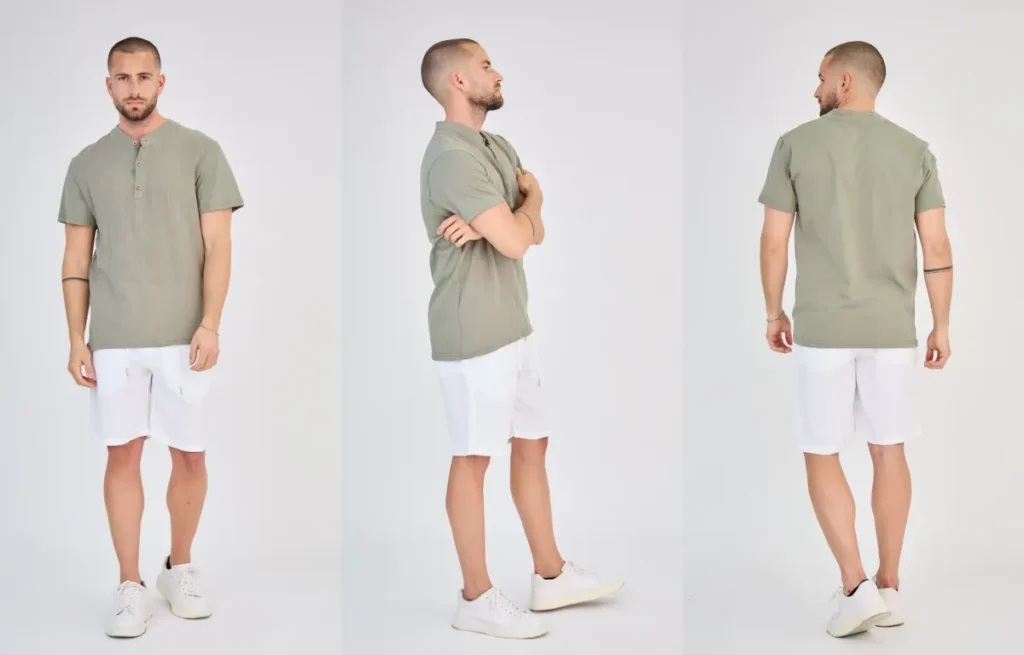
What makes the Linen Henley Shirt a perfect option for warm-weather fashion?
It’s light, breathable, and effortlessly refined—made for staying cool without losing style.
A linen Henley shirt uses natural flax fibers to offer a breezy, moisture-wicking garment that’s ideal for summer wear, resort fashion, or coastal-inspired collections.
Unlike cotton or synthetics, linen gives the Henley a crisp texture and a lived-in elegance that improves with every wash.
The Unique Nature of Linen Fabric
Linen is made from the fibers of the flax plant, known for its natural cooling properties. It’s prized for its breathability and texture—making it perfect for hot and humid climates.
| Property | Benefit in Henley Design |
|---|---|
| Natural Airflow | Keeps the body cool and dry |
| Slight Texture | Adds organic, effortless style |
| Moisture-Wicking | Dries quickly, ideal for sweat-prone environments |
| Sustainable Fiber | Low water use and fully biodegradable |
Linen Henleys often feature a slightly looser fit to support airflow and reduce fabric cling. The texture gives them a slightly rustic look, which is part of their charm.
Linen Henley Styling and Fit Considerations
Because of linen’s naturally stiff drape and wrinkle-prone nature, cut and fit must be intentionally designed:
- Relaxed or boxy fit – Allows air circulation and avoids fabric tension
- Side vents or curved hem – Enhances movement and lightness
- Band collar variations – Adds modern minimalism
- Rolled sleeve tabs – Emphasizes summer-ready aesthetic
Most linen Henleys are long sleeve or 3/4 sleeve with the option to roll, but short sleeve versions are also common in resortwear and casual lines.
Fabric Blends That Improve Wearability
While 100% linen looks and feels premium, it can sometimes be stiff or wrinkle more than desired. Many designers use blends to soften the handfeel:
- Linen-Cotton Blend – Softer, less wrinkle-prone, retains linen’s breathability
- Linen-Viscose – Adds drape and smoothness for a more polished finish
- Linen-TENCEL™ – Enhances softness, sustainability, and colorfastness
- Slub Linen Blends – Adds visual texture for a relaxed, vintage look
These blends preserve linen’s airy quality while making it more forgiving and accessible to wider audiences.
Popular Markets and Use Cases
Linen Henleys are especially effective in collections targeting:
| Market Type | Ideal Positioning |
|---|---|
| Resort / Coastalwear | Lightweight, elegant, and easy to pack |
| Summer Streetwear | Relaxed silhouette with natural styling cues |
| Bohemian / Naturalwear | Earth tones, textured buttons, organic aesthetics |
| Minimalist Fashion | Soft neutrals, clean placket, relaxed cut |
| Ethical/Sustainable | Fully biodegradable fibers, low-impact dyes |
They are often styled tucked into drawstring linen pants or worn open over tank tops. Accessories like straw hats, slides, or minimalist sneakers finish the look.
Linen Henley Details That Elevate the Design
To stand out, linen Henleys often include thoughtful design upgrades:
- Wooden or shell buttons – Natural texture aligns with fabric mood
- Contrast collar piping – Adds subtle design interest
- Garment-dye finish – Offers soft, washed-out tones with rich depth
- Patch pockets or pleats – Useful and stylish in men’s versions
- Loose neckline stitch detailing – Highlights craftsmanship
These small elements enhance the “effortless luxury” that linen offers.
Production and Quality Considerations
Working with linen requires knowledge of its behavior in cutting, stitching, and post-processing:
- Shrinkage – Pre-washing or enzyme washing reduces size variation
- Seam durability – Flat-felled or French seams reduce fraying
- Color fastness – Needs proper dye treatment to avoid fading in sun exposure
- Wrinkle control – Softened linen or linen blends reduce visible creasing
For brands, positioning linen Henleys as premium warm-season staples or eco-conscious essentials adds perceived value and justifies higher price points.
Heavyweight Henley Shirt
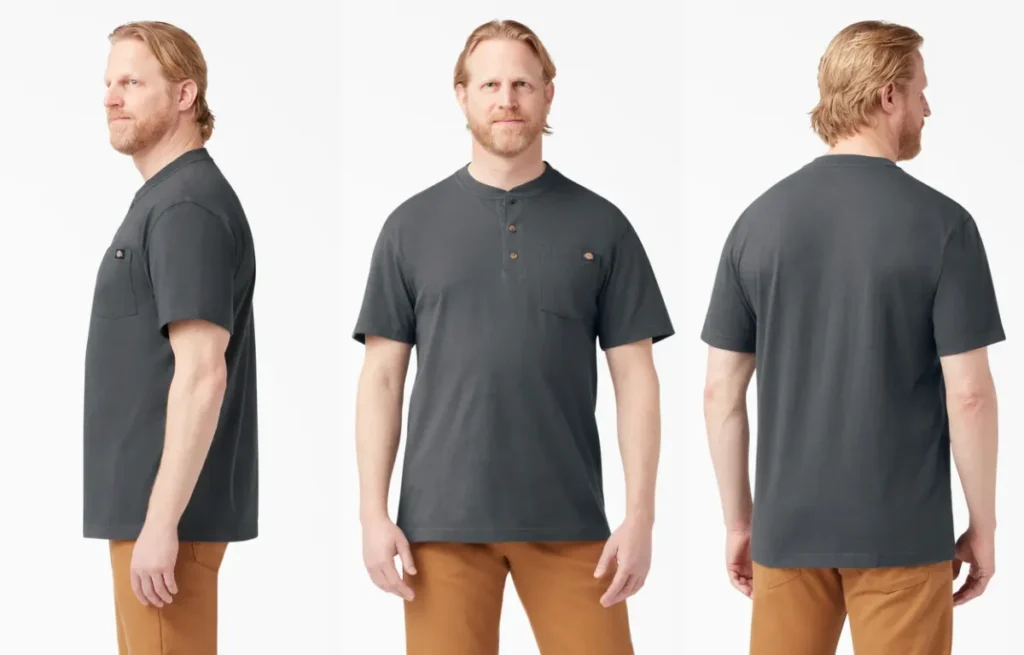
What defines a Heavyweight Henley Shirt and why is it ideal for rugged wear and colder climates?
It’s built to last, built to warm, and built to stand out—no compromises.
A heavyweight Henley shirt uses thick, durable fabrics—typically 250–300gsm or more—to offer superior warmth, structure, and durability, making it ideal for layering in colder seasons or wearing as a standalone piece in workwear or streetwear settings.
This style isn’t just about fabric weight—it’s about function, presence, and performance.
Technical Fabric Composition and Weight Range
Heavyweight Henleys are engineered to feel substantial. Unlike lighter versions made for layering, these shirts serve as outerwear alternatives or standalone staples.
| Fabric Weight | Typical Fabric Type | Function |
|---|---|---|
| 250–270gsm | Heavy cotton jersey | Mid-range insulation, holds structure |
| 280–320gsm | Loopback French terry or cotton fleece | Insulated warmth with soft interior |
| 320gsm+ | Thermal waffle or double-layer knit | Cold weather or rugged outdoor use |
These Henleys often feature brushed backs, dense knit construction, and reinforced seams to withstand repeated wear and wash cycles—especially in workwear or active lifestyle settings.
Key Design Characteristics of Heavyweight Henleys
Heavy fabric calls for a refined construction process to maintain fit and comfort. Standard features often include:
- Ribbed cuffs and hem – Helps maintain shape under pressure
- Reinforced shoulder seams – Prevents sagging over time
- Triple-stitched plackets – Ensures long-term durability
- Side gussets or vents – Aids in mobility without breaking structure
- Wide or tonal button plackets – Adds dimension and strength
Fit tends to lean toward relaxed or regular, allowing room for layering or movement. However, tailored heavyweight options do exist for elevated brands.
Style Applications Across Market Segments
Heavyweight Henleys aren’t just for utility—they’ve become part of fashion-driven capsule collections as well. Here’s how they’re used across various segments:
| Market Segment | Styling Use |
|---|---|
| Workwear / Heritage | Raw-edge stitching, natural tones, elbow patches |
| Streetwear | Oversized fit, drop shoulder, garment-dyed |
| Outdoor Lifestyle | Waffle knit, deep placket, thumbhole cuffs |
| Minimalist Menswear | Monochrome, dense jersey, boxy silhouette |
For women’s lines, heavyweight Henleys often appear in oversized cuts, styled with leggings or boots as cool-weather alternatives to sweaters.
Ideal Use Cases and Seasonal Value
Heavyweight Henleys are perfect for:
- Fall/Winter essentials – Insulates without the bulk of outerwear
- Outdoor or manual work – Provides warmth and abrasion resistance
- Transitional jackets – Worn alone or under a vest/shacket
- Cold commute layers – Polished enough for casual work settings
Their visual density and tactile texture also elevate any look—even when styled simply with jeans or chinos.
Premium Detailing and Differentiators
To stand out in a competitive market, top-tier heavyweight Henleys often include:
- Knit-in elbow reinforcement – Adds function without external patches
- Yoke paneling at back – Provides structure and drape balance
- Branded metal or horn buttons – Adds luxury and brand value
- Flatlock stitching – Reduces bulk and increases garment lifespan
- Garment-dyed or pigment-washed finishes – Creates depth in texture and tone
These enhancements help position the product not just as a “heavier shirt” but as a durable, premium alternative to basic long sleeves or sweatshirts.
Production Challenges and Quality Control
Working with heavyweight fabric increases production complexity:
- Needle and machine selection must match the density to avoid skipped stitches
- Shrinkage risk is higher, requiring pre-washing or steam setting
- Pattern grading must account for bulk and drape differently than light knits
- Packaging and shipping weight increases total logistics cost
However, when produced correctly, heavyweight Henleys offer high repeat value for buyers looking for quality over quantity.
Sleeveless Henley Shirt
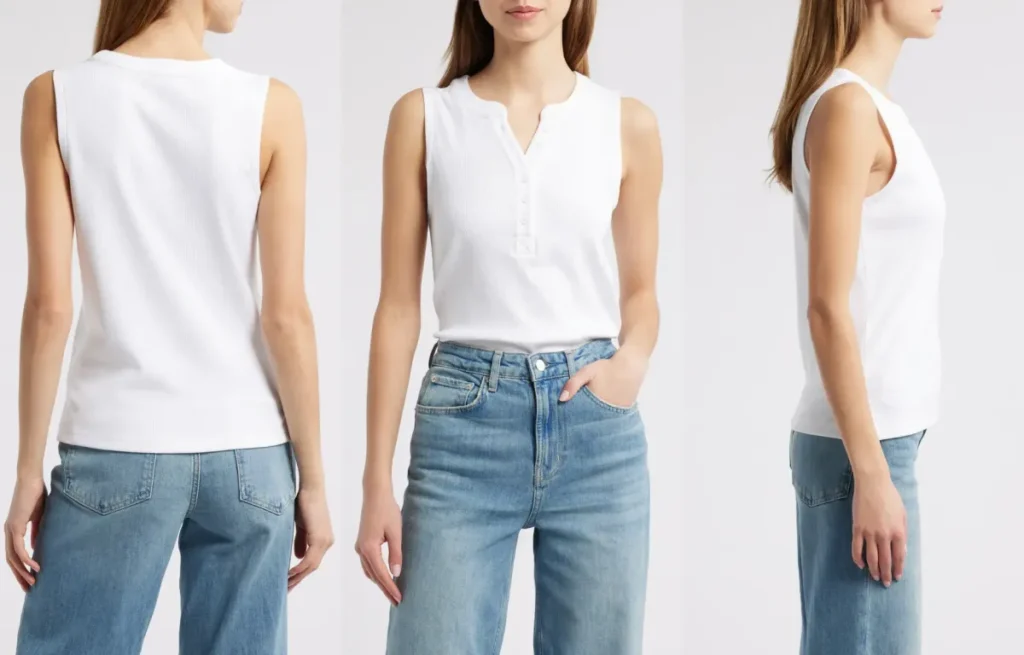
What makes the Sleeveless Henley Shirt a modern essential for summer and activewear collections?
It’s lightweight, breathable, and effortlessly bold—perfect for movement and warm-weather style.
A sleeveless Henley shirt removes the sleeves but retains the classic placket neckline, offering the casual structure of a Henley with the ventilation and arm mobility of a tank.
This version blends the athletic appeal of sleeveless tops with the timeless design of a Henley, making it ideal for both fashion and function.
Core Construction and Visual Identity
Though it lacks sleeves, the sleeveless Henley keeps the signature round neckline and placket front intact. The result is a hybrid garment that merges tank top comfort with Henley sophistication.
| Design Element | Sleeveless Henley Characteristics |
|---|---|
| Armhole Cut | Wide, reinforced for durability |
| Neckline | Collarless with 2–3 button placket |
| Fit Options | Slim, relaxed, or athletic fit |
| Common Hemline | Straight or curved with optional side vents |
This structure makes the sleeveless Henley more elevated than basic tanks, suitable for urban wear, fitness looks, and minimalist summer capsules.
Fabric Choices for Comfort and Performance
The ideal fabric balances softness, structure, and breathability. Since this style is often used in warm climates or active settings, fabric performance matters:
- Cotton-Modal Blend – Soft handfeel, good drape, perfect for premium basics
- Cotton-Spandex Jersey – Adds stretch for movement-heavy use
- Recycled Polyester Blends – Sweat-wicking, fast-drying, eco-conscious
- Bamboo Rayon – Naturally breathable, silky texture, sustainable
Weight generally ranges from 160–200gsm to maintain comfort without being see-through or clingy.
Fit Directions and Styling by Market Segment
Sleeveless Henleys cater to a wide range of demographics. Here’s how different markets style and design them:
| Market Focus | Common Fit & Details |
|---|---|
| Activewear | Slim fit, mesh side panels, reinforced placket |
| Streetwear | Relaxed or oversized, drop shoulders, raw edges |
| Minimalist Menswear | Regular fit, neutral tones, rib collar |
| Women’s Athleisure | Cropped cuts, racerback adaptations, soft knits |
| Resort / Summerwear | Loose fit, linen blend, faded tones |
For women’s fashion, cropped or fitted silhouettes dominate, often paired with leggings, shorts, or wide-leg trousers for a balance of sporty and chic.
Key Design Features That Make It Functional and Fashionable
Designers often use small yet impactful details to differentiate sleeveless Henleys from generic tanks:
- Topstitched Placket – Adds visual structure and finish
- Curved or step hems – Offers a longer back for layering appeal
- Contrast binding or inner neck tape – Increases perceived value
- Dropped armholes – Create a bolder, gym-friendly aesthetic
- Snap plackets or hidden buttons – Modernize the neckline
These upgrades help position the product for both casual basics and elevated capsule collections.
Practical Use Cases and Versatility
Sleeveless Henleys serve multiple functions, making them ideal for:
- Gym wear or running errands – Keeps arms cool and mobile
- Hot weather layering – Under open shirts or lightweight vests
- Beach or vacation outfits – Styled with linen shorts or drawstring pants
- Chill streetwear looks – Paired with cargos, caps, and sneakers
For brands targeting summer drops, festival fashion, or performance-meets-lifestyle buyers, the sleeveless Henley is a low-risk, high-style addition.
Manufacturing and Fit Challenges
Producing a well-constructed sleeveless Henley requires attention to:
- Armhole binding – Needs to prevent stretching or curling
- Neckline strength – Without sleeves, the neckline carries more visual weight
- Fabric shrinkage – Lightweight knits must be pre-shrunk to maintain shape
- Size grading – Armhole depth and width must be tested across body types
Because armholes draw attention to the upper torso, fit accuracy is more critical than with standard tees.
Two-Tone Henley Shirt
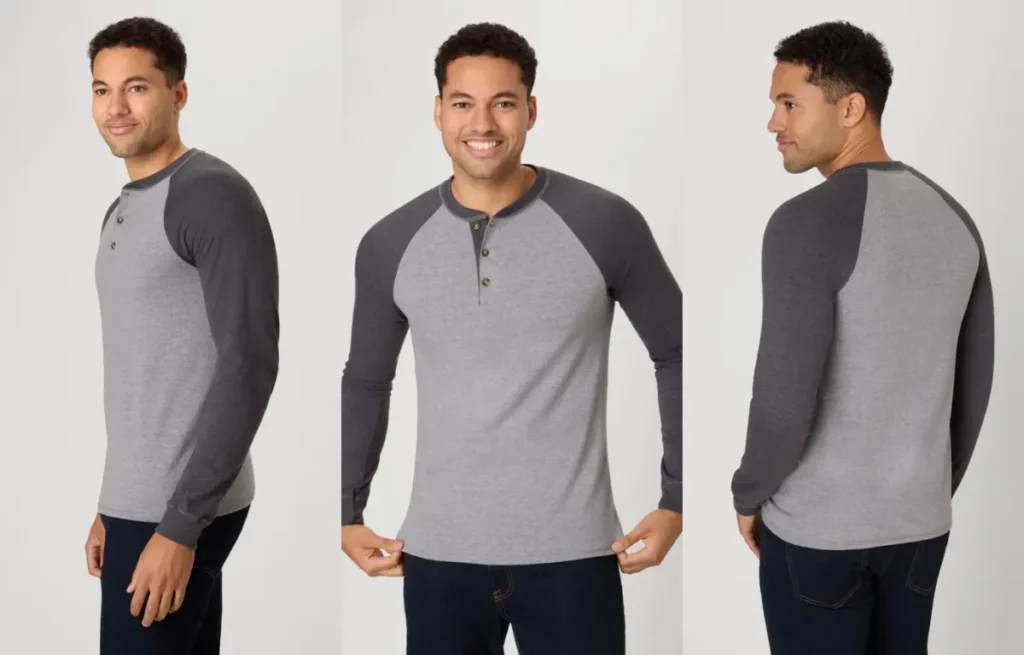
What defines a Two-Tone Henley Shirt and how does it add visual impact to a classic silhouette?
It’s a bolder take on a staple—designed to catch the eye and break visual monotony.
A two-tone Henley shirt features contrasting colors or fabrics across body parts—typically between sleeves and torso or between the placket and main body—offering a more dynamic and expressive look without compromising comfort.
This version keeps the core Henley structure but introduces subtle or bold contrast, making it perfect for fashion-forward collections.
Common Two-Tone Design Approaches
There are a few popular methods to achieve a two-tone Henley effect, each targeting a slightly different aesthetic:
| Two-Tone Style | Description |
|---|---|
| Contrast Sleeves | Different sleeve color or fabric (e.g., raglan) |
| Contrast Placket | Placket in a different tone or texture |
| Half-Panel Split | Horizontal or vertical color blocking |
| Sleeve & Neck Binding | Sleeves and collar detail matched in contrast tone |
| Textured Mix | One fabric in jersey, one in rib or waffle knit |
Designers can opt for either bold color blocks (black/white, red/navy) or subtle tonal contrasts (light grey/dark grey, beige/ivory) depending on brand identity.
Fabric Coordination and Technical Matching
Two-tone Henleys can use the same fabric base dyed differently, or they can combine different materials for added contrast in both look and feel. That said, mixing fabrics comes with its own set of challenges:
- Matching shrinkage rates – Avoid post-wash distortion
- Consistent stretch or drape – Prevent uneven pulling or fit issues
- Colorfastness – Ensure both fabrics hold color through repeated washes
- Surface finish harmony – Avoid mismatched textures that feel inconsistent
Popular fabric pairings include:
- Cotton Jersey + Cotton Rib – Keeps comfort while introducing sleeve contrast
- Modal Body + Thermal Sleeve – Blends smooth drape with textural ruggedness
- Cotton-Spandex + Mesh Panel – Used in activewear Henleys for visual and cooling effect
Market Applications and Styling Value
The two-tone Henley brings visual energy into categories that often rely on basics. Here’s how various segments use it:
| Market Segment | Styling Strategy |
|---|---|
| Streetwear | Oversized cuts, bold color blocking, curved hems |
| Sporty Casualwear | Raglan sleeves with athletic-style striping or mesh |
| Retro / Vintage Lines | Heathered body with contrast neck and sleeve cuffs |
| Women’s Athleisure | Pastel blocks, cropped length, tonal contrasts |
| Minimalist Menswear | Subtle tone shifts for depth without loud patterns |
These designs help brands stand out in the basics market, especially when shoppers are looking for something more eye-catching than a solid tee but not as loud as a graphic print.
Production Considerations and Challenges
Two-tone construction requires more precision in cutting and sewing. Common production concerns include:
- Seam alignment – Color blocks need to align perfectly to avoid visual flaws
- Fabric dye lot consistency – Slight variations between fabric rolls can become more visible
- Button and trim matching – Buttons may need to be custom-colored to harmonize with contrast elements
- Extra labor cost – More complex construction can slightly increase production time
However, the impact on shelf and e-commerce images is often worth the added complexity, especially for fast-fashion or detail-oriented brands.
Additional Design Touches That Elevate the Look
To enhance the two-tone impact, brands often add thoughtful extras:
- Topstitching in contrast thread – Highlights panel seams
- Patch pockets in contrast color – Adds utility and balance
- Sleeve piping or cuff tipping – Visual framing of arms
- Reversed fabric placket – Same fabric, inside-out for textural play
- Split hem with multi-tone panel inserts – Adds movement and asymmetry
These details can push the Henley from simple into statement territory while maintaining core functionality.
Printed Henley Shirt
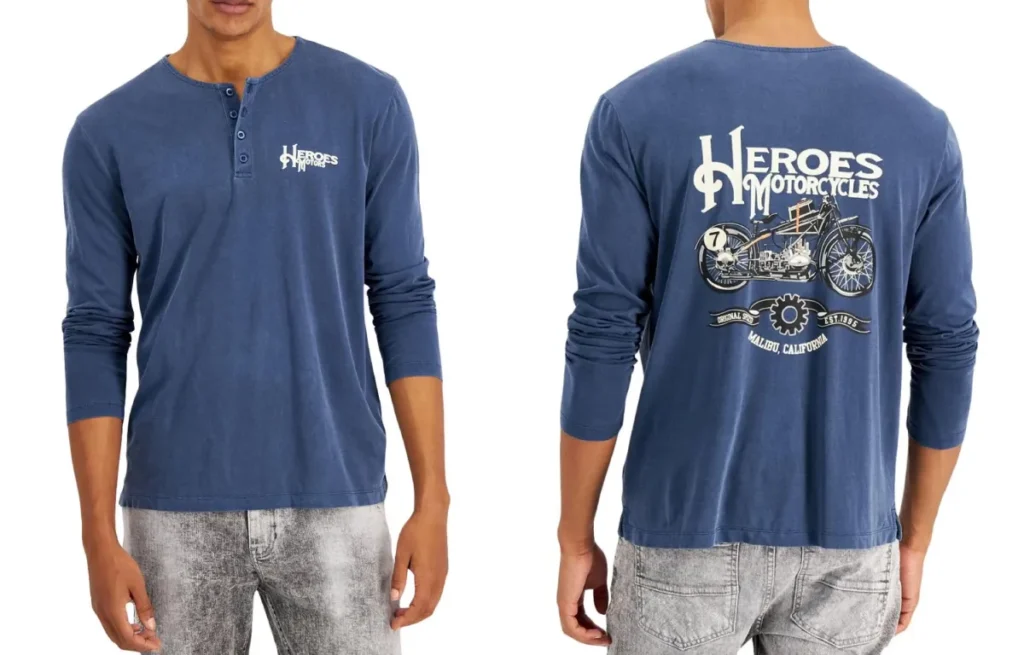
What defines a Printed Henley Shirt and how does it expand the design possibilities of this classic?
It’s the most expressive version—where function meets fashion and prints become the personality.
A printed Henley shirt adds graphics, patterns, or textures to the traditional Henley silhouette, transforming it from a quiet basic into a visual statement that aligns with brand identity and seasonal trends.
This version broadens the design horizon—allowing Henleys to fit into streetwear, boho, resort, or even edgy niche collections.
Types of Prints Used in Henley Shirts
Depending on brand positioning and fabric type, printed Henleys can feature a wide range of visual treatments:
| Print Type | Description |
|---|---|
| All-over prints | Repeating pattern across the entire shirt |
| Placement prints | Centered graphics or logos on chest/back |
| Sleeve-only prints | Adds contrast and subtle edge |
| Front-panel graphics | Works well with button placket as design divider |
| Faded or vintage prints | Washed-out look, ideal for street and retro aesthetics |
The key is balancing the print with the Henley’s structure. Since Henleys already have a placket, too much graphic detail near the neckline can clash if not designed carefully.
Print Methods and Fabric Compatibility
Choosing the right print technique is essential not just for aesthetics, but for durability and feel. Common print methods include:
- Screen Printing – Best for bold, flat colors on cotton or blends
- Discharge Printing – Used to remove dye and apply prints on darker fabrics
- Sublimation – Works on poly fabrics, offers full-color detail with no hand-feel
- Digital DTG (Direct to Garment) – Ideal for small runs or complex artwork
- Pigment Printing – Soft feel, works well on washed-down tones or retro styles
Certain knit fabrics like jersey, ribbed cotton, or modal blends accept prints better than textured surfaces like thermal waffle or slub knits.
Popular Market Applications for Printed Henleys
Printed Henleys allow brands to explore trend-driven or story-driven design. Here’s how they’re used across markets:
| Market Segment | Print Approach |
|---|---|
| Streetwear | Bold logos, graffiti-inspired art, pop culture themes |
| Retro/Vintage | Distressed typography, old-school racing motifs |
| Surf/Resortwear | Tropical patterns, tie-dye effects, beach graphics |
| Boho/Naturalwear | Floral motifs, ethnic prints, soft earth-tone patterns |
| Music/Art Culture | Abstract prints, hand-drawn sketch-style artwork |
By adjusting print scale and placement, designers can make Henleys either loud or understated—expanding audience appeal.
Key Considerations in Design and Production
Printed Henleys introduce complexity in alignment and print quality control. Key areas to manage include:
- Placket alignment – Ensure prints don’t misalign awkwardly at the button seam
- Shrinkage control – Pre-washed fabrics help maintain print placement post-wash
- Color layering – Prevent bleeding when layering multiple color screens
- Fabric feel – Prints shouldn’t reduce softness or stretch if used in active or loungewear lines
Also, for prints on rib knits or stretch-heavy fabrics, elasticity may distort graphics—requiring artwork adjustment or special inks.
Brand Differentiation Using Prints
Printed Henleys allow even small or niche brands to tell a story visually. These details often make the difference:
- Custom artwork – Creates exclusivity and aligns with seasonal themes
- Tone-on-tone printing – Subtle prints for premium, minimalist brands
- Mixed media (print + embroidery) – Elevates basic Henleys with tactile depth
- Inside placket or back-neck prints – Adds branding where least expected
These tactics are particularly effective for online or retail-first brands where visual identity is key to consumer recall and product differentiation.
Striped Henley Shirt
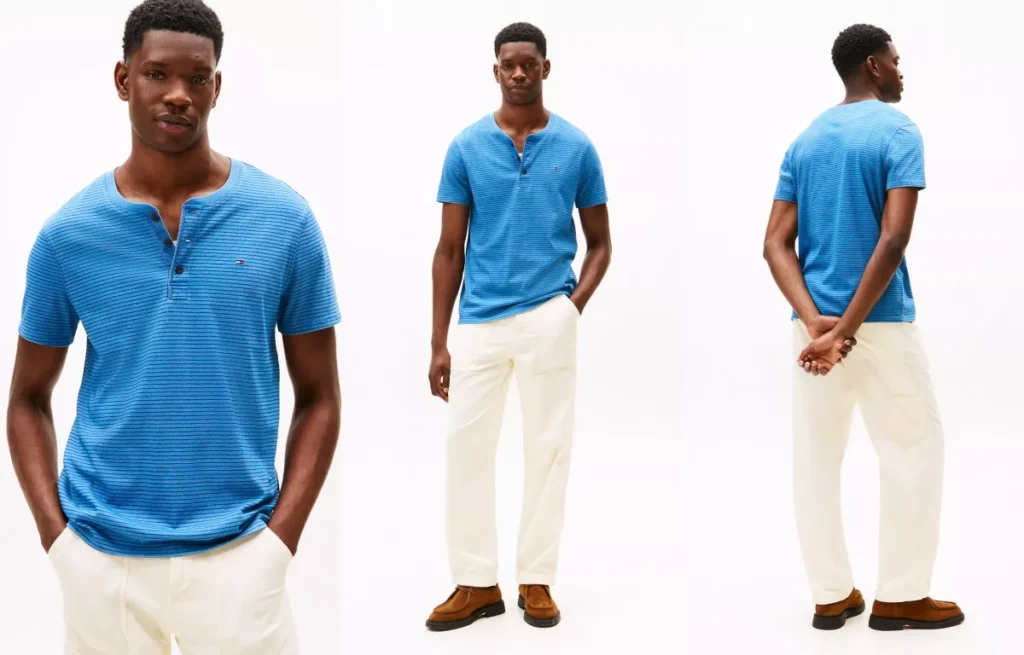
What defines a Striped Henley Shirt and how does it enhance visual appeal without overwhelming simplicity?
It’s the perfect balance of pattern and minimalism—adding energy without losing versatility.
A striped Henley shirt incorporates horizontal, vertical, or engineered stripe patterns into the classic Henley silhouette, offering a fresh, casual twist while preserving the shirt’s signature neckline and placket.
This design works across seasonal, nautical, preppy, and casual collections—allowing brands to inject personality into everyday basics.
Stripe Types and Their Impact on Styling
The effect of stripes depends heavily on direction, scale, and placement. Each variation offers a different fashion statement and market positioning.
| Stripe Direction | Style Effect |
|---|---|
| Horizontal | Traditional, casual, can broaden appearance |
| Vertical | Sleek, elongates the body, more fashion-forward |
| Engineered | Strategic stripe placement for slimming or shaping |
| Pinstripe | Subtle detail, often used in minimalist collections |
| Bold/Block Stripe | Eye-catching, popular in streetwear or retro themes |
Stripe width also affects the vibe: thinner stripes feel more refined, while wider stripes are sporty or playful.
Fabric Options and Weaving Techniques
Striped Henleys are usually produced in two ways:
- Yarn-dyed stripes – Where the pattern is created during the knitting or weaving stage. This method offers better colorfastness and a more premium look.
- Printed stripes – More cost-effective, flexible for small runs or seasonal variations.
Common fabrics include:
- Cotton Jersey – Most widely used, breathable, and easy to dye
- Ribbed Cotton – Adds stretch and texture, often used in women’s fitted versions
- Modal-Cotton Blend – Smooth and drapey, ideal for elevated basics
- Waffle Knit with Stripes – Textured and cozy, great for fall collections
Striped Henleys made from slub or mélange yarns also give a worn-in, vintage feel that aligns well with relaxed or bohemian aesthetics.
Market Applications and Brand Positioning
The striped Henley works well in both traditional and trend-driven markets. Here’s how different brands use them:
| Market Segment | Styling and Design Notes |
|---|---|
| Nautical/Preppy | Horizontal navy-and-white, red placket, regular fit |
| Streetwear | Oversized, vertical stripe, contrast button detail |
| Retro/Vintage | Cream/brown slub stripe, relaxed fit, drop hem |
| Athleisure | Engineered stripe placement to shape the torso |
| Women’s Casualwear | Thin ribbed fabric with pastel or tonal stripes |
The stripe adds just enough visual interest to separate it from a plain solid, yet remains versatile for layering or standalone wear.
Practical Design Considerations in Production
Working with stripes in garment construction requires precision:
- Stripe matching at side seams – Misaligned stripes can signal poor quality
- Placket placement – Must be carefully centered so stripes are not uneven
- Shoulder and sleeve matching – Stripe direction should flow cleanly across joints
- Shrinkage testing – Horizontal stripes must remain straight post-wash
For digitally printed stripes, color bleeding or distortion can occur on stretchy fabrics, which is why yarn-dyed options are usually preferred for higher-end collections.
Creative Enhancements That Elevate the Striped Henley
Subtle design tweaks can make the striped Henley stand out without becoming loud:
- Contrast collar or placket – Adds separation between stripe sections
- Half-stripe panels – Stripes on front, solid back for a mixed-media look
- Button color coordination – Buttons matched to stripe accents or contrast tones
- Directional mixing – Horizontal body with vertical sleeves or vice versa
These tricks allow brands to offer seasonal updates or limited-edition variations without reworking the entire pattern or fit.
Hooded Henley Shirt
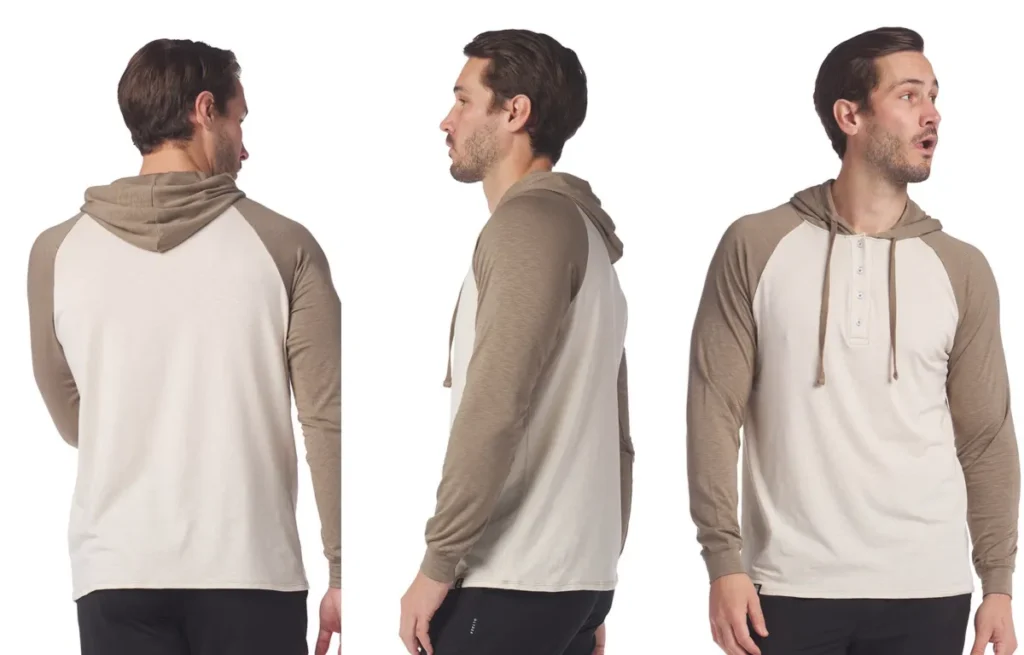
What makes the Hooded Henley Shirt a functional fusion of utility and laid-back style?
It’s the upgrade that adds attitude and adaptability—combining the comfort of a pullover with the polish of a Henley.
A hooded Henley shirt integrates a functional hood into the traditional Henley silhouette, offering added warmth, weather versatility, and a relaxed, sporty aesthetic.
This version bridges multiple style categories—streetwear, athleisure, loungewear, and transitional layering—making it one of the most flexible Henley adaptations on the market.
Core Construction of the Hooded Henley
The design merges two classic elements: the buttoned placket of a Henley and the attached hood of a hoodie or pullover. For the hybrid to work, the build must be carefully balanced:
| Design Feature | Description |
|---|---|
| Placket Type | Usually 2–3 buttons, sometimes deeper for layering |
| Hood Design | Attached at neckline, with or without drawstrings |
| Fit Profile | Relaxed to regular for easy layering |
| Cuff/hem Finishing | Ribbed cuffs and hem or open hem for draped effect |
Some versions include kangaroo pockets, giving a hoodie feel. Others keep the silhouette clean for minimalist versatility.
Fabric Options That Support Multi-Use Comfort
Because this style serves multiple functions (indoor comfort, outdoor layering, casual styling), the fabric must perform in several areas:
- French Terry – Soft loopback interior, breathable warmth
- Cotton-Spandex Jersey – Flexible, wearable year-round
- Thermal Waffle Knit – For cooler climates or workwear-inspired lines
- Modal or TENCEL™ Blends – Smooth handfeel with eco credentials
- Heavyweight Cotton – Adds structure and layering weight
Depending on target market, brands may offer lightweight versions for spring/summer and brushed fleece or lined options for fall/winter drops.
Market Applications and Brand Style Direction
The hooded Henley is incredibly adaptive. Here’s how different market segments use it:
| Segment | Typical Design Strategy |
|---|---|
| Streetwear | Oversized, raw hems, bold placket, tonal or tie-dye hood |
| Athleisure | Lightweight stretch knits, slim fit, muted colorways |
| Men’s Basics | Midweight cotton, classic fit, neutral or heather tones |
| Women’s Loungewear | Cropped hooded Henley, soft knits, thumbhole cuffs |
| Outdoor/Workwear | Thermal fabrics, utility-style details, snap placket |
This flexibility allows brands to place the hooded Henley in multiple product categories without major design overhauls.
Key Functional and Aesthetic Considerations
In addition to visual appeal, certain features are essential for this style’s success:
- Seam-reinforced hood – Prevents stretching and slouching
- Placket strength – Avoids bunching where hood and buttons meet
- Balanced weight – Hood should not pull back on neckline
- Stitching quality – Especially around high-stress zones (shoulders, neck)
- Tag-free interior – Enhances comfort for loungewear or all-day use
These details improve longevity and user experience, especially for consumers who will wear the piece regularly in transitional climates.
Creative Enhancements That Elevate the Style
To differentiate from standard hoodies or Henleys, brands often add subtle design elements:
- Printed or contrast-lined hoods – Adds pop or storytelling
- Curved or split hems – Modernizes the silhouette
- Half-zip plackets instead of buttons – For a sportier or techwear vibe
- Dropped shoulders or side gussets – Increases comfort and streetwear appeal
- Natural materials like wood or horn buttons – Elevates the perceived value
These variations allow for expansion into seasonal capsules, sustainable collections, or gender-neutral lines with minimal pattern changes.
Piqué Knit Henley Shirt
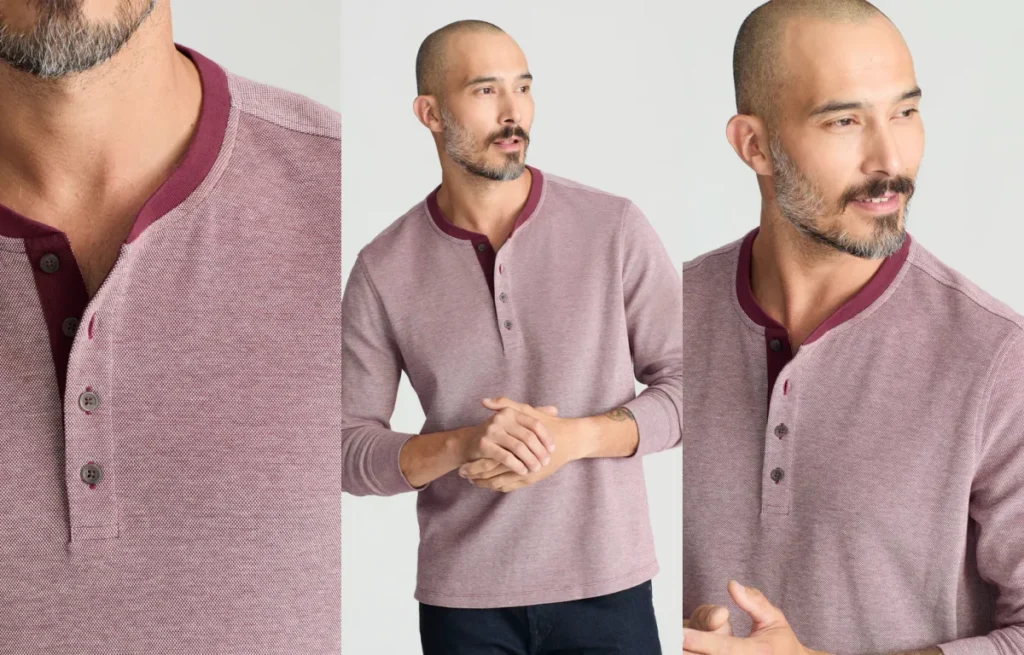
What makes a Piqué Knit Henley Shirt a refined and structured version of the classic?
It’s polished, breathable, and subtly textured—offering a more elevated take on the everyday Henley.
A piqué knit Henley shirt is made using a textured, waffle-like knit structure that provides breathability, durability, and a structured drape, often used in polos but adapted here to offer a more refined, dressier Henley option.
This version stands out for its hybrid feel—combining the sophistication of a polo shirt with the laid-back design of a Henley.
Understanding Piqué Knit Construction
Piqué (pronounced “pee-kay”) is a double-knit fabric known for its raised, patterned texture—often in a waffle, honeycomb, or birdseye weave. It was traditionally used in tennis shirts, but its benefits are now recognized across casual and smart-casual menswear.
| Feature | Piqué Knit Benefit in Henleys |
|---|---|
| Textured Surface | Adds depth and visual interest |
| Air Pockets | Increases breathability for warm climates |
| Moderate Structure | Helps retain shape through long wear |
| Subtle Sheen | Enhances polish for business-casual applications |
Unlike jersey or rib knits, piqué doesn’t cling to the body as much, making it ideal for slightly structured silhouettes.
Fabric Blends and Their Market Purpose
Piqué is often blended to balance comfort, structure, and wrinkle resistance. Here are common blends used in piqué Henley shirts:
- 100% Cotton Piqué – Classic, breathable, slightly stiff feel
- Cotton-Poly Blend – Reduces wrinkles, increases durability
- Cotton-Lycra – Adds light stretch for improved fit retention
- Organic Cotton Piqué – Sustainable alternative with a soft finish
Weight ranges typically fall between 180–240gsm, suitable for both warm and transitional seasons.
Where Piqué Henleys Fit in the Market
This Henley variant fits particularly well in smart casual, business casual, and elevated basics categories. It’s a strong candidate for clients who want something more dressed-up than a tee but less formal than a woven shirt.
| Market Segment | Positioning for Piqué Henley |
|---|---|
| Smart Casual Menswear | Pair with chinos or loafers |
| Resortwear | White or sand-colored piqué with rolled sleeves |
| Premium Basics | Tonal, slim-fit, minimalist buttons |
| Corporate Lifestyle | Worn under sport coats or cardigans |
Women’s versions are often styled with slightly more drape, cap sleeves, or tunic-length cuts to maintain softness while keeping the textured finish.
Construction Considerations and Fit Adjustments
Piqué’s thickness and reduced elasticity affect how it must be cut and sewn:
- Shoulder seams must be reinforced to prevent stretching
- Armholes and sleeves require clean finishing due to less drape
- Side seams must be slightly tapered to avoid boxy appearance
- Placket reinforcement is important to avoid curling or puckering
Since piqué has less natural stretch, sizing must be more forgiving or supplemented with elastane in the fabric blend.
Design Enhancements That Maximize the Piqué Texture
To emphasize the material’s unique texture and upgrade the overall look, brands often incorporate the following details:
- Metal or real wood buttons – Adds luxury contrast to textured fabric
- Stand placket with grosgrain backing – Keeps collar area structured
- Chest pocket with contrast stitching – Highlights texture depth
- Raglan or saddle sleeves – Adds tailored shape in shoulder area
- Embroidered logos or icons – Complements the woven texture subtly
This Henley works well in neutral color palettes—navy, charcoal, sand, ivory—but can also support seasonal tones like sage, rust, or denim blue.
Pocket Henley Shirt
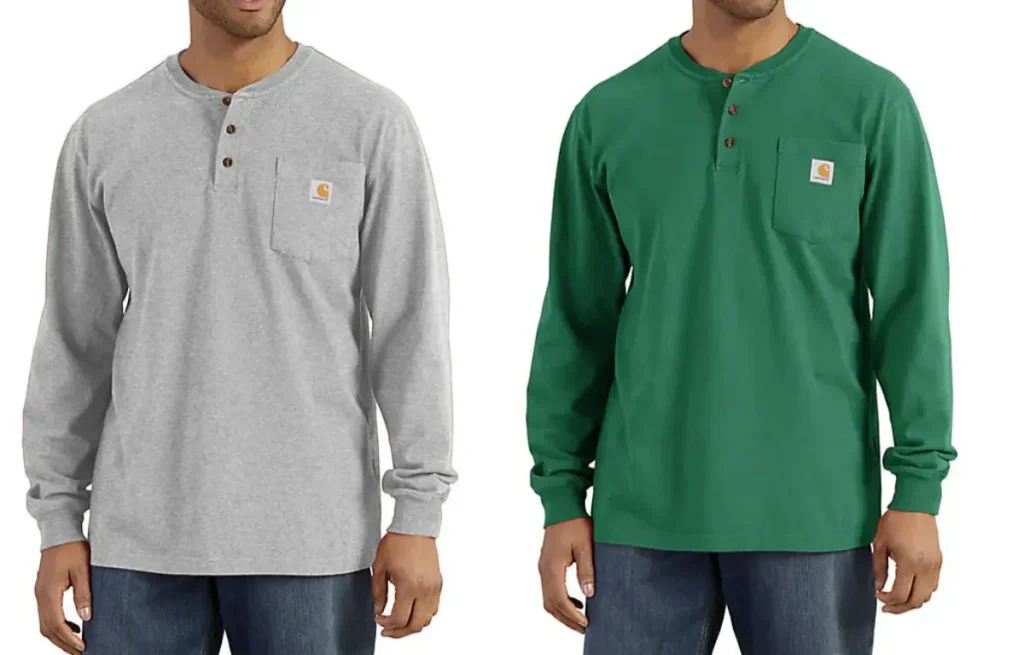
What is a Pocket Henley Shirt and how does it combine utility with subtle style?
It’s a functional twist on a classic—adding both storage and statement.
A pocket Henley shirt features a sewn-on chest pocket, typically on the left side, offering an extra layer of visual interest and functionality while maintaining the traditional Henley silhouette.
This design detail makes the shirt more versatile and brandable, especially for casual, workwear, or smart basics collections.
Purpose and Aesthetic Role of the Chest Pocket
The chest pocket isn’t just for looks—it serves multiple functions depending on the shirt’s context and construction.
| Functionality | Style Contribution |
|---|---|
| Storage | Holds small items (cards, glasses, notes) |
| Visual Framing | Breaks up solid fabrics, adds dimension |
| Texture or Color Play | Offers opportunity for contrast fabric or print |
| Brand Placement | Ideal for subtle logo embroidery |
The presence of a pocket can shift a Henley from minimal to casual-cool or utilitarian with just a few stitches.
Common Pocket Styles in Henley Shirts
Depending on the overall style direction, brands may choose from several chest pocket formats:
- Classic Patch Pocket – Straight edges, standard rectangle
- Rounded Corner Pocket – Softer, more refined feel
- Button-Down Pocket – Adds depth, workwear-inspired
- Flap Pocket – Used for outdoor or military-style shirts
- Angled Pocket – Introduces asymmetry for visual movement
Some designs incorporate double-needle stitching, bar-tack reinforcement, or contrast lining for durability and detail.
Fabric Pairing and Structural Considerations
The chest pocket affects how the shirt drapes and behaves, especially if made from a different material than the main body. It’s critical to match weight and stretch:
| Main Fabric | Pocket Strategy |
|---|---|
| Cotton Jersey | Use same fabric or slightly stiffer for support |
| Modal or Bamboo Blends | Use fused backing or double layer to prevent sagging |
| Slub Cotton | Pocket blends in naturally, great for tonal effects |
| Thermal Knit | Reinforced pocket opening to avoid stretch distortion |
In high-end basics, pockets may be cut on the bias to contrast with vertical knit lines or garment-dyed with the shirt to create vintage tone variation.
Market Fit and Design Usage by Brand Category
Pocket Henleys are highly adaptable depending on how you style the pocket:
| Market Segment | Design Direction |
|---|---|
| Casual Menswear | Relaxed fit, tonal pocket, logo embroidery |
| Workwear-Inspired | Heavier knits, flap or buttoned pockets |
| Urban Streetwear | Oversized, contrast pocket, raw hem or dropped hem |
| Women’s Everyday Wear | Fitted silhouette, small rounded pocket, pastel tones |
| Eco / Utility Brands | Recycled materials, functional pocket with tags |
The pocket detail gives designers flexibility to introduce subtle seasonal updates without needing to change the shirt pattern entirely.
Production Tips and Pocket Construction Challenges
When producing pocket Henleys, a few factors require extra care:
- Alignment – Pocket must sit flat and even with chest line
- Stitching accuracy – Top corners often stress points—bar-tack them
- Print or pattern matching – If using stripes or plaid, the pocket must align perfectly
- Stretch control – Ensure pocket doesn’t sag or warp with wash
In bulk runs, pre-pressing the pocket shape and using template folders in stitching helps maintain consistency.
Styling Benefits and Consumer Appeal
Customers often appreciate the pocket Henley for its blend of style and utility. It’s ideal for:
- Layering under jackets – Pocket adds structure under outerwear
- Solo statement pieces – Printed or textured pocket draws eye
- Minimalist wardrobes – Functional detail in neutral basics
- Gift or capsule products – Slight upgrade from standard tee or Henley
Adding a pocket allows for small-batch personalization or limited-edition embroidery, ideal for streetwear or lifestyle brands.
Curved Hem Henley Shirt
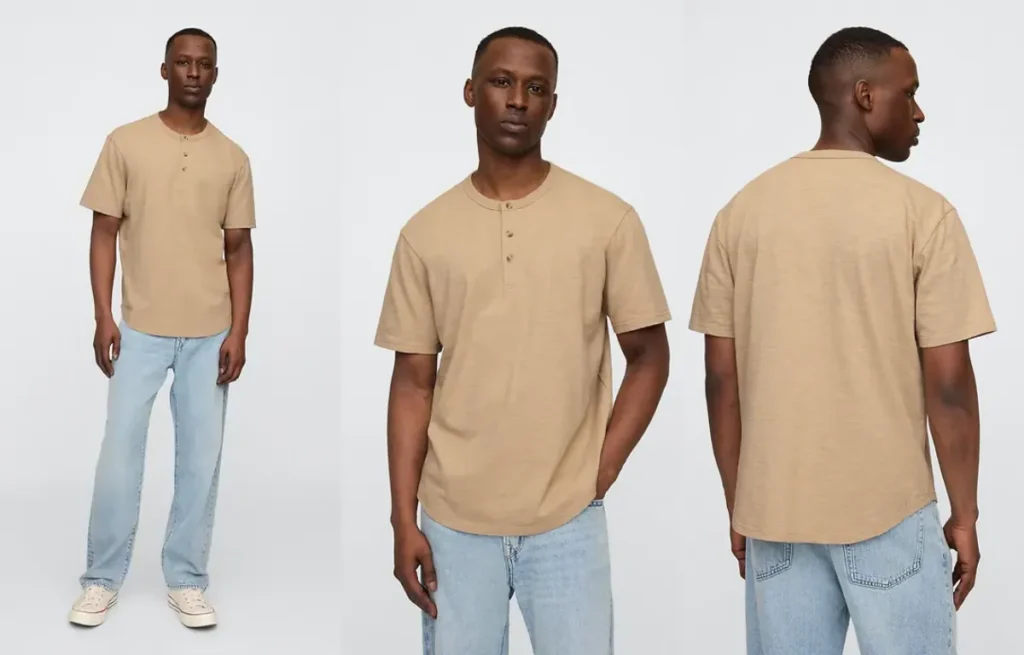
What defines a Curved Hem Henley Shirt and how does it enhance fit, flow, and fashion?
It’s tailored, flattering, and functionally stylish—designed for modern movement and silhouette enhancement.
A curved hem Henley shirt features a rounded, scooped bottom edge instead of a straight cut, offering a more dynamic fit that elongates the body and improves movement while elevating the shirt’s overall visual appeal.
This subtle adjustment transforms the basic Henley into a more refined and versatile garment, especially popular in streetwear, activewear, and modern minimalist lines.
Functional and Visual Impact of the Curved Hem
The hemline shape changes how the garment sits on the body. Rather than ending abruptly at the waist or hip, a curved hem drops lower at the front and back, often with a slight rise at the sides.
| Curved Hem Benefit | Description |
|---|---|
| Elongates torso | Creates a streamlined, vertical silhouette |
| Improves layering | Prevents bunching when worn under jackets or knits |
| Enhances movement | Side rise improves stride and comfort |
| Adds visual depth | Breaks the horizontal hemline for a more interesting shape |
The result is a Henley that feels and looks more elevated—even in casual fabrics.
Common Curved Hem Variations and Construction
Designers may choose different hem curves based on their brand direction and customer preferences:
- Slight Scoop Hem – Subtle curve, versatile for all ages
- Drop Tail Hem – Longer in back, ideal for streetwear or sport style
- Rounded Hem – Deeper curve both front and back for fashion-forward appeal
- Split Hem with Curve – Side vents plus curvature for added mobility
The hem is usually finished with double-needle stitching, coverstitch, or even raw edge in streetwear collections.
Fabric Choices That Pair Well with Curved Hem Construction
For the hem to drape cleanly and not ride up, the fabric needs a good balance of weight and flow. Popular fabric choices include:
- Modal-Cotton Blends – Lightweight, drapey, holds shape well
- Combed Cotton Jersey – Clean fall, smooth handfeel
- Bamboo Viscose – Ultra-soft and breathable with fluid movement
- Cotton-Polyester Stretch – Adds durability and shape retention
- Slub Knits – Offer natural texture and relaxed drape
These fabrics allow the curved hem to move naturally with the body without creating bulk or stiffness.
Brand Positioning and Market Segments for Curved Hem Henleys
The curved hem Henley works across multiple style identities. Here’s how brands use it effectively:
| Brand Type | Curved Hem Henley Strategy |
|---|---|
| Streetwear | Longline cut, extended curve, drop shoulder |
| Premium Basics | Fitted torso, slight curve, neutral tones |
| Athleticwear | Split curved hem, side gussets, moisture-wicking fabric |
| Women’s Essentials | Ribbed fabric, scooped hem, cropped front/long back |
| Modern Minimalist | Clean neckline, monochrome palette, subtle hem curve |
Curved hem Henleys also perform well in gender-neutral or unisex collections, offering an inclusive, fluid silhouette.
Manufacturing and Patterning Considerations
To execute a curved hem well, production needs to factor in:
- Pattern shaping – Hem curves require custom grading across sizes
- Edge control – Hem can roll or flare without proper stitch tension
- Hemming technique – Double-folded or coverstitched hems provide clean finish
- Label placement – Hem curve limits bottom label areas; side-seam branding works better
Misalignment in cutting or stitching becomes more noticeable with curved hems, so precision is key to maintain quality and consistency in bulk runs.
Styling Flexibility for Consumers
For the end user, the curved hem Henley offers more outfit versatility:
- Layer under jackets or flannels – Hem peek adds depth and layering contrast
- Tuck in front, leave back out – Popular casual styling technique
- Wear over leggings or joggers – Ideal for athleisure looks
- Pair with tailored trousers – For dressed-down yet structured fits
This format is especially favored in Instagram-friendly or influencer-driven styling, where movement and silhouette are key visual elements.
Conclusion
From sporty to sleek, rugged to refined—there’s a Henley shirt for every style. Knowing the types available lets brands tailor their offering and meet diverse consumer demands with confidence.