Skip to content
I see many beginners waste money and time at the start. They chase trends, copy others, and skip planning. That is why many clothing brands fail before they really begin.
I can start a clothing brand from scratch by choosing a clear niche, building a strong brand concept, testing small product runs, finding reliable suppliers, and using simple marketing that fits my target buyer. I do not need a huge team or budget, but I do need a clear plan and steady execution.
When I look back at early brand stories, I notice one thing. Most success did not start with a big collection. It started with one clear idea and one buyer problem worth solving.
What Are the First Steps to Start a Clothing Brand from Scratch?
I believe the first stage decides whether my brand becomes a business or stays just an idea. That is why I slow down here and get the basics right.
The first steps are to pick a niche, study buyers, define my product direction, set a price range, choose a business model, and validate demand before I invest too much in design or inventory.
 Linen Fabric Cutting
How do I choose a profitable niche for my clothing brand?
When I choose a niche, I do not start with what looks cool. I start with who I want to sell to and why they would buy from me instead of someone else.
A profitable niche usually sits at the meeting point of three things:
- clear customer demand
- strong repeat purchase potential
- manageable competition
If I try to sell to everyone, I usually become forgettable. If I focus on a clear group, I become easier to understand and easier to market. In clothing, that focus matters even more because buyers do not only buy fabric. They buy identity, function, and style.
Here is how I usually break niche research down:
| Question I ask myself | Why it matters |
|---|---|
| Who is the buyer? | It shapes product, price, and message |
| What problem do they have? | It gives the brand a reason to exist |
| What style do they want? | It helps define the collection |
| How much can they pay? | It protects margin and pricing logic |
| How crowded is the market? | It shows how hard it will be to stand out |
For example, “women’s clothing” is too broad. “High-waist performance leggings for yoga studios and boutique fitness brands” is much clearer. A clear niche helps me decide fabric, fit, packaging, and sales channels faster.
What signals tell me a niche may be profitable?
I look for simple signals first:
- people already spend money in that segment
- buyers care about quality or design, not only price
- there is room for repeat orders
- products can be extended into a collection later
- the niche has a story I can tell clearly
This matters in wholesale and B2B too. Buyers like Mark Chen are not only looking for a product. They want products that move well in their market, fit their brand image, and bring stable margin. So when I think about niche, I think about their resale potential as well.
Common mistakes I avoid when picking a niche
Many beginners make these errors:
- choosing a niche only because it is trending
- copying a famous brand too closely
- ignoring production difficulty
- targeting buyers with weak spending power
- creating too many product types at once
I have learned that a niche should be narrow enough to be clear, but wide enough to grow. That balance is important. A niche that is too broad makes my brand weak. A niche that is too tiny can limit my future expansion.
How do I validate the niche before I spend too much?
I try to validate fast and cheaply. I do not need full perfection at this stage.
I can validate with:
- small sample development
- mock product pages
- simple social media testing
- conversations with store owners or brand buyers
- pre-orders or small batch selling
That early feedback tells me whether people actually care. This step saves money because it is cheaper to adjust a concept than to clear dead inventory later.
What are the key elements of a successful clothing brand concept?
A successful concept is more than a nice logo or a product sketch. For me, it is the full logic behind the brand. It explains what I sell, who I sell to, and why the brand deserves attention.
The core parts of a clothing brand concept include:
- brand mission
- target customer
- product category
- price position
- style direction
- quality promise
- market difference
A weak concept sounds like this: “I want to sell stylish clothes for everyone.” A stronger concept sounds like this: “I want to build a premium activewear brand for fitness studios and wellness retailers that need clean design, reliable quality, and custom branding.”
The second one is easier to act on. It gives direction to product development and sales.
What makes a concept commercially strong?
I think a strong concept should pass four tests:
| Test | What I look for |
|---|---|
| Clarity | Can people understand it fast? |
| Relevance | Does it solve a real buying need? |
| Consistency | Can I repeat it across products? |
| Scalability | Can it grow into more categories later? |
A brand concept should also match real manufacturing ability. This point is often ignored. A beginner may dream of a complex luxury collection, but the budget and supply chain may only support simple basics at the start. I need ambition, but I also need realism.
Why concept matters before design
Many people start with sketches. I think that is too early. Design without concept becomes random. One piece looks sporty, another looks streetwear, and another looks premium casual. The result is confusion.
A good concept acts like a filter. It helps me say yes to the right ideas and no to the wrong ones. That discipline creates a brand that feels coherent, which buyers trust more.
How Can I Create a Unique Clothing Brand Identity and Style?
I know buyers see brand identity before they understand product details. That is why identity is not decoration. It is part of the business.
I create a unique clothing brand identity by aligning my brand name, logo, colors, tone, product style, and customer promise so everything looks and feels consistent to the right audience.
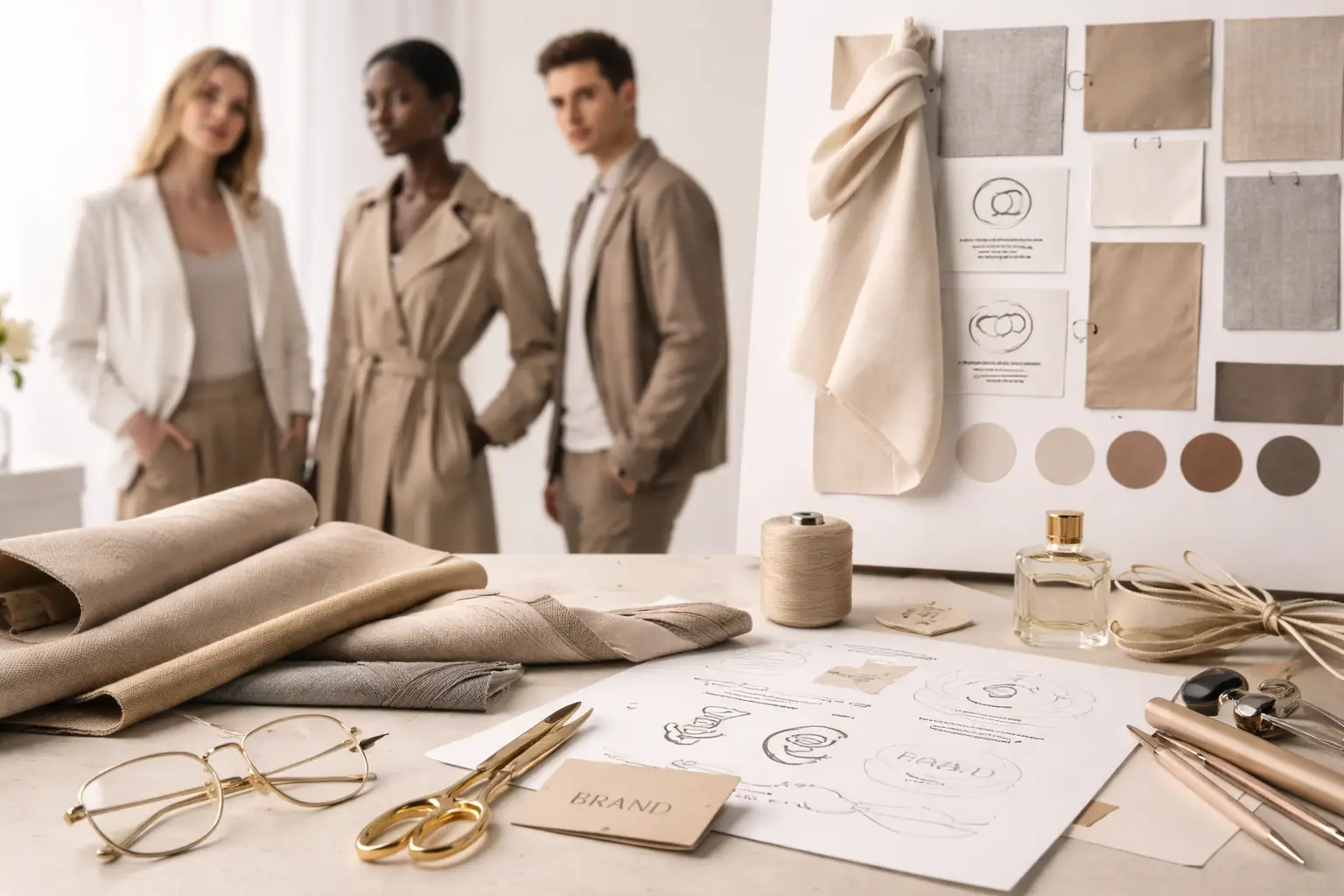 Fashion Brand Moodboard
How do I design a clothing logo and brand name that stands out?
I keep the brand name simple, clear, and easy to remember. If people cannot say it, spell it, or recall it, the name becomes a barrier.
A strong brand name often has these traits:
- easy pronunciation
- simple spelling
- emotional or visual meaning
- fit with target market
- room for future growth
I avoid names that are too generic, too long, or too tied to one short-term trend. I also avoid names that trap me in one product type unless that focus is part of my strategy.
For the logo, I do not chase complexity. A logo works best when it stays clear across labels, packaging, websites, and social media. In apparel, logos also need practical value. They may appear on hangtags, neck labels, woven patches, embroidery, and printed graphics.
What makes a logo effective for clothing brands?
I test my logo with these questions:
| Checkpoint | Why I use it |
|---|---|
| Does it still look good in black and white? | Good for labels and packaging |
| Can I shrink it without losing clarity? | Important for neck labels and tags |
| Does it fit the brand mood? | It should support the style story |
| Is it too similar to others? | Similarity weakens brand memory |
I usually choose from three broad logo directions:
- wordmark
- symbol plus wordmark
- monogram
For a new clothing brand, a clean wordmark is often the safest start. It is flexible, easy to apply, and easier to recognize when brand awareness is still low.
How do I connect name and logo with business strategy?
This is where many new founders stay too surface-level. A name and logo should not only look good. They should support sales.
For example, if I want to target boutique activewear buyers, I may need a clean and premium visual style. If I want to target trend-driven streetwear buyers, the design language may be bolder. The same logo does not fit every audience.
That is why I ask:
- What does my buyer want to feel when they see my brand?
- What market level am I entering?
- Do I want a fashion-led image or a function-led image?
- Will the brand work in B2B and B2C settings?
These questions turn branding from art into business thinking.
What factors influence my clothing brand’s visual identity and target audience?
Visual identity is shaped by product, market, buyer psychology, and price level. It is not just about color preference.
The main factors include:
- age and lifestyle of the target customer
- product category
- price positioning
- market culture
- sales channel
- seasonal direction
- competitor landscape
A yoga wear brand for women in North America will not look the same as a blank hoodie supplier for promotional buyers. The target audience changes everything.
How do I build visual identity beyond the logo?
I define a full visual system. This often includes:
- brand colors
- typography
- product photography style
- packaging style
- website mood
- label and tag design
- social media templates
Here is a simple example of identity choices:
| Brand direction | Visual result |
|---|---|
| Premium activewear | clean layout, muted colors, minimal logo |
| Youth streetwear | bold graphics, contrast colors, oversized typography |
| Eco casual basics | earthy tones, soft textures, simple imagery |
When these parts align, the brand looks intentional. That gives buyers confidence. If the product says premium but the packaging looks cheap, trust drops fast.
Why target audience should shape style decisions
I always remind myself that brand identity is not self-expression alone. It is communication. It should help the right people feel, “This brand is for me.”
That means I need to study:
- what my audience wears now
- what they post online
- what stores they shop from
- what they complain about
- what price range they accept
Style becomes stronger when it reflects real demand. This does not kill creativity. It makes creativity useful.
What Is the Best Way to Design and Produce My Clothing Line?
This stage turns vision into product. I think this is where many beginners feel excited, but also make expensive mistakes if they move too fast.
The best way to design and produce a clothing line is to match product complexity, budget, and business model, then start with a small focused collection and work with suppliers who can deliver consistent quality.
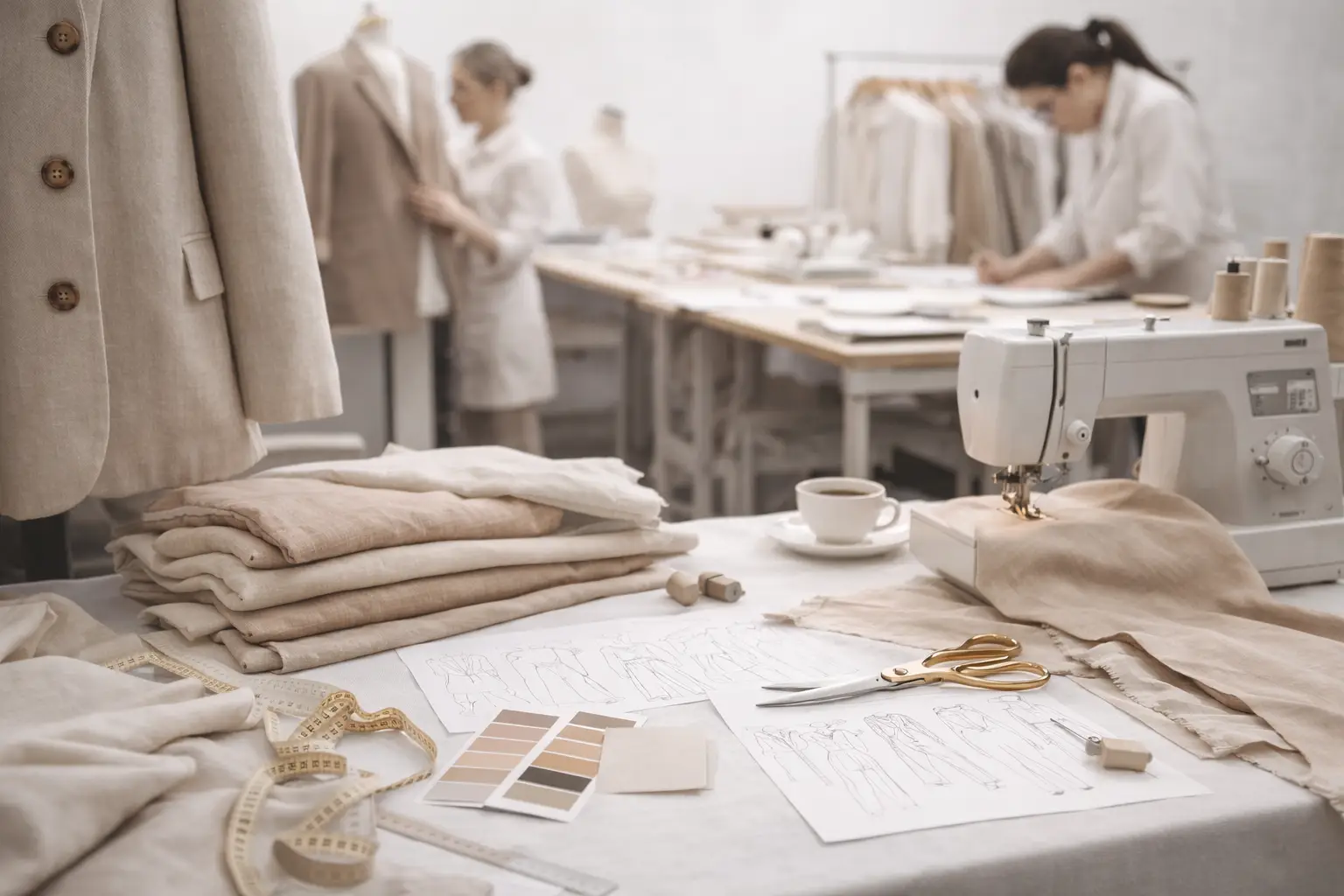 Fashion Studio Workspace
Should I start with custom designs, print-on-demand, or private label?
There is no one perfect model for everyone. The best option depends on my budget, speed, brand goals, and risk tolerance.
Here is a simple comparison:
| Model | Best for | Strength | Weakness |
|---|---|---|---|
| Custom design | long-term brand building | high uniqueness | higher cost and complexity |
| Print-on-demand | low-risk beginners | low inventory risk | weaker quality control and margin |
| Private label | faster market entry | quicker launch | lower uniqueness unless customized |
If I want fast testing with low cost, print-on-demand can help me validate ideas. But if I want stronger brand control, it has limits. Fabric, fit, finishing, and packaging are often not unique enough for a serious apparel brand.
Private label is useful when I want to move faster with proven base styles. I can customize labels, colors, packaging, and some product details. This works well for many beginners who want a practical launch.
Custom design gives the strongest identity, but it also demands more from me. I need better tech packs, stronger product development, and more money for samples and revisions.
How do I decide which model fits my stage?
I ask three things first:
- Am I testing demand or building deep brand differentiation?
- How much money can I risk at the start?
- How much control do I need over fit, fabric, and finish?
A simple decision path looks like this:
- choose print-on-demand for low-risk market testing
- choose private label for faster launch with moderate control
- choose custom design for stronger long-term uniqueness
Sometimes the smartest path is hybrid. I may test market response with simpler products first, then move into custom development after I understand what buyers actually want.
What product strategy should I use for the first collection?
I do not try to launch twenty products. That usually creates stress, confusion, and cash pressure.
A first collection works better when it is:
- narrow
- easy to explain
- connected by one clear story
- built around a few hero products
For example, instead of launching leggings, bras, hoodies, tees, and jackets all at once, I might start with leggings, a matching sports bra, and one lightweight outer layer. That keeps sampling and production under control.
How do I find reliable clothing manufacturers or suppliers?
Finding a supplier is not only about price. The cheapest supplier can become the most expensive mistake if quality fails or shipments come late.
I look at suppliers in layers.
First, I check basic fit:
- product category match
- order quantity fit
- export experience
- communication speed
- sample ability
Then I go deeper.
What should I verify before choosing a manufacturer?
I check these areas carefully:
| Area | What I verify |
|---|---|
| Product capability | Can they make my product well? |
| Quality control | Do they have clear inspection steps? |
| Compliance | Can they provide valid documents? |
| Communication | Are replies clear and timely? |
| Delivery | Can they meet realistic timelines? |
| Flexibility | Can they support sampling and changes? |
This deeper review matters because many supplier problems do not show up in the first message. They appear later, during development, production, and shipping.
Red flags I do not ignore
I take these warning signs seriously:
- vague answers about production details
- sample quality far below promise
- refusal to explain quality process
- pressure to pay too quickly
- certificates that look inconsistent
- weak communication after first contact
For buyers like Mark Chen, these issues are not small. Poor supplier communication can delay a whole season. False documents can damage trust and create risk in the market. That is why I think supplier screening is one of the most professional tasks in the whole business.
How do I build a better supplier relationship?
I do not treat suppliers as simple order takers. Good suppliers can help me improve fabric choice, cost structure, and production planning.
To build a stronger relationship, I try to:
- send clear tech packs and comments
- approve samples carefully
- confirm timelines in writing
- ask about risk points early
- pay on agreed terms
- give structured feedback
A strong supplier relationship does not remove all problems. But it makes problem-solving much faster when issues happen.
How Can I Launch and Market My Clothing Brand Successfully?
A good product is not enough. I have seen great products fail because no one noticed them, and average products grow because the marketing was sharper.
I can launch and market my clothing brand successfully by building a clear message, creating strong content, using the right digital channels, and focusing on trust, consistency, and repeat visibility.
 Fashion Marketing Desk
What are the most effective digital marketing strategies for new clothing brands?
For a new brand, I keep the strategy simple. I do not try every channel at once. I choose a few channels where my buyers already spend time.
The most effective strategies often include:
- content marketing
- email marketing
- search-focused website pages
- paid social testing
- short-form video
- customer reviews and social proof
The goal is not just traffic. The goal is qualified attention from people who are likely to buy.
What should I focus on first?
I usually focus on these foundations first:
| Priority | Why it matters |
|---|---|
| Clear brand message | Helps people understand the brand fast |
| Strong product pages | Turns attention into sales |
| Quality visuals | Builds trust in apparel |
| Email capture | Keeps future sales opportunities |
| Retargeting | Improves conversion from warm traffic |
Many beginners spend too much on traffic before the website is ready. I think that is backward. If product pages are weak, ad money leaks out fast.
How does content support clothing brand growth?
Content gives the brand a voice. It also helps buyers imagine the product in real life.
Useful content can include:
- fit and styling videos
- behind-the-scenes production stories
- fabric education
- founder story
- customer testimonials
- comparison posts
This is especially useful when I sell quality-focused products. If my product costs more than low-end alternatives, I need content that explains why.
Social media helps me get repeated exposure. Influencers help me borrow trust and reach. Both matter, but they only work when the fit is right.
I do not look only at follower count. I care about audience match, content quality, and real engagement.
What kind of influencer strategy works best for a new brand?
For new brands, micro-influencers are often more practical than large celebrities. They usually cost less, feel more authentic, and often have a more focused audience.
I usually compare influencer options like this:
| Type | Strength | Risk |
|---|---|---|
| Large influencers | fast reach | expensive, lower trust fit |
| Micro-influencers | stronger niche connection | smaller audience per account |
| UGC creators | useful content output | may not bring direct audience |
A smart early strategy may combine:
- a few niche influencers
- several UGC creators
- strong reposting on my own channels
This gives me both content and reach.
Visibility alone does not mean sales. I need a system behind it.
That means I connect social traffic to:
- landing pages
- email sign-up offers
- retargeting ads
- product bundles
- reviews and trust elements
Without this, social traffic becomes noise. With this, social traffic becomes part of a repeatable sales process.
Why launch timing and message matter
A launch should feel like a focused event, not a random product upload.
I make sure the launch answers these questions:
- Who is this for?
- Why now?
- What makes it different?
- Why should people care today?
A strong launch message creates urgency and clarity. That combination is powerful, especially when the brand is still unknown.
How Much Does It Cost to Start a Clothing Brand and How Can I Scale It?
This is the part most beginners worry about. I understand that. Money pressure can shape every decision in the early stage.
The cost to start a clothing brand can range from a small test budget to a much larger setup, depending on product type, production model, and marketing plan. I scale faster when I control inventory, protect margin, and expand only after I confirm demand.
 Fashion Business Planning
What is the minimum budget required to start a clothing brand?
The minimum budget depends on how I start. A print-on-demand model can start with a much smaller budget. A custom private label launch needs more.
Here is a simple budget view:
| Cost area | Low-budget start | Higher-control start |
|---|---|---|
| Branding | basic | more custom work |
| Samples | limited | multiple revisions |
| Production | none or low | higher MOQ commitment |
| Website | simple | more polished setup |
| Marketing | small tests | broader launch campaign |
The real issue is not only how little I can spend. It is whether the budget matches the business model. A very small budget and a premium custom vision often do not fit together.
Where should I spend first?
I think early money should go to the areas that reduce risk and support sales:
- product validation
- good samples
- basic branding
- a functional website
- quality content
- small marketing tests
I avoid overspending on fancy packaging, huge stock orders, or too many styles too early. Those choices look exciting, but they can trap cash.
Many new founders only count visible costs. They forget hidden costs like:
- sample revisions
- shipping changes
- label corrections
- import duties
- photo shoots
- returns and exchanges
- slow-moving inventory
These hidden costs can turn a workable plan into a stressful one. That is why I always leave room in the budget for mistakes and adjustments.
How can I grow and scale my clothing brand into a profitable business?
I do not scale just because I feel ready. I scale when I see proof.
The best proof usually includes:
- repeat orders
- stable margins
- strong feedback on hero products
- predictable lead times
- repeatable marketing performance
Scaling before these signals appear can create bigger problems, not bigger success.
What are the smartest ways to scale?
I scale in layers:
- improve best-selling products
- add related products
- strengthen supplier systems
- improve customer retention
- expand channels carefully
This layered approach is safer than trying to go everywhere at once.
How do I protect profit while scaling?
Profit often drops when growth gets messy. To protect profit, I track:
| Metric | Why I track it |
|---|---|
| gross margin | shows product health |
| return rate | shows product or expectation issues |
| reorder rate | shows demand strength |
| lead time | affects stock planning |
| marketing cost per sale | shows channel efficiency |
I also keep asking hard questions. Which products truly deserve restocking? Which channels bring real buyers? Which custom requests create too much complexity for too little return?
That critical thinking matters because growth can hide waste. A bigger business is not always a better business if margin gets weaker and operations get unstable.
What does sustainable scaling really look like?
To me, sustainable scaling means my systems improve as orders grow. I do not want sales growth that breaks quality, delays shipping, or confuses the brand.
Real scaling often looks like this:
- fewer but stronger suppliers
- clearer product line structure
- better forecasting
- stronger customer retention
- tighter brand positioning
That kind of growth is slower than hype-driven expansion, but it is usually more durable. In apparel, durability matters. Trends move fast, but good systems keep the business alive.
Conclusion
I believe I can start a clothing brand from scratch when I focus on a clear niche, a strong concept, reliable production, and simple marketing. I do not need to do everything at once. I need to do the right things in the right order.