 Skip to content
Printing all-over designs on hoodies might seem straightforward, but it’s actually a detailed process with multiple crucial steps. Choosing the wrong printing method or fabric can lead to poor print quality, faded colors, or misaligned artwork.
All-over print (AOP) hoodies are typically printed using sublimation on polyester fabrics1. The fabric is printed first, then cut and sewn into the hoodie. This method ensures vibrant, durable designs covering the entire garment seamlessly. Alternative methods include large-format DTG or panel screen printing.
I’ve created many AOP hoodies2 and learned firsthand the details that make or break quality. Here’s everything you need to know.
What Exactly Is an All Over Print Hoodie?
All-over print hoodies are visually striking because their designs cover the entire garment, front-to-back and sleeve-to-sleeve. This printing style allows highly creative and immersive graphics.
An all-over print hoodie is defined by designs printed over the entire surface, including sleeves, hood, and pockets, with seamless patterns and vibrant, detailed artwork. Unlike standard printed hoodies, which typically feature designs in limited areas, AOP hoodies provide maximum creative freedom.
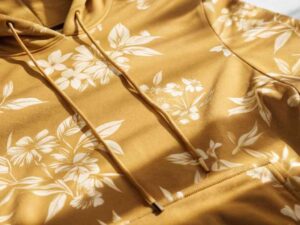 Floral Hoodie Detail
Definition and Key Features
- Full-surface, edge-to-edge printing.
- Vibrant, continuous designs.
- Typically uses sublimation on polyester fabrics for best results.
Differences Between AOP and Standard Print Hoodies
| Feature | AOP Hoodie | Standard Hoodie |
|---|---|---|
| Print Coverage | Entire garment | Limited to specific areas |
| Design Complexity | High, unlimited | Medium, limited |
| Printing Methods | Sublimation, DTG | Screen, DTG, Heat Transfer |
| Fabric Type | Polyester or poly blends | Cotton or blends |
What Are the Main Techniques for All Over Printing?
Choosing the correct technique directly affects your hoodie’s look, feel, and durability. Sublimation printing dominates, but other methods exist based on your project’s specifics.
Main AOP techniques include sublimation printing3 (most common), cut-and-sew methods, large-format DTG, and panel screen printing. Sublimation is preferred due to vibrant colors, durability, and seamless print coverage.
Sublimation Printing (Most Common for AOP)
Sublimation printing uses heat to transfer dye into polyester fabric fibers, providing vibrant, permanent, fade-resistant designs. It’s ideal for all-over, seamless prints.
Cut and Sew Process: Print Fabric First, Then Assemble
The fabric is sublimation-printed first in large sheets, then precisely cut and sewn into a hoodie. This approach eliminates seams disrupting artwork and ensures uniformity across the garment.
Alternative Methods (Large Format DTG, Screen Printing for Panels)
- Large Format DTG: Suitable for smaller runs; prints directly onto assembled hoodies but may have slight gaps near seams.
- Panel Screen Printing: Printed before sewing; durable but limited colors and costly for detailed designs.

What’s the Step-by-Step Process for Making an All Over Print Hoodie?
Creating an AOP hoodie involves precise steps, from design creation to sewing. Each step ensures the final garment matches your vision exactly.
The AOP hoodie process includes designing high-resolution artwork, selecting polyester fabrics, sublimation printing the fabric, accurately cutting fabric patterns, and assembling pieces into the final hoodie.
Step 1: Design Creation (High-Resolution, Full Canvas Artwork)
Start with a high-resolution, continuous artwork covering the entire hoodie template. Maintain at least 300 DPI for clarity and detail.
Step 2: Fabric Selection (Typically Polyester or Poly Blends)
Choose polyester or poly-blend fabrics that absorb sublimation inks effectively. Fabric choice impacts color vibrancy and durability.
Step 3: Printing the Fabric Using Sublimation
The fabric sheets are printed via sublimation. Heat transfers the ink deeply into fibers, resulting in vibrant, durable prints.
Step 4: Cutting Fabric Pieces to Match the Pattern
Printed fabric is carefully cut according to hoodie patterns. Precision here ensures artwork aligns correctly when sewn.
Step 5: Sewing the Pieces Together into a Finished Hoodie
All printed and cut pieces are sewn meticulously, ensuring accurate alignment and high-quality finishing.
Why Does Fabric Choice Matter for All Over Print Hoodies?
The fabric you choose dramatically affects print quality, durability, and comfort. Not every fabric suits AOP equally.
Polyester fabrics are ideal for sublimation AOP hoodies due to vibrant color reproduction and durability. Cotton has limitations, though recent methods allow partial AOP prints. Fabric weight and texture also affect comfort and print outcome.
Polyester and Sublimation Compatibility
Polyester absorbs sublimation inks effectively, resulting in vivid, permanent prints. It’s currently the best choice for full AOP hoodies.
Cotton Limitations for AOP (and Newer Workarounds)
Cotton doesn’t readily accept sublimation inks. Newer techniques using special coatings enable limited AOP on cotton blends, but results aren’t as vibrant or durable.
Texture, Weight, and Color Vibrancy Differences
Heavier polyester fabrics enhance durability, lighter ones maximize comfort. Smooth textures provide sharper prints, whereas textured fabrics might diffuse colors slightly.
What Are the Pros and Cons of All Over Print Hoodies?
Knowing advantages and limitations ensures informed decisions before production.
AOP hoodies allow bold, continuous designs without peeling or cracking. However, they’re limited mainly to synthetic fabrics, involve complex production processes, and minor design misalignments at seams are possible.
Pros: Bold Designs, No Peeling/Cracking, Seam-to-Seam Printing
- Eye-catching, continuous graphics.
- Permanent prints, won’t peel or fade easily.
- Ideal for creative, vibrant artwork.
Cons: Limited to Synthetic Fabrics, More Complex Production, Slight Design Misalignments
- Primarily polyester-based fabrics required.
- More expensive, complex production.
- Potential minor misalignment at seams if not carefully executed.
How Do You Choose the Right Production Method for Your AOP Hoodie?
Your choice depends on quantity, quality, budget, and specific requirements.
For small batches, use large-format DTG or print-on-demand services. Mass production favors sublimation with cut-and-sew. Always ask printers about resolution, fabric shrinkage, and colorfastness before proceeding.
Small Batch vs. Mass Production
- Small Batch: Use DTG or panel screen printing for quick turnaround.
- Mass Production: Sublimation and cut-and-sew offer cost-effectiveness at higher volumes.
DIY Platforms vs. Professional Manufacturers
| DIY Platforms | Professional Manufacturers |
|---|---|
| Printify, Subliminator | Alibaba suppliers, specialized AOP |
| Quick and easy | Better cost per unit, quality |
| Higher per-unit cost | Higher MOQ, longer production time |
Key Questions to Ask Your Printer (Resolution, Shrinkage, Colorfastness)
- What’s your print resolution capability (DPI)?
- How much does fabric shrink during production?
- Can you provide a wash test report for colorfastness?
Bonus Section: Best Platforms to Order Custom AOP Hoodies
These platforms are reliable options to produce high-quality AOP hoodies.
Printify
- Excellent for print-on-demand.
- Good customer support and ease of use.
Subliminator
- Specializes exclusively in sublimation AOP.
- Vibrant, seamless prints ideal for designers.
Printful
- High-quality print-on-demand with proven reliability.
- Great integrations and consistent quality.
Local Specialized AOP Manufacturers
- Quick communication and faster turnaround.
- Greater control over customization and sampling.
Conclusion
All-over print hoodies offer incredible creative potential but require precise steps, correct fabric choices, and careful planning. Whether you’re designing one or thousands, understanding this detailed process ensures vibrant, high-quality results every time.
-
Learn why polyester is the go-to fabric for sublimation printing, ensuring vibrant and durable designs for AOP hoodies. ↩
-
Discover the advantages of AOP hoodies, including their unique design capabilities and production considerations. ↩
-
Explore this resource to understand the sublimation printing process, which is crucial for creating vibrant all-over print hoodies. ↩












