Skip to content
Many activewear collections do not struggle because the market is too crowded. They struggle because the collection is built from the inside out. The founder starts with personal taste, scattered inspiration, or a list of styles that “feel complete,” then hopes customers will understand the value on their own. Online, that rarely works. People cannot touch the fabric. They cannot test the stretch. They cannot compare the waistband tension or the shoulder comfort in real life. So the collection has to do more work. It has to explain itself clearly, solve a visible problem, and reduce uncertainty before the customer ever reaches checkout.
The strongest activewear collections usually begin in a much simpler way. They start with a small number of products, a clear use case, a fabric story that makes sense, and fit details that match how people actually move through a normal day. Instead of trying to look big, they try to feel easy to understand. That difference matters more than many brands expect.
To build an activewear collection that sells online, start with a focused product range, choose fabrics based on actual wear situations, design fit around comfort and repeat use, and describe each product in a way that removes doubt. The collection does not need to be large. It needs to be clear, consistent, and easy for customers to trust.
That is also why early product decisions matter so much. A customer may arrive because the product looks clean, modern, and wearable. But what makes them stay is something deeper: they can imagine where they would wear it, how it would feel after hours of movement, and whether the product will still make sense after the first order. That is where a strong activewear collection begins.
What Activewear Should You Sell First?
The best activewear to sell first is not the most complicated product, and it is not the widest collection. It is the product group that customers can understand quickly, wear often, and feel confident buying online without too much guessing. For most new or growing brands, that means starting with a tight range of repeatable core pieces rather than trying to launch every category at once.
This matters because the first collection has two jobs at the same time. It has to attract attention, but it also has to teach the market what your brand stands for. If the opening range is too broad, customers may see many products but still fail to understand the point of the brand. If the range is too narrow without enough logic, the collection may feel incomplete. The right starting point usually sits in the middle: small enough to stay clear, strong enough to feel intentional.
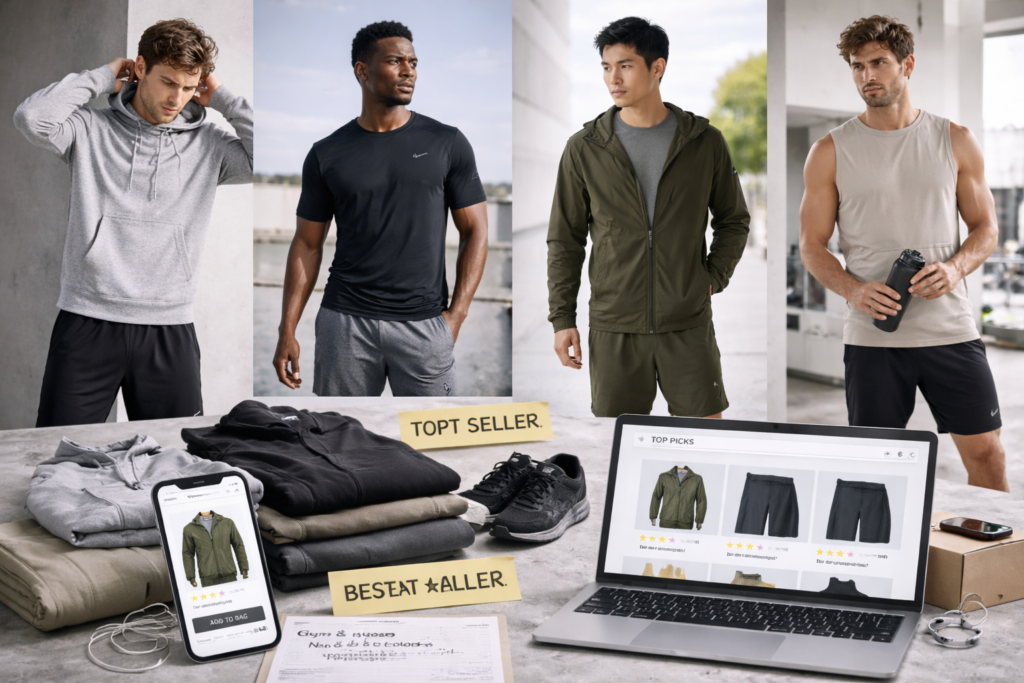
When customers shop for activewear online, they are usually trying to solve very practical problems. They want to know which pieces will actually get worn, which ones will feel comfortable for longer than an hour, which items work across more than one part of the day, and which products are worth buying again if the first order goes well. That is why the first activewear collection should be built around real use, not around the desire to “look like a big brand” on day one.
A good opening collection usually has four qualities. It is easy to style. It is easy to explain. It has a clear fit purpose. And it supports repeat orders once the first winning products emerge. That is where many brands either build momentum or create avoidable inventory pressure.
Which activewear styles should you launch first?
For most online-first brands, the strongest opening range includes one bottom, one top, and one layer. This structure works because it matches how customers naturally build activewear outfits. It also gives the brand enough variety to feel complete without forcing too many product decisions in the first drop.
A useful starting combination often looks like this:
| Product | Why It Is Strong for a First Launch | Main Risk to Control | Why Customers Come Back |
|---|---|---|---|
| High-waist leggings | Clear category demand, easy outfit anchor, strong visual identity | Sheerness, rolling waistband, over-compression | Customers reorder if fit feels dependable |
| Performance tee or tank | Easier sizing, lower return pressure, wide use range | Fabric cling, transparency, weak shape recovery | Easy first purchase and repeat basic |
| Lightweight hoodie or zip layer | Good perceived value, useful across seasons, easy styling | Too bulky, poor drape, lack of shoulder ease | Works beyond workouts and gets frequent wear |
| Shorts | Useful for warm weather, lower fabric cost in some cases | Riding up, rise discomfort, thigh opening issues | Strong repeat if comfort is right |
| Light-support bra | High interest category, pairs well with leggings | Support mismatch, pressure, cup coverage complaints | Good second purchase once trust is built |
If the budget is limited, starting with three core styles is often enough:
- one hero legging
- one active tee or tank
- one light layer
That small range can already create a full outfit story. It also helps the brand learn faster. If you launch with ten or twelve styles, weak signals get mixed together. You may see sales, but it becomes harder to understand why one product moved and another stalled. Was it the fabric? The fit? The price? The styling? The product page? A smaller launch makes those answers easier to see.
It also helps to think in terms of wear frequency. The best first styles are usually the ones customers can imagine wearing at least once a week. A dramatic fashion-forward activewear item may get attention, but a clean pair of leggings or a well-balanced active tee is more likely to become part of routine life. That matters because routine products are the products that support repeat business.
A practical first-drop ratio often works best when it leans toward lower-risk essentials:
| Category Mix for First Launch | Suggested Share |
|---|---|
| Core bottoms | 35% to 40% |
| Tops | 25% to 30% |
| Layers | 20% to 25% |
| Bras / niche pieces | 10% to 15% |
This does not mean every brand must follow the exact same ratio. It means the collection should give more room to the pieces that are easier to understand and easier to wear often.
Another useful rule is to keep fabric directions under control. Too many fabrics in the first launch can confuse customers and complicate production. A smarter approach is to work with one clear legging fabric, one clear top fabric, and one clear layer fabric. That gives enough variety without turning the first collection into a technical puzzle.
Which activewear niches are easiest to test?
The easiest niches to test are the ones where the customer need is simple, visible, and easy to describe. In activewear, not every niche carries the same level of difficulty. Some product directions ask the customer to trust a lot. Others fit naturally into everyday life and feel easier to try.
For most new brands, these niches are often the most practical starting points:
| Niche | Why It Is Easier to Test | Customer Need It Solves |
|---|---|---|
| Yoga / Pilates wear | Softness and stretch are easy to explain | Comfort, movement, calm daily wear |
| Walking / everyday movement | Broad use, lower fit pressure, easy styling | All-day comfort and versatility |
| Light training wear | Clear performance purpose without extreme technical claims | Basic support and breathability |
| Golf-inspired active basics | Polished appearance with movement value | Presentable activewear beyond the gym |
| Travel-friendly athleisure | Strong value story and repeat wear potential | Comfort across long hours and mixed settings |
These niches usually test better because the customer can picture the garment quickly. That is one of the biggest advantages a product can have online. If the use case is easy to imagine, the path to purchase becomes shorter.
For example, a customer seeing “soft studio leggings for Pilates, stretching, errands, and long seated wear” can immediately understand the product’s job. A customer seeing “maximum performance multi-sport training leggings for every condition” has more questions. The second description sounds broader, but broad often creates hesitation.
This is why everyday movement categories often outperform more extreme performance categories in early-stage testing. They place the product inside normal life. That makes the garment easier to trust because the customer does not feel the brand is asking them to believe too much.
There is also a production advantage here. Easier-to-test niches often have fewer failure points. A walking legging or an all-day active tee still needs good fit and fabric, but the customer is usually not judging it by elite athletic standards. That gives the brand more room to refine the product over time.
A useful way to compare early testing difficulty looks like this:
| Niche Type | Messaging Difficulty | Fit Sensitivity | Product Risk |
|---|---|---|---|
| Everyday active basics | Low | Medium | Lower |
| Studio / yoga wear | Low | Medium | Lower to medium |
| Golf-inspired activewear | Medium | Medium | Medium |
| Light training wear | Medium | Medium to high | Medium |
| High-intensity performance wear | High | High | High |
For many brands, the smartest move is not to enter the loudest niche first. It is to enter the clearest niche first. A clear niche makes sampling easier, page writing easier, photography easier, and customer education easier. That usually leads to better first-launch results.
What can golf bag weight teach activewear brands?
Golf bag weight may seem far from activewear, but it teaches an important product lesson: people do not judge gear only by appearance. They judge it by how it feels during real use over time. The same is true for clothing. Many activewear products look strong in photos, but the customer’s final judgment comes later, after walking, sitting, stretching, sweating lightly, commuting, or wearing the garment through a longer day.
That matters because a lot of first collections are still designed too much for the image and not enough for the real routine. The founder focuses on the clean waistband, the strong color, the polished campaign styling, or the idea of performance. But the customer often notices more practical things first:
- Does the waistband stay comfortable after lunch?
- Does the fabric feel too warm indoors?
- Does the shoulder seam bother me in the car?
- Can I wear this from class to errands without wanting to change?
- Does it still feel good after three hours, not just three minutes?
This is where the golf example becomes useful. A product that looks premium is not always the product that feels best in use. A bag with more structure, more compartments, and more visible features may look impressive, but a lighter and more balanced bag may be the better choice for many real users. Activewear follows the same pattern. More seams, more panels, more pockets, more compression, and more “technical” design do not always create more value.
For many online-first customers, especially those buying for mixed daily use, the better product is often the one that removes friction rather than adds features. That can mean:
- a softer waistband instead of a tighter one
- a smoother inner surface instead of a heavier fabric hand
- cleaner shoulder movement instead of more decorative seam lines
- a lighter layer instead of a bulky one
- moderate support instead of very aggressive hold
This is one reason activewear collections built for everyday life often create more reliable repeat demand than collections built only around performance language. Most customers are not dressing for competition. They are dressing for motion inside normal life. If the product respects that reality, it becomes easier to wear and easier to reorder.
Do shoppers prefer a full activewear line?
Most shoppers do not need a full line at the start. They need a line that feels clear. A smaller collection often performs better because it reduces decision fatigue and gives each product more room to matter. Customers are not impressed by product count alone. They are more likely to respond to a collection that feels edited, understandable, and easy to shop.
Too many products in the opening range often create hidden problems:
| Problem Caused by a Large First Line | What Happens |
|---|---|
| Too many similar choices | Customers hesitate instead of choosing |
| Inventory spread becomes too thin | Best sellers go out of stock too fast while weak styles sit |
| Product pages become less detailed | Important fit and fabric information gets overlooked |
| Marketing focus gets diluted | No hero product becomes memorable |
| Reorders become less clear | The brand cannot tell which products deserve expansion |
A tighter range often does the opposite. It creates a stronger center of gravity.
For example, a five-style collection might be easier to sell than a twelve-style collection because the customer can understand it in one glance. They see the legging, the bra, the tee, the hoodie, and the short. The brand point of view becomes visible. Each item has a job. The collection feels intentional.
This is especially important for new and growing brands because first-time customers are making several judgments at once:
- Is this brand clear about what it offers?
- Do these products look wearable in my real life?
- Can I tell the difference between one item and another?
- Does this feel like a collection with a purpose?
- Would I come back for a second order if the first one works?
A focused line answers these questions faster.
There is also a practical sales advantage in keeping the first launch edited. A smaller range lets the brand put more attention into the things that actually affect conversion:
- stronger fit notes
- better product photos
- clearer fabric descriptions
- more consistent styling
- more usable size guidance
- cleaner collection page structure
Those details usually matter more than having three extra styles with weak explanation.
A practical first collection often works well when it stays inside these boundaries:
| Launch Type | Number of Styles | Why It Works |
|---|---|---|
| Tight opening drop | 3 to 4 | Very clear, easy to explain, low inventory pressure |
| Balanced opening drop | 5 to 6 | Enough variety to feel complete, still manageable |
| Broad early launch | 8+ | Only works if the brand already has strong systems and clear demand |
For a manufacturer, this kind of focused launch is also healthier. It allows better sampling control, easier quality review, and more stable production planning. For a brand, it makes growth more intelligent. Once one or two styles clearly win, the brand can deepen those categories with more confidence.
That is where a supplier like Modaknits becomes useful. Brands often do not need the biggest first order. They need a manufacturing partner that can support a staged path: sample, test, refine, restock, then scale. A collection that begins with discipline usually has a better chance of becoming a product line that customers actually want to buy again.
the first activewear collection should not try to prove that the brand can make everything. It should prove that the brand understands what customers will actually wear. That difference is often what separates a good-looking launch from a commercially strong one.
How Do You Choose Activewear Fabrics?
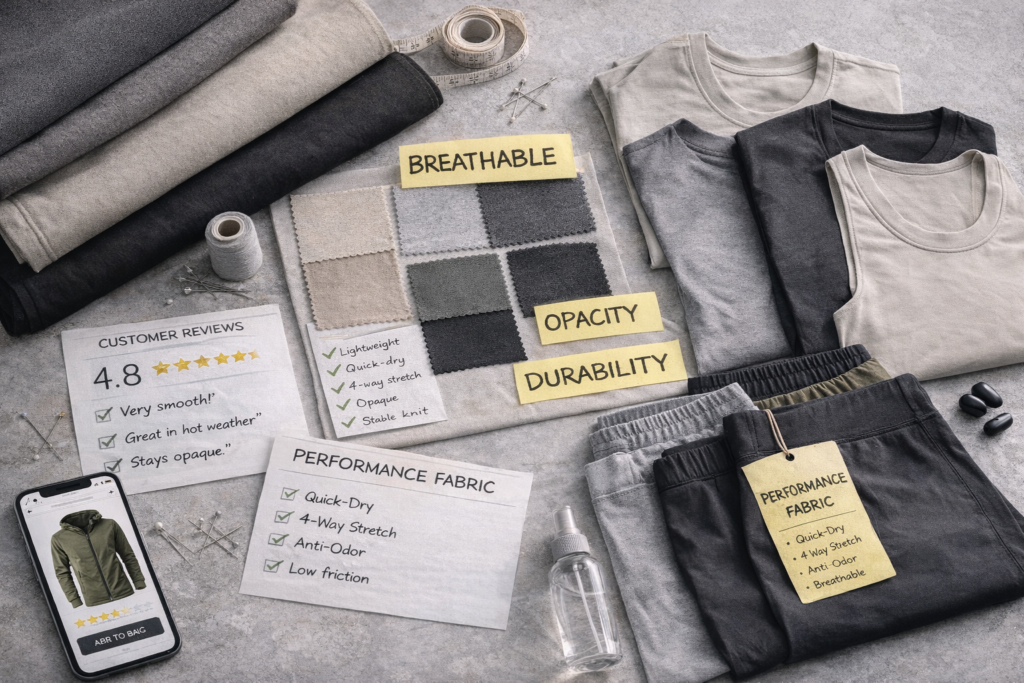
Choosing activewear fabric starts with a simple question: what kind of day is this garment built for? Most customers do not buy fabric names. They buy outcomes. They want leggings that do not turn sheer when they bend. They want tops that do not feel sticky after a short walk or light workout. They want a hoodie that feels soft but does not become heavy, bulky, or misshapen after washing. In other words, fabric choice is not a technical detail at the end of development. It is the part that decides whether the product feels worth wearing again.
This is also very close to how MODAKNITS already frames fabric internally. In the brand’s own content planning, fabric is treated as the beginning of comfort, especially around softness, breathability, stability, long-hour wear, and quality consistency rather than trend language alone.
For a growing activewear brand, the fabric decision usually affects six commercial results at once: first-touch impression, fit comfort, product page clarity, return risk, repeat order potential, and production consistency. A fabric that looks fine on paper but behaves poorly in wear can damage all six. That is why the best collections normally use fewer fabric stories, explain them more clearly, and match each one to a very specific use.
A practical way to judge fabric is to ask whether it can deliver on these real customer expectations:
| Customer Expectation | What the Fabric Must Actually Do |
|---|---|
| “I want it to feel good right away.” | Soft surface, no harsh hand feel, no plastic-like touch |
| “I don’t want it to feel too hot.” | Good air flow or at least lower heat build-up |
| “I need it to move with me.” | Stretch plus recovery, not stretch alone |
| “I don’t want see-through leggings.” | Coverage under tension, especially in lighter shades |
| “I want it to last.” | Stable surface, lower pilling risk, better wash behavior |
| “I may wear this for hours.” | Balanced weight, low irritation, comfortable pressure |
A useful product team will usually test fabric in three stages. First, how it feels in hand. Second, how it behaves in movement. Third, how it holds up after washing. Those three stages are much closer to the customer’s real judgment than technical claims alone. A fabric may feel premium in hand but fail during sweat, sitting, bending, or repeated washing. That gap is where disappointment starts.
What fabric matters most in activewear?
The fabric quality that matters most depends on the category, but for most activewear customers the key concerns are usually comfort, breathability, coverage, stretch recovery, and long-wear stability. The exact order changes by product. Leggings are judged more heavily on opacity, hold, and recovery. Tops are judged more on breathability, cling, and softness. Layers are judged on warmth balance, weight, and shape retention.
This is why “good fabric” should never be explained as one single thing. Customers experience fabric differently depending on what they are buying.
For leggings, the most important questions are usually these. Does the fabric stay opaque under stretch? Does it feel smooth or dry against the skin? Does it bounce back after wear, or does it bag out at the knees and seat? Does it feel supportive without becoming tiring? A legging fabric that passes these tests is already doing more than most marketing language can explain.
For active tops, customers usually notice heat, cling, surface feel, and drape first. If the top traps heat, sticks to the body after light sweating, or feels rough at the neckline and underarm, the product can lose favor quickly even if the cut looks good. In warm-weather markets, many customers are more sensitive to fabric feel than to visual design details.
For hoodies and layers, weight becomes more important. A layer that feels too light may feel cheap. A layer that feels too heavy may feel tiring, especially if the customer wants it for commute, travel, or mixed daily wear. The best balance often sits in the middle: enough body to hold shape, enough softness to feel easy, and enough breathability that it does not become stuffy too quickly.
A practical comparison looks like this:
| Product Type | Fabric Qualities That Matter Most | What Customers Usually Notice First |
|---|---|---|
| Leggings | Opacity, recovery, support, surface smoothness | Waist feel, coverage, movement comfort |
| Sports bra | Recovery, softness, support balance, lining comfort | Pressure, strap feel, chest comfort |
| Active tee / tank | Breathability, cling control, softness, drape | Heat comfort, stickiness, easy wear |
| Shorts | Stretch, surface comfort, weight, recovery | Riding up, thigh feel, lightness |
| Hoodie / layer | Weight balance, softness, structure, wash stability | Bulk, drape, interior comfort |
In practical development, many teams make the mistake of overvaluing first-touch softness and undervaluing wear stability. A fabric can feel soft in a meeting room and still perform badly after an hour of movement. That is why softness should be judged together with stability. MODAKNITS’ internal fabric direction already points to this exact balance: softness, breathability, and stability should be considered together, especially for long-hour wear.
Which activewear fabric fits each use?
The right fabric depends on how the garment will actually be worn. A yoga legging, a gym top, a travel hoodie, and a daily active tee should not all be built from the same logic. Even when two products look visually close, the wear expectation can be very different.
In development, it helps to think less in terms of abstract fabric categories and more in terms of wear scenes. A studio legging needs a different feel from a top designed for repeated sweaty training. A light layer for errands and travel needs a different weight from a hoodie meant mainly for warmth.
Here is a useful planning grid for first collection development:
| Use Scene | Fabric Direction | Typical Weight Range | What the Customer Usually Wants |
|---|---|---|---|
| Yoga / Pilates leggings | Nylon-spandex or similar smooth knit | 220–280 gsm | Soft touch, stretch, opacity, no harsh compression |
| Training leggings | Firmer nylon or polyester blend with elastane | 240–300 gsm | More hold, better recovery, stable fit |
| Active tank / tee | Polyester-spandex or cotton-performance blend | 140–220 gsm | Breathability, lighter feel, lower cling |
| Daily active tee | Cotton blend or cotton-rich jersey | 180–240 gsm | Comfort, easy wear, lower synthetic feel |
| Lightweight zip layer | French terry or soft performance knit | 240–320 gsm | Soft structure, lighter warmth, easy layering |
| Hoodie / warm layer | Cotton-rich fleece or denser knit | 320–420 gsm | Soft inside feel, warmth, shape retention |
These ranges are practical development references, not rigid rules. They are useful because they help a brand avoid two common problems. The first is choosing a fabric that is too thin for the product promise. The second is choosing a fabric that is too heavy for the real use. Both mistakes create product friction.
For example, a studio legging built from a fabric that is too light may feel nice in hand but lose customer trust once stretched. A daily active hoodie built too heavily may look premium at first but feel too hot for commuting, indoor wear, or mild weather. A performance tee built with the wrong surface feel may be technically breathable yet still feel uncomfortable against damp skin.
This is also where fabric range discipline matters. A new collection often works better when it uses two to four well-defined fabric directions instead of seven or eight loosely explained ones. A smart first range might look like this:
| Fabric Role in Collection | Suggested Use |
|---|---|
| Core legging fabric | Main leggings and shorts line |
| Light top fabric | Tanks and active tees |
| Soft daily fabric | Crossover tee or lounge-active product |
| Layer fabric | Zip hoodie, light sweatshirt, or soft outer layer |
That kind of setup is easier to explain on the site, easier to manage in production, and easier for customers to understand. It also creates better conditions for repeat orders because the customer learns the fabric family over time.
How does stretch shape activewear sales?
Stretch affects almost every part of the customer experience. It shapes comfort, fit confidence, silhouette, opacity, recovery, and even how honest the product page feels. A fabric with poor stretch behavior can create returns even when the design itself is attractive.
There are four kinds of stretch problems that show up again and again in activewear.
The first is stretch without coverage. The fabric feels flexible, but once the customer bends or squats, the garment loses opacity. This is one of the fastest ways to lose trust in leggings and fitted shorts.
The second is stretch without recovery. The garment feels good for the first try-on, but after sitting, walking, or a few hours of wear it starts to bag out. Customers often describe this as the product feeling “tired” or “loose in the wrong places.”
The third is stretch that feels too aggressive. The product may technically fit, but the pressure level is higher than expected. This usually causes complaints around waistbands, underbands, and upper thigh areas.
The fourth is uneven stretch behavior. The fabric may feel fine in one part of the garment but become too tight, too thin, or too unstable in another. This often happens when the product pattern and the fabric recovery are not working well together.
A practical stretch review often looks like this:
| Stretch Check | What to Look For | Why It Matters Commercially |
|---|---|---|
| Bend test | Opacity and seam tension | Prevents fit-based return complaints |
| Sit test | Waist comfort and recovery | Shows long-wear suitability |
| Walk test | Pulling, shifting, riding up | Reflects real daily use |
| Wash test | Shape retention after cleaning | Protects repeat-order trust |
| Multi-hour wear test | Pressure build-up and fatigue points | Confirms comfort beyond first try-on |
For many customers, the ideal fabric is not the stretchiest fabric. It is the fabric that feels stable. They want enough give to move easily, but not so much that the garment becomes loose, thin, or unpredictable. That is why the phrase “stretch” on its own is too weak. What matters is how the stretch behaves.
A more commercially useful way to frame stretch in development is this:
| Stretch Type | Customer Experience |
|---|---|
| Soft stretch + moderate recovery | Feels easy, often better for studio and all-day wear |
| Firm stretch + stronger recovery | Feels more held-in, often better for training bottoms |
| High stretch + weak recovery | Feels good at first, often disappoints later |
| Low stretch + high firmness | Feels restrictive unless category and fit are very clear |
This is also where fit and fabric cannot be separated. A great pattern cannot fully save a poor recovery fabric, and a strong fabric cannot fully save a poor pattern. The customer experiences both together. In activewear, the sales result often depends on whether that combination feels dependable enough to wear twice, three times, and then buy again.
Why do big PGA bags matter for activewear?
The golf comparison helps because it reminds product teams that “more” is not always better. In golf, bigger and heavier bags exist for a reason, but they are not the right answer for every user. The same is true in activewear. More panels, more bonded seams, more pockets, more trims, more structure, and more aggressive compression do not automatically create a better garment.
Many customers now want activewear that can move between settings. They may wear it for a short workout, then a car ride, then errands, then home. That is a very different requirement from a purely performance-driven piece of sports gear. In these cases, the best fabric is often the one that feels balanced rather than extreme.
Fabric choice should reflect that balance. A very dense, firm, highly compressive knit may look premium and perform well in certain training categories, but it can also feel tiring, hot, or overbuilt for a customer who mainly wants comfort and polish across a mixed day. On the other hand, a fabric that is too soft and too light may feel pleasant at first but fail to deliver enough stability, especially in bottoms.
A useful comparison looks like this:
| Fabric Direction | What It Gives | What It Can Cost |
|---|---|---|
| Lighter, softer knit | Easy comfort, lower pressure, better daily wear feel | Less hold, may need stronger opacity control |
| Medium-weight balanced knit | Better all-round use, easier crossover from activity to daily wear | May feel less “technical” in marketing |
| Dense, firm performance knit | Strong hold, sculpted feel, more support | More heat, more pressure, less long-hour ease |
For many online-first activewear brands, the middle category is often the strongest place to start. It gives enough support to feel intentional, enough comfort to stay wearable, and enough versatility to support repeat demand.
This connects directly with the internal MODAKNITS approach to fabric and wear. The brand’s planning is not centered on trend language. It is centered on how fabric affects comfort, movement, breathability, and long-term consistency in daily life. That is the right direction for activewear too. Customers rarely remember the most complicated fabric story. They remember the product that felt right and kept feeling right.

How Should Activewear Fit Online?
Activewear should fit in a way that feels right in motion, not just in a mirror. That idea is especially important for online sales, because the customer cannot try the garment on before buying. She is making a decision based on photos, measurements, product language, and her own past disappointment with clothes that looked good on screen but felt wrong in real life. That is why fit in activewear is not only about size. It is about movement, pressure, balance, recovery, comfort across time, and whether the garment still feels good after walking, sitting, stretching, and wearing it for hours. MODAKNITS’ own internal fit direction already treats fit this way: good fit is not about standing still, but about how clothing moves with the body, how structure affects comfort through the day, and how shape can support motion instead of restricting it.
This is also why fit content matters so much on a brand site. Internally, MODAKNITS has already defined “Fit & Structure,” “Long-hour Comfort,” and “Care & Durability” as core guide pages because they help lower returns and give practical customers more confidence before purchase. The logic is simple: a clearer fit explanation reduces uncertainty, and reduced uncertainty leads to better conversion and fewer avoidable returns.
For most activewear brands, fit problems show up in very predictable places. Leggings fail at the waist, knee, seat, or opacity under stretch. Tops fail at the shoulder, chest, hem, or cling level once the body gets warm. Sports bras fail at support matching, underband pressure, or strap comfort. Layers fail when they feel too narrow across the upper body or too bulky once worn over another piece. These are not small issues. In online selling, they are often the difference between a product that gets reordered and a product that gets returned.
A useful way to think about activewear fit is to judge it across four wear moments:
| Wear Moment | What the Customer Is Quietly Testing |
|---|---|
| First try-on | Does this feel flattering, comfortable, and easy to understand? |
| Movement | Does it stay in place during bending, walking, stretching, or lifting arms? |
| Long wear | Does the pressure build up in the wrong places after 1 to 3 hours? |
| Rewear | Does the product still feel dependable after washing and repeated use? |
That is why the best online activewear does not simply “fit true to size.” It fits with purpose. The product has to tell the customer what kind of fit it offers, where it holds, where it gives room, and how it behaves in daily life.
What sizing details matter in activewear?
The most useful sizing details are the ones that answer the customer’s real concern before she leaves the page. Standard size labels alone are rarely enough. In activewear, customers usually want to know not just what size they are, but how the garment will feel. Will the leggings feel firm or easy at the waist? Will the bra feel supportive or restrictive? Will the tank sit close to the body or skim over it? Will the hoodie leave enough room for layering?
For leggings, the key sizing details are usually rise, inseam, waistband width, compression feel, and whether the fabric becomes more or less forgiving after wear. Rise matters because it affects comfort and confidence. A high-rise label is not enough by itself. Some high-rise leggings feel secure and smooth. Others press too hard into the stomach or roll down when sitting. Inseam matters because it changes the look and the comfort of the whole product. A 24-inch inseam, a 26-inch inseam, and a full ankle length can all feel completely different, especially across different heights.
For sports bras, the most important information is usually support level, cup coverage, underband pressure, and strap shape. A customer buying a low-impact bra wants softness and light stability. A customer buying for more active training wants a firmer hold but still needs to know whether the pressure will be tolerable after extended wear. That is why many bra returns are not about “wrong size” in the simple sense. They happen because the pressure level or support level was not described clearly enough.
For tops, customers tend to care about chest ease, shoulder comfort, body length, armhole shape, and cling level. A training top that is too close through the chest or underarm can become uncomfortable quickly once the body warms up. A relaxed top that is too loose at the hem may feel shapeless instead of easy. These are small differences on paper, but large differences in wear.
A practical size-detail structure often looks like this:
| Product Type | Most Important Details | Why They Matter |
|---|---|---|
| Leggings | Rise, inseam, waistband feel, compression level | Comfort, coverage, confidence, leg length |
| Sports bra | Support level, cup coverage, band pressure, strap width | Security, chest comfort, movement match |
| Tank / tee | Chest ease, shoulder fit, body length, cling level | Heat comfort, layering, range of motion |
| Shorts | Rise, inseam, thigh opening, lining details | Ride-up risk, coverage, walking comfort |
| Hoodie / layer | Chest room, shoulder ease, sleeve length, hem shape | Layering ease, bulk, all-day comfort |
Many customers also rely heavily on model reference data, especially when shopping a new brand for the first time. A short line such as “Model is 5’8″ and wears size S” is helpful, but it becomes much more useful when paired with a fit note such as “designed for a close, lightly compressive fit” or “cut with ease through the shoulders for layering.” Those two lines together help the customer picture the garment more accurately.
A brand that wants lower return pressure should also avoid vague fit language. Words like flattering, supportive, sculpting, and comfortable are not enough on their own. They sound positive, but they do not explain anything specific. A better fit description tells the customer where the garment holds, where it relaxes, and what kind of body experience to expect.
How should different activewear pieces fit?
Different activewear pieces should fit according to the job they need to do. One common problem in online collections is that the brand uses one general fit vocabulary for every category. That usually creates confusion. Leggings, bras, tanks, shorts, and layers each have a different relationship with the body. If they are all described with the same few words, the customer learns very little.
Leggings need a stable and believable fit. Most customers want them to sit smoothly at the waist, stay opaque under movement, and feel supportive without becoming tiring. In everyday activewear, the most commercially useful legging fit is often moderate rather than extreme. It should feel held together, not trapped. The waistband should stay in place when walking, bending, and sitting. The fabric should not cut harshly into the stomach or upper thigh. The seat should feel smooth rather than over-tight. A legging that feels good for five minutes but annoying after lunch is not a strong product.
Sports bras work very differently. Here the fit must match the movement level honestly. A studio bra, a daily comfort bra, and a medium-support training bra should not all feel the same. For studio or all-day wear, customers often value softer underband pressure and less rigid hold. For more active use, they are willing to accept more firmness, but they still expect strap comfort and a stable chest feel. The brand has to explain this clearly. If not, the customer may buy expecting softness and receive something much stronger, or buy expecting support and receive something too light.
Tops and tanks usually need a more balanced fit system. If they are too close, they can cling when warm or feel narrow across the upper body. If they are too loose, they can lose shape and become hard to style. The best fit often depends on the purpose. A fitted performance tank may be right for training. A daily active tee often works better with a little more air around the body, especially in warmer conditions or for long-hour wear.
Shorts require especially careful balance. Too narrow at the thigh and they ride up or feel tight when walking. Too loose and they can lose shape. Too short and some customers feel under-covered. Too long and the proportions may feel heavy. In many cases, the right short fit is the hardest to get right quickly because small measurement changes have a big effect on comfort.
Layers and hoodies should give room without looking clumsy. They are not supposed to behave like compressive garments. Their job is to create ease, cover transitions between settings, and support repeated wear over other pieces. If the shoulders are too narrow, the layer becomes tiring. If the sleeves are too tight over an inner top, the customer notices it immediately. If the body is too boxy without enough structure, the layer can feel sloppy instead of relaxed. This is very close to MODAKNITS’ internal fit view that structure should support daily motion and that oversized only works well when the balance and shape are controlled.
A useful category comparison looks like this:
| Category | Best Fit Direction | Most Common Failure |
|---|---|---|
| Leggings | Secure waist, moderate hold, clean recovery | Rolling, sheerness, over-pressure |
| Sports bra | Honest support level, stable chest feel, comfortable band | Digging, flattening, weak hold |
| Tank / tee | Balanced ease, shoulder comfort, good body length | Cling, armhole discomfort, ride-up |
| Shorts | Stable rise, comfortable thigh opening, clean seat fit | Ride-up, tight leg opening, poor coverage |
| Hoodie / layer | Easy layering room, soft structure, shoulder freedom | Upper-body restriction, bulk, sloppy shape |
The main point is simple. Every category needs its own fit logic. Once that logic is clear, the collection becomes easier to shop, easier to explain, and easier to expand later.
How does golf bag weight relate to activewear comfort?
Golf bag weight is useful here because it highlights something many clothing brands forget: comfort is cumulative. A product is not judged only at the moment of first contact. It is judged by how it feels over time. That is true for a golf bag carried through a round, and it is equally true for a pair of leggings, a bra, or a layer worn across a real day.
Many activewear fit mistakes only become visible after 30 minutes, 60 minutes, or several hours. A waistband may feel sleek during try-on, then become tiring after sitting or eating. A sports bra may feel supportive at first, then begin to dig in at the shoulders or ribs. A hoodie may look clean in photos but feel restrictive once worn over a fitted top and used through commuting, errands, or travel. That is why short try-on logic is not enough. Long-wear fit matters more.
Internally, MODAKNITS already separates “Fit & Structure” from “Long-hour Comfort” and “Quality & Consistency,” which is a smart framework because it reflects how customers actually judge clothing over time. The site planning also emphasizes that category pages should help customers choose rationally through filtering and comparison, while product pages complete the purchase. That means long-wear comfort cannot be treated as a side note. It is part of the decision system.
A practical long-wear review often looks like this:
| Time in Wear | What Should Be Checked |
|---|---|
| 5 minutes | First pressure points, balance, first impression |
| 20 minutes | Heat build-up, waistband feel, shoulder tension |
| 1 hour | Seam comfort, support fatigue, cling or shifting |
| 2 to 4 hours | Long-wear comfort, sitting recovery, all-day ease |
| After wash and rewear | Fit stability, shape recovery, confidence to wear again |
This matters especially for activewear that is meant to move between settings. Many customers are no longer buying separate clothes for every part of the day. They want one garment that can handle exercise, walking, travel, and normal daily life. In that kind of use, comfort over time matters more than a dramatic first impression. A product that feels slightly less “technical” but much easier over hours often has stronger reorder potential.
Do activewear fit guides reduce returns?
Yes, when they are specific, honest, and built around real decisions. A fit guide reduces returns because it narrows the gap between what the customer expects and what she receives. In activewear, that gap is often more important than the size label itself. A customer may technically order the correct size and still return the product if the pressure, support, or silhouette feels different from what the page suggested.
A strong fit guide does not need to be complicated. It needs to answer three things clearly. First, where should I start with size? Second, how will this feel on my body? Third, what should I do if I am between sizes or want a different fit experience? Those three questions cover most of what customers need to decide.
This is one reason MODAKNITS treats fit guides as part of a practical guide-page system rather than as decorative content. Internally, these guide pages are meant to lower returns and give rational users a stronger sense of safety before buying. That is exactly the right role for fit guidance.
The most effective fit guides often include these parts:
| Fit Guide Element | Why It Helps |
|---|---|
| Body measurement chart | Gives a starting point |
| Model reference | Makes the silhouette easier to picture |
| Fit note | Explains how the garment feels, not just how it measures |
| Support / compression note | Especially important for bras and bottoms |
| Size adjustment suggestion | Helps customers between sizes choose faster |
A fit guide becomes more useful when it speaks plainly. For example, “If you prefer less pressure at the waist, choose one size up” is more helpful than “true to size with sculpting support.” “Designed for low-impact movement and all-day comfort” is more useful than “engineered for performance.” A customer who feels guided is more likely to buy than a customer who feels she still needs to guess.
It is also worth noting that fit guides improve more than return rate. They improve repeat behavior. Once a customer trusts one fit block, she is much more willing to come back for another color, a related style, or a second product in the same family. That is why strong fit guidance is not only a service tool. It is also one of the foundations of repeat business in activewear.

Which Activewear Details Help It Sell?
Activewear sells when the product details remove hesitation. Most customers are not asking only whether the item looks good. They are asking whether it will stay comfortable after a few hours, whether it will feel too tight in the wrong places, whether the fabric will turn shiny or sheer under stretch, whether the seams will irritate the skin, and whether the product will still look and feel worth the money after repeated wear and washing. That is why the details around an activewear product do much more than “support” the sale. In many cases, they are the sale.
This is also very close to the way MODAKNITS already organizes its site thinking. Internally, the most important early guide pages are Fabric & Feel, Fit & Structure, Long-hour Comfort, and Care & Durability, because those pages help reduce returns and give practical customers more confidence before purchase. The broader blog plan is also built around lowering decision cost, not just adding more content.
For activewear brands, the strongest product pages are usually built around a simple idea: help the customer choose with less guessing. Category pages are meant to help compare and filter. Product pages are where the customer finishes the decision. That means the details on the product page need to feel concrete, useful, and honest.
A useful way to think about activewear product details is to group them into four layers:
| Detail Layer | What the Customer Wants to Understand |
|---|---|
| Feel | Will this be soft, breathable, smooth, or heavy? |
| Fit | Will this sit right, move right, and stay comfortable? |
| Function | Will it support movement, coverage, and daily use? |
| Reliability | Will it hold up after wash, wear, and repeat use? |
When those four layers are explained well, the product starts to feel easier to trust. When they are missing, even a well-made garment can feel risky.
What product details build activewear trust?
The details that build trust are the ones tied directly to real wear. Customers do not want to read broad claims about quality if the page never answers the practical questions in their mind. On leggings, the trust-building details are usually opacity, waistband stability, seam comfort, inseam clarity, and how the fabric behaves during movement. On sports bras, trust comes more from support level, cup coverage, strap comfort, and underband feel. On tops, customers usually care about breathability, cling level, softness, transparency, and body length.
That is why strong product pages tend to put these real-use details ahead of vague style language. A sentence like “soft studio leggings with a held-in waistband and non-sheer coverage” is more useful than a sentence like “premium sculpting leggings designed for modern performance.” The first one gives the customer something she can imagine wearing. The second one sounds polished, but it does not reduce uncertainty.
Trust also depends on whether the page answers the right questions for the right category. A legging customer is often worried about four things at once:
- Will the waistband roll or dig in?
- Will the fabric stay opaque when I bend?
- Will these feel too tight after an hour?
- Will the fit stay stable after washing?
A bra customer often has a different set of concerns:
- Is this for low, medium, or stronger support?
- Will the straps feel comfortable over time?
- Is the band secure without feeling harsh?
- Will the cup coverage feel enough during movement?
A practical trust-detail framework looks like this:
| Product Type | Details That Build Trust Fastest |
|---|---|
| Leggings | Opacity, waistband hold, inseam, recovery, seam smoothness |
| Sports bra | Support level, cup coverage, band comfort, strap pressure |
| Tank / tee | Breathability, cling level, softness, body length, transparency |
| Shorts | Rise, inseam, ride-up resistance, lining comfort, thigh ease |
| Hoodie / layer | Weight, softness, shoulder room, drape, shape after washing |
What matters most is not the number of details. It is whether the details answer the customer’s real concern in plain language. A page packed with technical words but missing the most obvious questions still feels weak. A page with fewer but more useful details usually performs better because it feels easier to trust.
Is comfort or support more important in activewear?
Comfort and support should not be treated like one has to win over the other. The better question is how much of each the product is meant to deliver, and whether that balance is described clearly. For many customers, disappointment begins when the page promises one balance but the garment feels like another.
This happens often in leggings. A customer may want enough hold to feel secure, but not so much pressure that the waistband becomes tiring halfway through the day. In sports bras, the difference becomes even sharper. A customer shopping for Pilates, walking, or low-impact wear usually wants a softer, calmer feel. A customer shopping for more active sessions usually accepts firmer hold, but still expects the product not to feel punishing at the ribs or shoulders.
That is why support needs to be described in a way that feels usable, not exaggerated. Most customers do not need every item to feel “maximum” anything. They want to know where the product sits on the comfort-support spectrum.
A useful positioning grid looks like this:
| Product | Comfort-Leaning Description | Support-Leaning Description |
|---|---|---|
| Leggings | Soft hand feel, easy hold, all-day wear comfort | Firmer waist, more held-in feel, training-friendly |
| Sports bra | Light support, soft band, low-impact use | Medium support, more secure hold, active movement |
| Shorts | Relaxed feel, lighter pressure, easy walking comfort | More stable fit, less shifting, workout-oriented |
| Tank / top | Softer drape, lower cling, easier daily wear | Closer fit, more stable through movement |
This balance matters commercially because it affects who reorders. A product that gets the comfort-support balance right tends to create steadier repeat demand. A product that sounds impressive but feels tiring often gets a weaker second purchase rate, even if first-click interest is strong.
It also affects pricing confidence. Customers are usually more willing to accept a higher price when they feel the product offers a specific and believable wearing experience. “Comfortable enough for long wear, supportive enough for movement” is often more persuasive than a louder promise that tries to make the garment sound ideal for every person and every use.
How should you describe activewear use?
The best use descriptions sound like real life. Customers rarely buy activewear for one isolated moment. They buy it for a sequence of moments. A customer may wear leggings to a morning class, then sit in them during a coffee stop, then drive, then work from home, then walk again in the evening. A good product page helps her picture that whole rhythm. It does not only label the garment as “workout wear.”
That is why activewear use should be described through situations, not only categories. “Good for training” is too broad. “Built for studio sessions, walking, light errands, and long seated wear” is much more useful. It gives the customer a clearer sense of what the product is meant to do, and just as importantly, what it is not meant to do.
This kind of language also reduces mismatch. If a bra is best for low-impact movement and all-day wear, the page should say that clearly. If a hoodie is meant for commute, warm-up, travel, and easy layering rather than intense training, the page should say that too. Customers respond well to those boundaries because they sound honest.
A useful use-description table looks like this:
| Product | Better Use Description |
|---|---|
| Studio leggings | Yoga, Pilates, stretching, walking, errands |
| Training leggings | Gym sessions, firmer movement, shorter active wear windows |
| Light-support bra | Studio classes, daily wear, layering under easy tops |
| Active tee | Walking, light training, warm days, travel |
| Zip layer | Commute, warm-up, post-workout, flights, cool mornings |
Use descriptions also shape how the collection feels as a whole. If every product is described for every possible situation, the collection becomes blurry. If each product has a more believable role, the collection becomes easier to shop and easier to expand later. One product can own studio comfort. Another can own light training. Another can own all-day layering. That kind of structure makes the brand feel more disciplined.
Which sport details improve activewear appeal?
Sport details improve appeal when they make the product feel more suitable, not more complicated. Many brands assume that more visible performance features automatically create more value. In reality, the most useful sport details are often the quieter ones. They help the garment fit the customer’s routine better. They make the clothing feel thought through.
For studio-focused activewear, that usually means details like smoother seams, softer waistband construction, lower-friction interior feel, and stable stretch recovery. For walking or travel-oriented activewear, comfort over time becomes more important. Pocket placement, lighter pressure at the waist, balanced fabric weight, and lower cling may matter more than dramatic technical styling. For golf-inspired activewear, appeal often comes from cleaner lines, better shoulder movement, polished collars, and layers that look presentable outside a clearly athletic setting.
A practical comparison helps show how these details work:
| Product Direction | Detail That Improves Appeal | Why It Matters |
|---|---|---|
| Studio wear | Smooth seams, easy stretch, calm waistband | Better comfort in slower, repeated movement |
| Walking wear | Stable rise, balanced weight, less cling | Supports longer wear and mixed daily use |
| Golf-inspired activewear | Clean finish, shoulder mobility, refined layering | Feels more polished beyond sport |
| Training wear | Stronger recovery, secure fit, sweat comfort | Matches more active use without shifting |
The best sport details do not interrupt the customer’s life. They support it. That is why a shoulder line that moves well, a waistband that stays flat, or a fabric that feels calm against the skin can often matter more than bigger design gestures.
This is also where product naming, product structure, and page language start working together. MODAKNITS’ internal naming logic already leans on a clear product type plus a fit or function cue, which is useful because it helps customers understand what the product is before they read deeply. The landing-page guidance also emphasizes sections like Thoughtful Design, Premium Fabric, Reliable Fit, and Everyday Wearability because those are the areas that lower uncertainty before purchase.
How Do You Test and Scale Activewear?
The healthiest way to build an activewear business is to test in small steps and scale in clear steps. Many brands get into trouble because they treat launch and scale as the same thing. They spend too much on the first drop, order too many styles before knowing what customers actually want, or expand too quickly after a few early sales. In activewear, that is especially risky. One product may look promising in photos but underperform because the waistband feels too firm, the fabric feels too warm, or the fit creates more return pressure than expected. That is why testing should answer one question first: which product is strong enough to deserve a second order?
A good test phase does not need to feel small or weak. It needs to feel controlled. The goal is not to prove that the brand can make everything. The goal is to find out which products customers understand fastest, trust fastest, and wear often enough to buy again. That is where real growth begins.
This is also very close to the way Modaknits is positioned for brand clients. The company supports flexible small-batch production with no MOQ, sample development in about 5 to 7 days, and bulk production in roughly 15 to 30 days depending on complexity. Its broader manufacturing setup includes 5 production lines, around 300 workers, and annual capacity above 2 million pieces, which makes it easier for a growing brand to move from testing into repeat production without rebuilding the supply chain from scratch.
A practical testing and scaling plan usually needs to answer five things:
| Stage Question | What the Brand Needs to Learn |
|---|---|
| What should we launch first? | Which products are easiest to understand and compare |
| What deserves a reorder? | Which products sell without creating high return pressure |
| What should be adjusted? | Which styles need fit, fabric, or page-level improvement |
| When should we increase quantity? | Which products have repeat demand, not just first-week interest |
| When should we add new styles? | Whether the core range is strong enough to support expansion |
The more clearly a brand answers those questions, the safer and faster scaling becomes.
How many activewear styles should you start with?
For most online-first activewear brands, three to six styles is usually a stronger starting point than a large opening collection. That range is wide enough to feel like a real collection, but still narrow enough to manage properly. It gives the brand space to test different product roles without spreading attention too thin across too many SKUs.
A useful first range often looks like this:
| Product Role | Suggested Count | Why It Helps |
|---|---|---|
| Core bottom | 1 to 2 | Usually the main traffic and repeat driver |
| Top | 1 to 2 | Easier entry point for first-time customers |
| Layer | 1 | Makes the collection feel more complete |
| Bra or short | 0 to 1 | Optional, depending on budget and fit confidence |
That means a practical first drop might be:
- 1 hero legging
- 1 active tee or tank
- 1 light zip layer or hoodie
- 1 optional short or light-support bra
This kind of launch gives customers a clear way into the brand. They can understand the range quickly. They can picture how the pieces work together. And the brand can see where demand is actually forming.
The danger of launching too many styles too early is not only inventory. It is weak learning. If a brand launches 10 or 12 styles at once, it becomes much harder to know why one item worked and another did not. A product may underperform because the fit was wrong, because the photos were weak, because the price was off, or because the product page did not explain it properly. Too many styles blur the signal.
A smaller starting range improves testing quality in four ways:
| Benefit of a Smaller Start | What It Improves |
|---|---|
| Clearer customer response | Easier to see which style customers understand fastest |
| Better product pages | More room to explain fit, fabric, and use clearly |
| Lower inventory pressure | Less cash tied up in uncertain products |
| Easier reordering | Stronger focus on proven winners |
This is why many successful activewear launches do not begin by trying to look complete. They begin by trying to look clear. A focused collection is often much more persuasive than a crowded one, especially when the brand is still earning trust.
Does small-batch activewear reduce risk?
Yes, and in more ways than most brands expect. Small-batch production is not only about keeping the first order small. It is about preserving flexibility while the brand is still learning. In activewear, that flexibility matters because product performance depends on details that only become fully visible once real customers start wearing the garment.
A small-batch run helps control several types of risk at the same time:
| Risk Type | What Small-Batch Production Protects |
|---|---|
| Inventory risk | Prevents overcommitting to weak styles |
| Fit risk | Gives room to adjust measurements after first feedback |
| Fabric risk | Makes it easier to improve hand feel, weight, or recovery |
| Cash-flow risk | Reduces pressure during early launch cycles |
| Message risk | Allows the brand to revise product positioning if customer response is unclear |
This is where a flexible manufacturer becomes important. Modaknits’ internal positioning specifically highlights no-MOQ support, small-batch flexibility, support for market testing, and the ability to adjust production based on market feedback. Sample turnaround is framed at around 5 to 7 days, while bulk production is typically 15 to 30 days depending on order complexity.
That kind of production structure is useful for activewear brands because the first run often teaches lessons the sample stage could not fully reveal. A waistband may need to soften slightly. A sports bra may need a more forgiving underband. A legging may need a different inseam split between petite and regular lengths. A hoodie may need more shoulder room for layering. If the first order is too large, all of those lessons become expensive.
A strong first test order often has a practical goal behind it. It is not simply “let’s see what happens.” It is more structured:
| Test Goal | What the Brand Should Watch |
|---|---|
| Product demand | Which styles attract clean first-purchase conversion |
| Return pressure | Which products create sizing or comfort complaints |
| Wear response | Which items customers describe as easy to wear again |
| Restock potential | Which products customers ask for again in the same shape or fabric |
| Production stability | Which products are easiest to reproduce consistently |
That is why small-batch testing is not a slow approach. It is a sharper approach. It helps the brand protect cash, improve the product faster, and scale the right styles instead of the loudest styles.
Which activewear niches should you test first?
The best niches to test first are the ones where customer expectations are easy to understand and the product promise can be explained without too much effort. In activewear, that usually means categories that sit close to daily life: studio wear, walking wear, everyday active basics, travel-friendly activewear, and golf-inspired movement pieces.
These niches are easier to test because customers can picture them quickly. That matters online. The easier a use case is to imagine, the easier it is to buy.
Here is a practical comparison of early testing directions:
| Niche | Why It Tests Well | Main Watchout |
|---|---|---|
| Studio / Pilates wear | Softness, stretch, and comfort are easy to explain | Fit still needs to feel secure |
| Everyday active basics | Broad wear frequency and easy styling | Needs strong product clarity to avoid feeling generic |
| Walking / travel wear | Strong all-day comfort story | Fabric must stay comfortable for hours |
| Golf-inspired activewear | Polished look plus movement value | Needs clean design discipline |
| High-intensity training wear | Strong performance angle | Higher expectation and sharper fit pressure |
The mistake many brands make is starting in the hardest niche before they have enough proof. A highly technical training legging or high-support bra can succeed, but it usually asks more from the product, the page, and the customer’s trust. That makes it a tougher place to learn.
A clearer niche often gives better first feedback because the customer is evaluating the garment against a more realistic standard. She is not asking whether it beats every major performance brand. She is asking whether it feels good, fits well, and works for her routine. That is a much better environment for a young collection to prove itself.
This also fits the kind of brand client Modaknits already describes serving: quality-sensitive, cost-aware buyers who care about sample development, flexible customization, lead time, and practical value rather than unnecessary complexity.
Which activewear products should you scale?
The products worth scaling are the ones that show strength in more than one area at the same time. A style should not be scaled just because it got attention in the first launch. It should be scaled because it sold clearly, returned cleanly, and created enough confidence that the brand can support a second or third order with less uncertainty.
A strong scaling candidate usually shows these signals:
| Scaling Signal | Why It Matters |
|---|---|
| Clean conversion | Customers understand the product quickly |
| Lower return pressure | Fit and product promise are aligned |
| Positive wear response | The product feels good beyond first try-on |
| Stable repeat production | The style can be reproduced consistently |
| Easy extension potential | The block can support more colors or nearby styles |
This is where many brands go wrong. They expand too early into more categories instead of deepening the category that already works. In practice, depth is often safer than width.
For example, if one core legging performs well, scaling might mean:
- adding two more proven colors
- offering a second inseam
- building a matching short from the same fabric logic
- adding one related top designed around the same customer
That kind of scaling is much healthier than jumping into five unrelated new styles. It keeps the collection coherent, protects production consistency, and makes the brand easier to understand.
A sensible scale path often looks like this:
| Growth Stage | Better Move | Riskier Move |
|---|---|---|
| After first launch | Reorder proven styles | Add many new categories |
| After first reorder | Deepen colors and adjacent fits | Change fabric and fit logic too quickly |
| After stable repeat demand | Add one nearby style family | Build a broad collection without proof |
| After strong category proof | Increase order depth | Expand beyond what operations can support |
This is also where manufacturing capacity becomes more than a headline number. Modaknits’ broader capacity and factory setup mean that a brand can start from small-batch testing, then move into larger production without changing suppliers every time the order size changes. That is commercially important because every supplier change risks new fit shifts, fabric inconsistencies, and communication delays. A more continuous supply path helps protect what the customer already likes.

How Do You Make Activewear Easier to Find?
Activewear becomes easier to find when the site helps people choose instead of making them work too hard. That sounds simple, but it changes everything. Many brands still build pages as if the customer will browse slowly, enjoy the visuals, and figure things out alone. In reality, most shoppers arrive with a practical question in mind. They want leggings for Pilates. They want a hoodie that feels structured but not heavy. They want a top that works for movement and daily wear. If the page helps them narrow the choice quickly, they keep going. If not, they leave.
That is why “being easier to find” is not only a search issue. It is a site structure issue, a page clarity issue, and a product sorting issue. MODAKNITS’ internal planning already treats the site this way: scene pages explain lifestyle context, category pages help customers compare and choose, product pages complete the purchase, and guide pages reduce returns and give practical users more confidence. The internal blog plan also makes one thing very clear: content should lower decision cost, not just increase volume.
For activewear, that usually means customers should be able to do five things fast:
| What the Customer Wants to Do | What the Site Should Make Easy |
|---|---|
| Find the right category | Clear collection names and scene-based entry points |
| Narrow options quickly | Useful filters such as fit, weight, feel, and use |
| Compare similar products | Short comparison modules and simple product card clues |
| Resolve common doubts | FAQ on fit, shrinkage, opacity, and returns |
| Move between context and product | Clean links between scene pages, category pages, guides, and product pages |
This is also why a restrained site often performs better than an overbuilt one. MODAKNITS’ own internal page plan recommends a mature, controlled site structure of roughly 15 to 16 core pages: 4 scene pages, 5 category pages, 4 guide pages, and 2 to 3 brand pages. That is a strong reminder that customers usually need a clearer path, not more pages.
What activewear questions drive search traffic?
The most useful traffic usually comes from people who are already trying to choose. They are not searching in a vague way. They are trying to solve a clothing problem. They want to know how leggings should fit, which fabric feels better in heat, what the difference is between light and midweight, whether a bra is supportive enough, or which hoodie works best for commuting and light movement.
These are strong topics because they sit close to purchase. The person asking them is usually not looking for entertainment. They are trying to reduce risk before they buy. That is why activewear content works best when it is tied to the customer’s actual concerns rather than broad lifestyle talk.
A practical content map often starts with four main groups:
| Question Group | What the Customer Is Really Asking |
|---|---|
| Fabric | Will this feel good, stay breathable, and hold up? |
| Fit | Will this sit right and stay comfortable? |
| Use | Where does this product fit into my day? |
| Comparison | Which option is actually better for me? |
MODAKNITS’ internal content priorities line up with this very closely. The first blog categories recommended for execution are Fabric & Material, Fit & Structure, and Product Guides because they sit at the overlap of search, ads, and conversion. That order makes sense because these are the areas where people are already trying to decide.
For activewear specifically, the strongest customer-facing topics are often the least dramatic ones:
- how leggings should fit for all-day comfort
- what fabric works best for studio wear
- how to choose between lightweight and midweight active tops
- what makes a hoodie better for movement
- how to choose activewear for travel or walking
- what support level is right for a bra
- what makes bottoms feel too tight or too loose
- how to compare products without overthinking
These questions are commercially useful because they support the parts of the site that actually sell. They feed category pages, product pages, and guide pages with language customers already use in their own head.
How does product data help activewear rank?
Product data helps because it turns vague products into understandable products. In activewear, customers want specifics. They want to know whether a pair of leggings is lightweight or midweight. They want to know whether a top feels soft, dry, or smooth. They want to know whether the product is better for workday wear, everyday use, or movement. When those details are missing, the page becomes harder to shop and harder to compare.
This is one reason MODAKNITS’ internal collection-page planning is so practical. The recommended filter structure for category pages includes four core dimensions: Fit, Weight, Feel, and Use. Those four dimensions are exactly the kind of information customers need to make faster decisions.
A useful product data structure for activewear often looks like this:
| Data Point | Why Customers Care |
|---|---|
| Fit | Helps them avoid guessing about silhouette |
| Weight | Helps them judge season, structure, and layering comfort |
| Feel | Helps them imagine softness, dryness, or smoothness |
| Use | Helps them place the product into real life |
| Size range | Helps them see whether the product feels inclusive and practical |
| Color options | Helps them compare styling value |
| One-line product clue | Helps them scan a grid quickly |
The internal collection-page guidance goes one step further and recommends that product cards surface color, size, and one short selling point directly in the grid, while the default product order should be Best Selling or Featured rather than A-Z. These details matter because most customers scan before they read deeply. If the product card already tells them “midweight structure,” “soft everyday comfort,” or “lighter for warm days,” the grid becomes much easier to use.
A practical product grid can be much more helpful than a heavily styled page with little information. For example:
| Product Card Element | Why It Helps |
|---|---|
| Visible color options | Reduces back-and-forth clicking |
| Visible size range | Gives quick confidence on availability |
| Short use clue | Helps customers understand the role of the product |
| Fit or weight label | Supports comparison between nearby styles |
That kind of structure does not feel flashy, but it lowers friction. In activewear, lowering friction is often what improves discoverability because the customer can move faster from search to product understanding.
Do question-led activewear pages help search visibility?
Yes, especially when the page answers a real choice problem clearly. A useful page does not need to sound technical. It needs to help the customer get unstuck. That could mean explaining the difference between regular and relaxed fit. It could mean helping someone choose between soft and smooth fabric. It could mean showing when a midweight hoodie is better than a lightweight one.
The important part is that each page should solve one main problem well. If one page tries to cover too many things, it becomes weaker. MODAKNITS’ internal planning supports this approach by separating guide pages into focused roles like Fabric & Feel, Fit & Structure, Long-hour Comfort, and Care & Durability. That structure is useful because each page answers a clear customer concern.
A strong question-led page usually works best when it does three things:
| Page Job | What It Should Do |
|---|---|
| Define the problem | Show the customer they are in the right place |
| Compare a small number of options | Make the choice feel easier |
| Link to the next step | Move naturally to category or product pages |
This also keeps the content connected to commerce. MODAKNITS’ internal blog framework does not treat content as an isolated reading area. It explicitly links blog planning to guide pages, landing pages, and product pages. That is the right way to think about activewear content. A guide about fit should lead into a collection page. A fabric page should support category browsing. A comparison page should help the customer enter the right product family.
Question-led pages also work better when they stay grounded in specific customer language. A page titled around “How to Choose Activewear for Long Days” is often more useful than a vague page about performance lifestyle. A page on “What’s the Difference Between Lightweight and Midweight Activewear?” is more helpful than a page full of broad comfort claims. The more the page sounds like a real decision, the easier it is for a shopper to recognize its value.
Can golf topics bring activewear traffic?
Yes, if the connection is natural and useful. Golf topics work best when they open a door into cleaner, more wearable activewear rather than pulling the brand too far into a separate world. The overlap is real. A lot of customers looking at golf-inspired pieces are also looking for movement, polish, shoulder ease, layering comfort, and clothing that does not look too gym-specific.
This makes golf-related themes useful for certain parts of an activewear collection, especially when the range includes:
- clean polos or active tops
- polished lightweight layers
- structured but comfortable bottoms
- easy pieces for travel, commute, or weekend wear
The key is not to force a golf angle where it does not belong. The key is to use it where it helps customers picture the clothing more clearly. For example, a golfer or golf-adjacent shopper may be interested in:
| Golf-Linked Interest | Activewear Connection |
|---|---|
| Shoulder mobility | Better tops and layers for movement |
| Clean silhouette | More polished active basics |
| Long wear comfort | Products that work across several hours |
| Easy layering | Light jackets, zip tops, and smooth mid-layers |
This kind of crossover also fits MODAKNITS’ broader internal page thinking, where scene pages and category pages have different jobs. Scene pages explain life context, while category pages help rational selection. Golf-related content can work well as a context layer, especially when the products themselves still sit inside a broader activewear or everyday movement collection.
How should activewear collection pages be structured?
Collection pages should help people choose, not just display products. This is one of the most important parts of making activewear easier to find because many customers land on category pages before they ever reach a product page. If that collection page is confusing, slow, or too shallow, they may never get to the point of buying.
MODAKNITS’ internal collection-page model is a very strong example of a practical structure. The recommended flow is:
- a simple hero with one line of selection logic
- a “quick pick” section with 3 to 5 choice-entry cards
- faceted filters
- the product grid
- a short “how to choose” comparison section
- a small FAQ
- a quiet link back to scene pages
That is a highly usable structure because it matches the way customers actually browse.
A strong activewear collection page often needs these exact ingredients:
| Section | Why It Matters |
|---|---|
| Clear hero line | Tells the customer what kind of products are here |
| Quick-pick cards | Helps shoppers enter by need, not only by product name |
| Filters | Reduces overwhelm in larger collections |
| Product grid | Shows the full range clearly |
| Comparison help | Helps customers decide between similar items |
| FAQ | Resolves common doubts without extra support requests |
| Scene link | Lets customers return to shopping by context |
The internal guidance also gives a very practical MVP version for a category page: one banner, filters, product grid, a short comparison block, and 3 FAQ items. That is a good reminder that a useful page does not have to be large to be effective. It just needs to help the customer move forward.
What filters make activewear easier to shop?
The most useful filters are the ones customers naturally use when narrowing activewear. Based on MODAKNITS’ internal collection-page structure, the best starting filters are Fit, Weight, Feel, and Use. This is a strong setup because it matches how people actually think about clothing.
A customer usually asks questions like:
- Do I want regular, relaxed, or oversized?
- Do I want lightweight, midweight, or something heavier?
- Do I want soft, smooth, or dry-touch fabric?
- Is this for workday, everyday, or movement?
Those are very different from internal factory terms, and that is exactly why they work. They describe the product in a way the shopper can use.
A practical filter structure for activewear can look like this:
| Filter Group | Good Filter Terms |
|---|---|
| Fit | Fitted, Regular, Relaxed |
| Weight | Lightweight, Midweight, Heavyweight |
| Feel | Soft, Smooth, Dry-touch |
| Use | Studio, Everyday, Movement, Travel |
| Category | Tops, Bottoms, Layers, Sets |
| Price | Entry, Mid, Premium |
The strongest filter set is usually not the largest one. Too many filters can make the page feel heavy. A tighter filter structure makes the site easier to scan and easier to maintain.
What content helps activewear product pages get chosen?
A product page gets chosen when it answers the customer’s final doubts faster than the competing page. At this stage, the customer is no longer asking broad questions. They want confirmation. They want to know whether this product is the right one.
That is why MODAKNITS’ internal site logic separates collection pages and product pages so clearly. The collection page helps the customer choose among options. The product page is where the purchase is completed.
A strong activewear product page usually needs these content blocks:
| Product Page Element | What It Helps Answer |
|---|---|
| Clear product title | What is this item, exactly? |
| One short value line | Why should I care right away? |
| Fabric and feel details | What will this feel like on the body? |
| Fit notes | How will this sit and move? |
| Best-use guidance | Where does this fit into my day? |
| FAQ | Does it shrink, cling, show through, or feel heavy? |
| Return / exchange clarity | What happens if I choose wrong? |
Building an activewear collection that sells online is rarely about launching the most products or adding the most technical features. It is about making smart choices early and making those choices easy for customers to understand. The strongest collections usually begin with a focused range, fabrics that match real wear situations, fit that feels right beyond the fitting moment, and product details that answer practical concerns before they turn into hesitation. From there, growth becomes much more stable. You test in small batches, improve what customers truly respond to, and scale the pieces that earn repeat demand. For brands that want to build activewear with lower risk, clearer product logic, and a smoother path from sample to repeat production, Modaknits offers the kind of manufacturing support that makes that process more realistic. If you are planning your next activewear line, now is a good time to start the conversation, share your product ideas, and explore how to turn them into a collection customers will actually want to wear again.