Skip to content
Starting a clothing brand sounds exciting until the same question shows up again and again: do you need your own factory to make it real? Many founders assume the answer is yes. They picture warehouses, sewing lines, fabric rolls, cutting tables, and full production teams. It feels serious. It also feels expensive, slow, and risky. For most new brands, that is exactly the problem. Owning production too early often locks money into machinery, labor, and inventory before the brand has even proved what customers want to buy.
The stronger path is usually much simpler. A clothing brand does not win because it owns machines. It wins because it understands a customer, develops a product people want to wear again, and builds a supply chain that can deliver that product consistently. In other words, the brand should control the direction, not necessarily the factory.
You can build a clothing brand without owning a factory by focusing on the parts that actually create value: product idea, customer positioning, fit, fabric choice, quality standards, content, sales, and repeat order planning. Production can be handled by the right manufacturing partner. That lets a new brand test demand with lower risk, avoid heavy upfront investment, and grow step by step instead of making one large bet too early.
This matters more than most founders realize. A brand that starts lean can often move faster, learn faster, and correct mistakes before those mistakes become expensive. One founder launches ten styles and gets stuck with stock. Another launches one strong product, gathers real feedback, improves it, and comes back with a much sharper second order. From the outside, both look like fashion businesses. In reality, one is guessing, and the other is building a system.
What Is a Clothing Brand Today?
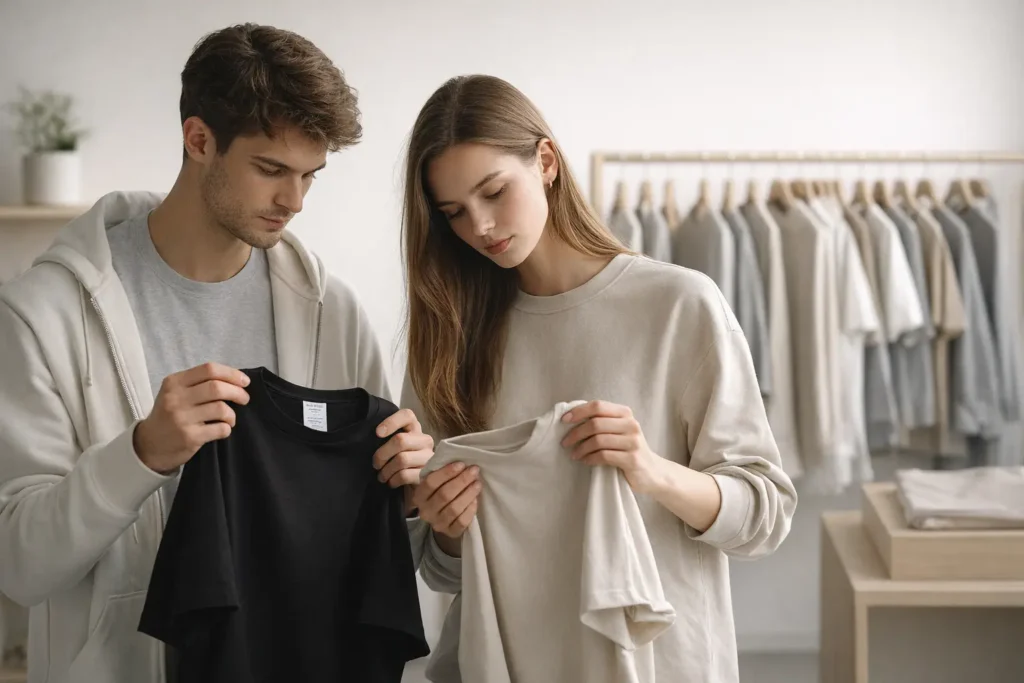
A clothing brand today is not simply a business that sells garments. It is a system that helps a customer make a faster and more confident decision. The product still matters, of course. But customers are no longer choosing only between fabric, color, and price. They are choosing between trust levels.
That is the real change.
A buyer looking at a T-shirt, hoodie, leggings, or activewear set is often asking a much more practical set of questions than many founders expect:
- Will this fit the way I think it will?
- Will it feel good after a few hours, not just in the first minute?
- Will it still look good after washing?
- Is this worth the price?
- If I reorder, will the next one feel the same?
- Can I build my own brand on top of this product and trust future production?
For that reason, a clothing brand today is judged less by how impressive it sounds and more by how clearly it reduces uncertainty.
A strong clothing brand usually performs well in five areas:
| Area | What Customers Actually Care About |
|---|---|
| Product clarity | What is this product really for? |
| Fabric and feel | Does it feel right for the price and use case? |
| Fit and comfort | Does it wear well in real life? |
| Consistency | Will the next order feel the same? |
| Trust | Does the brand seem reliable enough to buy from again? |
In simple terms, a clothing brand today is part product, part decision-making support, and part supply chain discipline.
That matters even more in categories like:
- T-shirts
- hoodies
- sweatshirts
- sweatpants
- leggings
- yoga wear
- activewear
- casual basics
- blank apparel for private label or printing
These are categories where customers often buy with repeat behavior in mind. They are not only buying for one photo or one occasion. They are buying for regular wear, everyday comfort, movement, content creation, merch programs, team use, or repeat selling. That makes consistency much more important than short-term appearance.
A new founder often assumes the market rewards variety first. In reality, the market usually rewards clarity first.
A brand does not become stronger because it launches twelve styles. It becomes stronger when the customer can quickly understand:
- who the product is for
- what problem it solves
- what feels better about it
- why the price makes sense
- whether they can trust the next order
That is why many successful clothing brands today start narrow. They focus on one product line, one fit direction, one fabric story, or one usage scenario.
For example:
| Weak Starting Point | Stronger Starting Point |
|---|---|
| We sell premium fashion basics | We make heavyweight cotton T-shirts for daily wear and repeat washing |
| We offer stylish activewear | We develop soft, supportive activewear for movement and all-day comfort |
| We produce custom apparel | We help growing brands launch small-batch tees and hoodies before scaling |
| We make streetwear | We focus on structured oversized basics with stable fit and better fabric feel |
The stronger message is easier to understand because it answers a real-world need.
What makes a clothing brand stand out?
A clothing brand stands out when it makes the customer’s decision easier and gives them a clear reason to remember it.
Many brands still try to stand out through surface-level things:
- logo size
- packaging
- trendy visuals
- vague words like premium or quality
- broad lifestyle language without product specifics
These things may help presentation, but they do not usually create long-term value on their own. Most customers, especially in basics and activewear, remember the product experience more than the branding language.
A clothing brand stands out more clearly when it does the following well:
1. It solves a real wearing problem
The strongest brands are often built around practical product frustrations.
For example:
- a T-shirt that is too thin after a few washes
- a hoodie that looks oversized online but fits awkwardly in real life
- leggings that feel supportive for 20 minutes but not for a full day
- blank apparel that prints well but feels too cheap for brand resale
- activewear that looks clean but does not hold shape after movement
When a brand solves one of these problems clearly, it becomes easier to position and easier to sell.
2. It gives the product a clear use case
Customers respond better when the product belongs to a visible situation.
Examples:
- everyday commute
- studio to street
- long-hour wear
- creator merch
- gym and casual crossover
- premium blank for printing
- repeatable casual uniform pieces
A use case gives the product context. It helps the customer picture it in life, not just on a model.
3. It is specific about product value
A brand should be able to explain its product in language that feels concrete.
Not just:
- high quality
- premium feel
- elevated basic
But things like:
- 260 GSM heavyweight cotton
- shape-holding rib collar
- brushed fleece interior
- four-way stretch
- better opacity
- softer hand feel
- stable fit for repeat orders
- embroidery-ready surface
- low-MOQ custom production
The more specific the product logic becomes, the more trustworthy the brand feels.
Here is a simple comparison:
| Generic Language | More Useful Product Language |
|---|---|
| Premium hoodie | Midweight hoodie with soft fleece interior and stable rib structure |
| Quality T-shirt | Heavyweight cotton tee with stronger neckline recovery |
| Comfortable leggings | Stretch leggings with better support and less show-through |
| Good manufacturer | Manufacturer that supports samples, small runs, repeat orders, and scaling |
Specificity builds confidence.
4. It feels consistent
A brand does not earn trust only from the first order. It earns trust when the second order still feels right.
In basics and repeatable apparel categories, customers notice small changes very quickly:
- lighter fabric weight
- different softness
- wider neckline
- shorter hoodie body
- weaker waistband hold
- changed color tone
- less accurate embroidery
- more shrinkage after wash
This is why consistency is one of the strongest ways a brand can stand out, even though it is rarely advertised loudly.
A brand that can maintain:
- stable fit
- stable fabric feel
- stable finishing
- reliable decoration quality
- more predictable lead times
usually has an advantage over a brand that changes too much from order to order.
5. It matches the customer’s stage
A good clothing brand also stands out by understanding what kind of customer it is serving.
Different customers care about different things.
| Customer Type | What Usually Matters Most |
|---|---|
| New DTC founder | Low risk, low MOQ, speed, product clarity |
| Growing apparel brand | Repeat quality, stable fit, scaling capacity |
| Influencer or creator | Small batch, fast launch, branding flexibility |
| Activewear startup | Comfort, support, fabric performance, consistency |
| Blank apparel brand | Hand feel, weight, printability, repeat orders |
The better a brand matches these needs, the easier it becomes to win trust.
Do you need a factory for a clothing brand?
No. You need product control, quality control, and supply chain control in the right places. That is very different from owning a factory.
This is where many founders lose time early. They believe factory ownership is the same as brand strength. It is not.
Owning a factory means taking responsibility for:
- rent or facility cost
- machinery purchase and maintenance
- worker recruitment and training
- line management
- raw material purchasing
- capacity planning
- compliance issues
- production scheduling
- quality management at the operating level
- equipment downtime and output efficiency
That is a completely different business layer from building demand for a clothing brand.
A brand founder usually needs to solve different problems first:
| Founder Priority | Why It Matters Early |
|---|---|
| Find the right customer | Without this, product and messaging stay weak |
| Build the right first product | The first product shapes the whole brand direction |
| Test price acceptance | A good product still needs the right price logic |
| Find a capable manufacturer | Production quality affects reputation quickly |
| Control sampling and revisions | Early product mistakes are cheaper to fix here |
| Launch with manageable inventory | Helps reduce cash pressure |
| Create repeat-buy logic | Repeat demand is what makes apparel stronger |
That is why many new and growing brands do better with outsourced manufacturing.
The founder can stay focused on:
- brand positioning
- customer research
- product decisions
- fit approvals
- fabric selection
- marketing and sales
- website conversion
- reorder planning
while the factory handles the production side.
A simple comparison helps show the difference:
| Path | Main Burden | Main Advantage | Main Risk |
|---|---|---|---|
| Own production early | High fixed cost and operational complexity | Full internal control | Heavy capital pressure before demand is proven |
| Use manufacturing partner | Supplier coordination and process management | Lower startup pressure and more flexibility | Must choose supplier carefully |
For most brands, especially in the beginning, the second path is much healthier.
This is especially true for products like:
- cotton T-shirts
- hoodies
- sweatshirts
- sweatpants
- leggings
- yoga wear
- activewear
- blank casual basics
These products do not require a founder to personally own sewing lines in order to build real brand value. What they require is:
- the right product standard
- the right development process
- the right fit approval
- the right material choice
- the right factory relationship
- the right reorder discipline
A founder should ask:
“Can I control the outcome?”
not:
“Do I own the machines?”
That is the more useful business question.
Why do many founders start a clothing brand small?
Because small beginnings often create stronger brands.
A small start is not a weak start. It is a way to protect cash, improve product decisions, and learn what the market actually wants before inventory gets too heavy.
Many founders make the same early mistake. They try to look big before they have clear proof of demand.
That often leads to:
- too many styles
- too many colors
- too many sizes with weak planning
- too much inventory sitting still
- too much money tied up too early
- too many unclear product messages
- too little room to improve the product after feedback
A smaller launch helps avoid that.
It lets the founder test the most important things first:
| What Needs Testing | Why It Matters |
|---|---|
| Fit acceptance | A good-looking product still fails if it fits poorly |
| Fabric response | Customers often buy again because of feel |
| Color demand | Not every launch color actually sells |
| Price comfort | The market tells you what feels reasonable |
| Size curve | Helps avoid repeated stock imbalance |
| Product story | Shows what customers actually respond to |
| Reorder potential | Tells you whether the item has long-term value |
For example, a brand may believe it needs six opening colors for a T-shirt launch. A smaller test may show that black, white, and washed grey carry most of the demand. Another brand may think customers care mainly about oversized shape, but real feedback may show that collar structure and fabric weight are the real reasons people reorder.
Those are expensive lessons in a large opening order. They are manageable lessons in a smaller one.
Starting small is especially useful for:
- first-time founders
- content-led brands
- creator merchandise programs
- custom blank apparel lines
- activewear startups
- low-MOQ private label projects
- brands testing one hero product before building a full line
A disciplined smaller launch often looks like this:
| Launch Element | Stronger Early Approach |
|---|---|
| Number of styles | 1 to 3 focused products |
| Colors | Limited, proven options |
| Quantity | Small batch or controlled MOQ |
| Development | Sample-first, then test run |
| Messaging | One clear product promise |
| Reorders | Based on actual response, not guesswork |
This is not only about lowering risk. It is also about increasing clarity.
A small launch forces the founder to answer hard questions:
- What is the actual hero product?
- Why should someone buy this instead of another option?
- What makes this product worth repeating?
- Which part of the product matters most: softness, weight, support, printability, fit, or shape retention?
- Which factory setup gives me room to test and then grow?
Those are the questions that help turn a clothing idea into a real clothing brand.
Small beginnings also work better when the manufacturing partner can support different stages of growth inside one system.
That means the founder may be able to start with:
- sample development
- very low quantity testing on selected products
- small production runs
- repeat orders after feedback
- larger bulk production later
That kind of path is far more useful than a factory that only wants large opening orders from day one.
In the end, many founders start small for one simple reason: it gives them room to be right later.
A brand that starts with clear product thinking, controlled production, and real customer feedback often becomes much stronger than a brand that starts with too much stock and too little signal.
How Do You Start a Clothing Brand?
Starting a clothing brand looks simple from the outside. Pick a name. Design a logo. Make some samples. Build a website. Start posting. But that is not how most strong brands are actually built.
A clothing brand usually becomes real in a different order.
It starts with a clear customer.
Then a clear product.
Then a clear reason that product deserves to exist.
Then a production path that fits the brand’s current stage.
That order matters.
Many founders do the opposite. They begin with the visual layer first. They spend weeks on the brand name, the packaging mood, the website layout, and social media direction before they have answered the most important business questions:
- Who is this product really for?
- What problem does it solve better than other options?
- Why would someone pay this price?
- Which product should launch first?
- How small can the first order be without making the business look weak?
- Can the manufacturer support both testing and later growth?
- If the first product works, what gets reordered next?
Those questions shape the future of the brand much more than the logo does.
A useful way to understand the startup process is to look at it in five parts:
| Startup Layer | Main Question | Why It Matters |
|---|---|---|
| Customer | Who are you serving? | Without this, product and messaging become vague |
| Product | What should launch first? | The first product becomes the brand’s first proof |
| Positioning | Why should people care? | This affects pricing, content, and conversion |
| Production | How will you make it? | This affects risk, quality, and speed |
| Testing | What does the market actually want? | This helps avoid expensive wrong decisions |
A founder does not need everything perfect before launch. But these five parts need to be clear enough to support a smart first move.
For most new brands, especially in categories like T-shirts, hoodies, sweatshirts, sweatpants, leggings, yoga wear, activewear, and blank casual basics, the best start is usually narrower than expected.
A focused brand launch often looks more like this:
- 1 hero product
- 2 to 4 colors
- 1 clear customer segment
- 1 clear use case
- controlled sample development
- small-batch production
- simple reorder plan
That kind of setup is easier to manage, easier to explain, and easier to improve.
How do you define your clothing brand idea?
A clothing brand idea becomes strong when it is based on a real customer need, not only on personal taste.
A lot of founders begin with what they like wearing. That is normal. But personal preference alone is not enough. A brand idea needs to connect to a practical gap in the market.
That gap may come from:
- poor fit in existing products
- weak fabric quality at a given price point
- basics that lose shape too quickly
- activewear that looks good but lacks comfort
- blank apparel that is easy to print but not strong enough to resell
- custom manufacturing options that force high MOQ too early
- trendy products with low repeat-buy value
The strongest brand ideas usually sit where three things meet:
| Brand Idea Layer | What to Define Clearly |
|---|---|
| Customer | Who is this product for? |
| Use Case | When and where do they wear it? |
| Product Value | What feels better, works better, or lasts better? |
A founder should try to answer these questions in plain language.
Customer
Be specific.
Not:
- everyone
- fashion lovers
- people who like quality
Better:
- men who want heavyweight everyday tees that hold shape
- women looking for soft, supportive leggings for low-impact workouts and daily wear
- creators building merch lines that need better blanks in small batches
- growing DTC brands that want custom hoodies without placing oversized opening orders
Use Case
A product becomes easier to sell when its use case is visible.
Examples:
- long workday casual wear
- creator merch
- gym-to-street use
- studio wear
- light outdoor layering
- everyday city basics
- repeatable blank essentials for printing
- comfort-first travel wear
Product Value
This is where a lot of brands stay too vague.
Instead of saying:
- premium basic
- quality fabric
- elevated essential
Say what the product actually offers:
- 260 GSM heavyweight cotton
- compact-knit jersey with stronger shape retention
- brushed fleece interior
- cleaner oversized fit
- less show-through in leggings
- better four-way stretch recovery
- softer hand feel after wash
- embroidery-friendly hoodie surface
- low-MOQ custom production for first launch
A founder should also check whether the idea is easy to remember.
Here is a useful comparison:
| Weak Idea | Stronger Idea |
|---|---|
| We make modern basics | We make heavyweight cotton basics built for daily wear and repeat washing |
| We sell activewear | We develop soft, supportive activewear for movement and all-day comfort |
| We do custom apparel | We help new brands launch custom tees and hoodies in smaller runs before scaling |
| We make blank products | We offer better-feel blank tees and hoodies for brands that need resale-ready quality |
The second column is easier to understand because it tells the customer what the brand is trying to solve.
A practical exercise is to write down the answers to these questions:
- What does my target customer wear now?
- What do they dislike about current options?
- What would make them switch?
- What would make them reorder?
- What product detail would they notice first: softness, weight, fit, support, drape, print quality, or shape retention?
- What price point feels realistic to them?
- What would make them trust a newer brand?
This work may feel slower than jumping into design, but it saves a lot of wasted time later.
What products should a clothing brand launch first?

A clothing brand should usually launch with the product that is easiest to explain, easiest to produce well, and most likely to create repeat demand.
That is the practical answer.
The first product does not need to show everything the brand may become in the future. It needs to prove that the brand can make one product people actually want.
This is where many founders get stuck. They want the first launch to feel complete, so they add too many categories too early:
- T-shirts
- hoodies
- sweatshirts
- shorts
- sweatpants
- hats
- outerwear
- accessories
The result often looks busy, but it is harder to sell clearly.
A better first launch product usually has these traits:
| Product Trait | Why It Matters |
|---|---|
| Easy to understand | Customers know quickly why it exists |
| Real repeat potential | Helps the brand build revenue beyond one purchase |
| Production-friendly | Easier to get right with fewer revisions |
| Strong fit with brand story | Supports content and website clarity |
| Room for future expansion | Can lead into related products later |
For many apparel startups, strong opening products include:
- heavyweight T-shirt
- everyday hoodie
- clean sweatshirt
- leggings
- yoga set
- blank tee or hoodie line
- activewear set with one clear function
Why these categories work well:
T-shirt
A T-shirt is one of the best first products because the market understands it immediately. It is also one of the best products for testing:
- fit preference
- color demand
- fabric reaction
- neckline structure
- print appeal
- repeat-buy behavior
A founder can learn a lot from one good tee.
Hoodie
A hoodie often gives a brand stronger visual presence and higher perceived value. It also creates good space for branding details like:
- embroidery
- screen print
- woven labels
- inside labels
- packaging upgrades
It is often a good choice for creator brands, street-influenced basics, and casualwear brands.
Leggings or Activewear Set
These can work well when the brand’s core value depends on comfort, support, and movement. They require more care in development, but when done well, they can build very strong repeat demand.
Customers in this category often care about:
- opacity
- support
- waistband stability
- stretch recovery
- softness
- shape retention
Blank Tee or Hoodie Program
This works especially well for founders serving a B2B or creator market. The value often comes from:
- better hand feel
- better printability
- stable fit
- small-batch production
- easier reordering
A useful first-launch structure often looks like this:
| Launch Element | Better Starting Range |
|---|---|
| Number of hero products | 1 to 2 |
| Number of colors per product | 2 to 4 |
| Size range | Focused but realistic |
| Initial MOQ | Small-batch or controlled run |
| Sample rounds | Enough to lock quality, but not endless |
| Brand message | One clear promise |
For example, a cleaner first launch could be:
- 1 heavyweight cotton T-shirt
- 3 colors
- 1 consistent fit
- 1 clear message around daily wear and shape retention
- 1 manufacturer who can support reorders
That is far easier to manage than 8 styles with mixed positioning.
A founder should also think about reorder logic before choosing the first product.
Ask:
- If this product works, is it easy to reorder?
- Is the fabric stable enough?
- Can the same fit be repeated?
- Will customers buy again?
- Does the product still make sense six months from now?
Those questions help keep the first launch tied to long-term value, not just launch excitement.
How can a clothing brand start with less risk?
A clothing brand starts with less risk when it reduces uncertainty before increasing inventory.
That is the real goal.
Risk in apparel usually comes from one or more of these problems:
- ordering too many units before testing demand
- launching too many styles at once
- choosing an unclear customer segment
- using a manufacturer that cannot support revisions well
- approving samples too quickly
- guessing size ratios
- building too much around trend demand instead of repeat demand
- tying too much cash into stock that has not been validated
A lower-risk launch does not mean launching in a weak way. It means building in steps.
A practical low-risk path often looks like this:
| Stage | Main Goal | What to Confirm |
|---|---|---|
| Brand concept | Clarify customer and product logic | Who, what, why |
| Sample stage | Confirm the product is physically right | Fit, fabric, finish, comfort |
| Small production run | Confirm market response | Sales, feedback, return reasons |
| Repeat order stage | Confirm product strength | Reorders, consistency, margin |
| Scale stage | Increase with more confidence | Volume, color depth, adjacent products |
This structure protects both cash and learning quality.
Some of the best ways to lower startup risk include the following.
Start with fewer SKUs
Every added SKU increases complexity.
That includes:
- more forecasting
- more size distribution decisions
- more possible slow sellers
- more product-page work
- more production chances for error
- more stock that may not move
A tighter SKU count often leads to better focus.
| Launch Style | Risk Level |
|---|---|
| 10 products in multiple colors | High |
| 3 products with moderate color count | Medium |
| 1 hero product with focused variants | Lower |
Use sampling properly
A sample is cheaper than a wrong bulk order.
A founder should use the sample stage to test:
- fit
- hand feel
- fabric weight
- neckline or waistband behavior
- print or embroidery results
- wash performance
- comfort after real wear
- whether the product matches the intended price point
If a founder is not fully convinced by the sample, bulk should wait.
Choose a manufacturer that fits the brand stage
A manufacturer that only wants large-volume business can make early testing harder.
A more useful partner for many startups is one that can support:
- sample development
- low MOQ or controlled opening runs
- small-batch repeat orders
- later bulk scaling
This matters because a brand’s needs change quickly between the first sample and the third reorder.
A factory that can support multiple stages is often far more valuable than a factory that only looks good on the first quote sheet.
Control opening inventory
The goal of the first launch is usually not maximum volume. It is maximum clarity.
A founder needs to learn:
- which sizes sell fastest
- which colors convert
- what customers mention in reviews
- whether price resistance is high or low
- which content angle works best
- whether the product creates repeat behavior
Those answers make the second order much stronger.
Build around a reorder path
A strong first launch should not end with the launch itself.
The founder should already think about:
- what happens if this product sells well
- how quickly it can be sampled again
- how long the production cycle is
- whether the factory can repeat it consistently
- what quantity level becomes realistic next
- how cash flow will support the next run
That is why products with stronger repeat logic often create lower risk over time than novelty-heavy launches.
A simple comparison shows the difference:
| Higher-Risk Start | Lower-Risk Start |
|---|---|
| Large opening inventory | Smaller controlled batch |
| Many untested styles | One clear hero product |
| Supplier chosen mainly by low price | Supplier chosen by fit, quality, and scalability |
| Broad unclear branding | Product-first message |
| No reorder system | Planned follow-up production path |
A founder should also separate two kinds of risk:
| Risk Type | What It Means |
|---|---|
| Financial risk | Too much money tied into stock, samples, or development |
| Decision risk | Making product choices before enough real feedback exists |
The best startup process reduces both.
What should a founder prepare before contacting a manufacturer?
A manufacturer can only work clearly when the founder brings enough structure to the conversation.
Many early-stage founders contact factories too soon with only a rough idea:
- “I want to make a premium hoodie”
- “I need custom activewear”
- “Can you make oversized T-shirts?”
Those questions are a starting point, but not enough for useful development.
Before contacting a manufacturer, a founder should prepare as much of the following as possible:
| Item | Why It Helps |
|---|---|
| Product category | Keeps the discussion focused |
| Reference photos or samples | Shows intended direction clearly |
| Target customer | Helps shape fit and quality choices |
| Fabric preference | Guides sourcing and pricing |
| Estimated GSM or weight | Useful for tees, hoodies, sweatshirts |
| Decoration method | Print, embroidery, heat transfer, or blank |
| Size range | Affects development and MOQ planning |
| Color plan | Helps estimate production setup |
| Target order quantity | Helps the factory suggest the right path |
| Target price level | Keeps development realistic |
| Delivery timing | Important for launch planning |
A very simple factory brief can already improve the process a lot.
For example:
- Product: oversized heavyweight T-shirt
- Customer: men 20 to 35, daily casual wear
- Fabric: 100% cotton, target 240 to 260 GSM
- Fit: relaxed body, drop shoulder, clean neckline
- Branding: woven neck label and chest print
- Colors: black, white, washed grey
- Opening quantity: small-batch test run
- Goal: validate hero product, then repeat order if it performs well
That is much easier for a factory to respond to than a vague request for “premium custom streetwear.”
A founder does not need perfect technical language to get started. But the more specific the product brief becomes, the easier it is to get useful pricing, realistic sampling, and better production advice.
How should a founder think about timeline, budget, and first-order planning?
A clothing brand launch becomes much healthier when the founder thinks in phases instead of one big event.
A simple working structure is:
| Phase | Focus |
|---|---|
| Phase 1 | Product definition |
| Phase 2 | Sample development |
| Phase 3 | Small test order |
| Phase 4 | Market feedback |
| Phase 5 | Repeat order or product revision |
This helps avoid a common mistake: spending too much money upfront before the product has earned it.
A founder should budget for more than the bulk order itself.
Real startup costs often include:
- sample fees
- fabric and trim changes
- logo files or print setup
- labeling and packaging
- shipping
- photography
- website setup
- paid content or launch marketing
- possible sample revisions
- possible quality adjustments before repeat orders
That is why a smaller first order is often healthier. It leaves room for correction.
A practical first-order mindset is usually:
- enough units to test properly
- not so many units that slow-selling sizes create heavy dead stock
- enough time for sampling and approval
- enough budget left for launch and follow-up
For example, a founder who uses all available budget on inventory often creates pressure immediately. A founder who keeps room for sample improvements, content creation, and a fast second order usually has more flexibility.
That is especially important for brands using manufacturers that can support:
- 3 to 5 day sample development
- 5 to 10 day small-batch production
- selected low-quantity programs
- future growth into larger runs
That kind of production structure makes phased launching much easier.
In the end, starting a clothing brand well is not about doing everything at once.
It is about making the first few decisions in the right order:
- define the customer
- define the hero product
- define the product value clearly
- sample with discipline
- launch in a controlled way
- learn from real demand
- reorder with more confidence
That is how a clothing brand starts with a better chance of becoming something stable, profitable, and worth growing.
Which Model Fits a Clothing Brand Best?
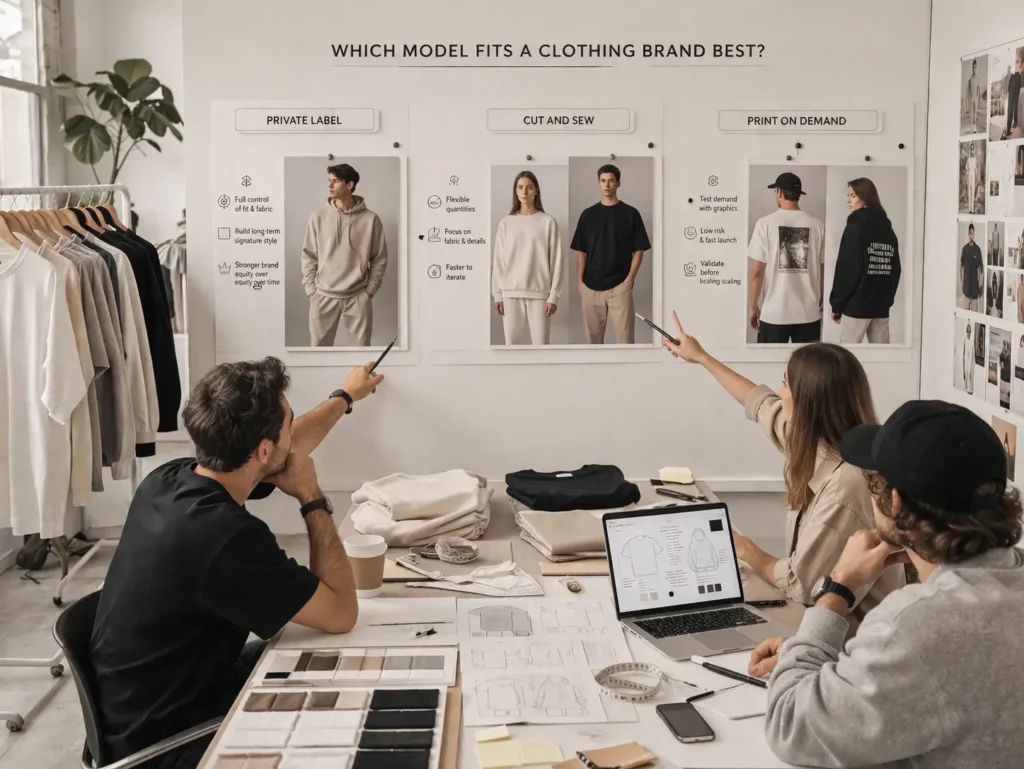
The best model for a clothing brand depends on one simple question: what exactly is the brand trying to control at this stage?
Some founders need speed. Some need lower risk. Some need a product that feels unique in the hand, not just different in photos. Some need to test the market before making a bigger commitment. Some already know their customer well and want to invest in a stronger product foundation from the beginning.
That is why there is no one perfect model for every clothing brand.
A brand selling printed tees to an existing audience does not need the same setup as a brand building premium basics around fabric weight and fit. A creator launching a small merch line has different needs from a startup building leggings or yoga wear meant for long-term repeat sales. A blank hoodie program for resale has different priorities from a fashion brand developing its own pattern and silhouette.
In practice, most new clothing brands usually begin with one of these three paths:
- private label
- cut and sew
- print on demand
Some brands stay with one model for years. Others move from one model to another as the business becomes clearer.
For example:
- A founder may start with print on demand to test graphic demand, then move top-selling items into private label.
- A basics brand may begin with private label to launch faster, then gradually move into cut and sew once it knows which fit and fabric details matter most.
- An activewear brand may go directly into cut and sew because support, stretch, and shape are too important to leave generic.
The key is not choosing the most impressive model. The key is choosing the model that matches the brand’s real situation.
A simple side-by-side view helps make the differences clearer:
| Model | Best For | Product Control | Startup Cost | Speed to Launch | MOQ Pressure | Long-Term Differentiation |
|---|---|---|---|---|---|---|
| Print on Demand | Design testing, creator merch, audience validation | Low | Low | Very fast | Very low | Low |
| Private Label | Fast launch with moderate customization | Medium | Low to medium | Fast | Low to medium | Medium |
| Cut and Sew | Fit-led, fabric-led, long-term product identity | High | Medium to high | Slower | Medium to high | High |
A founder should also think about the hidden questions behind the production model:
- Do I need to launch quickly or build deeply?
- Is the garment itself the brand’s main value?
- Can I afford to spend more time on development?
- Do I need low opening risk?
- Will customers reorder because of product feel and fit, or mainly because of design and branding?
- Do I expect this first product to become a long-term core item?
Those questions matter much more than trend-driven advice.
Is private label right for a clothing brand?
Private label is often the most practical starting point for a new clothing brand because it gives the founder enough control to build a real product story, but not so much complexity that development becomes heavy and slow from day one.
In simple terms, private label means the factory already has a workable product base or development structure, and the brand customizes it under its own name. The level of customization can vary, but it often includes things like:
- custom neck labels
- wash labels
- hang tags
- print placement
- embroidery
- fabric weight selection
- color selection
- packaging
- fit adjustments in some cases
- brand-specific finishing details
This works well for founders who want something more brand-owned than off-the-shelf blank goods, but do not yet need full pattern-level development.
Private label is especially useful for:
- startup DTC brands
- influencer or creator brands
- small-batch hoodie and tee lines
- blank apparel programs
- growing brands testing first product categories
- brands that want to move fast with moderate risk
- brands that want custom identity without building everything from zero
A founder choosing private label usually cares about a few very practical things:
| Real Need | Why Private Label Can Work |
|---|---|
| Faster sample-to-launch path | Existing development base saves time |
| Lower opening risk | Often easier to start with smaller batches |
| Better customization than generic wholesale | Helps the product feel more brand-owned |
| Easier communication for first-time founders | Fewer moving parts than full custom development |
| Better chance of quick reorder setup | Useful for brands testing repeat demand |
For example, a new brand might want to launch a heavyweight cotton T-shirt line. With private label, the founder may not need to invent every part of the garment from zero. Instead, they can work from a stable T-shirt base and improve the parts that matter most to the brand:
- choose 100% cotton
- set a target weight such as 240 to 260 GSM
- select a more structured neckline
- refine body width and length slightly
- add a woven neck label
- decide on embroidery or print
- choose packaging that fits the brand tone
That is enough to make the product feel more considered and more resale-ready without forcing a full custom development cycle.
Private label also makes financial planning easier for many new brands. The founder can often use the first product to answer important market questions:
- Which colors actually sell?
- Does the customer respond more to softness or weight?
- Is the chosen fit accepted?
- Do people reorder?
- Is the product price aligned with the feel of the garment?
- Is the product strong enough to carry the brand story?
These are very valuable things to learn before moving into deeper customization.
That said, private label also has clear limits.
If the factory base product is too generic, or if the brand adds only surface-level branding, then the product may not feel truly memorable. Customers may see it as similar to many other options. That becomes risky in a crowded market, especially when the brand is competing mainly on visual presentation instead of product experience.
Private label is strongest when the founder adds real product judgment.
That usually means being careful about:
- fabric hand feel
- weight
- fit balance
- color selection
- print or embroidery quality
- label and trim details
- consistency between runs
A useful comparison looks like this:
| Weak Private Label Use | Stronger Private Label Use |
|---|---|
| Add logo to a common blank | Improve fabric, fit, labels, and finish |
| Launch many products too early | Build one strong hero product first |
| Use vague “premium” positioning | Explain actual product value clearly |
| Choose lowest-cost option only | Choose stable product foundation |
| Treat first run as final | Treat first run as testing and refinement |
For many brands, private label is not the end point. It is the smart first stage. It creates a lower-friction path to launch, gather feedback, build customer trust, and then decide whether deeper custom development is worth the investment.
Is cut and sew better for a clothing brand?
Cut and sew is often the better model when the garment itself carries most of the brand’s value.
This is the path founders usually choose when they do not want to rely too heavily on pre-existing product blocks, and when they believe that the customer will notice and value more specific product differences.
Those differences may include:
- a more distinctive silhouette
- custom body proportions
- better drape
- specific shoulder shape
- better neckline construction
- a cleaner oversized fit
- stronger hoodie hood structure
- more supportive activewear patterning
- better seam placement
- fabric chosen for a very specific feel or use case
In cut and sew, the founder usually has much more control over the full garment. That can include:
| Product Area | Possible Cut and Sew Control |
|---|---|
| Pattern | Body width, length, shoulder, sleeve, rise, inseam |
| Fabric | Composition, weight, stretch, hand feel |
| Construction | Stitching type, seam method, panel build |
| Trim details | Rib, drawcord, zipper, labels |
| Finishing | Wash, feel, shape, shrinkage behavior |
| Product identity | Stronger overall uniqueness |
This matters a lot in categories where subtle details affect the customer’s experience every time they wear the product.
For example, in a premium T-shirt brand, customers may notice:
- how the collar sits after washing
- whether the body twists
- whether the shoulder line feels balanced
- whether the fabric hangs cleanly
- whether the tee keeps structure through repeated wear
In a hoodie brand, customers may care about:
- hood shape
- rib recovery
- body proportion
- brushed interior feel
- warmth versus weight balance
- embroidery stability on heavier fabric
In leggings or activewear, the differences can be even more important:
- support level
- opacity
- waistband hold
- four-way stretch behavior
- recovery after movement
- seam comfort
- shape retention after repeated wear
These are not small details. In repeat-driven categories, they are often the real reason a customer comes back.
That is why cut and sew is often the right choice for:
- premium basics brands
- activewear startups
- yoga wear brands
- fit-led casualwear brands
- fashion brands with original silhouettes
- higher-end private label transitions
- brands that want long-term product ownership without factory ownership
But cut and sew also requires more discipline.
A founder moving into this model should be ready for:
- more sample rounds
- more detailed communication
- clearer reference materials
- stronger measurement control
- longer development time
- more decisions around fabric and trims
- more pressure on manufacturer capability
A helpful comparison is this:
| Area | Private Label | Cut and Sew |
|---|---|---|
| Development speed | Faster | Slower |
| Complexity | Lower | Higher |
| Product uniqueness | Moderate | High |
| Fit control | Moderate | High |
| Fabric control | Moderate | High |
| Startup risk | Lower | Higher |
| Long-term brand moat | Moderate | Stronger |
This does not mean cut and sew is only for large brands. It means the founder should use it when the product truly needs it.
A simple test helps:
If the product would lose much of its value without custom fit, fabric, or construction, then cut and sew may be the right path.
For example:
- If your brand promise is “clean everyday basics,” private label may be enough at first.
- If your brand promise is “heavyweight tees with a specific boxy silhouette and stronger neckline recovery,” cut and sew becomes more valuable.
- If your brand promise is “activewear that supports movement without sacrificing comfort,” cut and sew is often the better route from the start.
Another thing founders should think about is development cost versus repeat value.
Cut and sew usually costs more to build, but that cost can be justified if:
- the product becomes a long-term hero item
- reorder rates are strong
- customers clearly feel the difference
- the product carries better pricing power
- the fit becomes part of the brand identity
In that case, the extra development work is not wasted. It becomes part of the brand’s long-term value.
Can print on demand help a clothing brand start?
Print on demand can be a useful starting model, but only when the founder is clear about what it is good for and what it is not good for.
It is good for speed, low opening risk, and testing design demand.
It is weaker when the long-term brand depends on the garment itself.
This distinction matters a lot.
Print on demand works best when the founder’s first question is something like:
- Will this audience buy my designs?
- Which graphic direction gets attention?
- Do people want my message on a T-shirt or hoodie?
- Is there enough interest to justify a deeper product line later?
That makes print on demand especially useful for:
- creators
- artists
- online communities
- streamer merch
- slogan-led products
- niche internet brands
- brands testing early demand without inventory
The practical advantages are easy to see:
| Advantage | Why It Helps |
|---|---|
| No large opening inventory | Reduces financial pressure |
| Fast store setup | Makes it easier to test quickly |
| Low order risk | Good for uncertain demand |
| Easy design rotation | Useful for testing multiple directions |
| Simple fulfillment setup | Helpful for very small teams |
That is why many founders are drawn to it.
But the limits are just as important.
Print on demand usually gives the founder less control over:
- garment base quality
- fabric weight options
- long-term fit stability
- premium finishing
- exact hand feel
- custom trims
- true pattern control
- deeper product identity
This becomes a problem when the brand wants to compete through product experience rather than design alone.
For example, a founder building a premium basics brand cannot rely on graphic design alone. The customer needs to feel that the tee is better, the hoodie feels more substantial, or the garment fits more cleanly. Print on demand usually cannot deliver enough control in those areas.
A realistic comparison looks like this:
| Good Use for Print on Demand | Weak Use for Print on Demand |
|---|---|
| Testing graphic demand | Building a fabric-led basics brand |
| Creator merch launch | Developing a signature fit |
| Slogan and niche design validation | Long-term premium activewear |
| Early audience learning | Strong repeat-buy quality control |
| Low-budget first test | Product categories where feel matters most |
That is why many brands use print on demand as a starting experiment, not a permanent product strategy.
A healthy transition often looks like this:
| Stage | Better Role for Print on Demand |
|---|---|
| Early stage | Test audience and design traction |
| After early sales | Identify strongest products or categories |
| Next step | Move strong performers into private label or custom production |
| Growth stage | Improve quality, margin, and product identity |
This path works well because it separates two important questions:
- Do people care about this idea?
- Do they care enough for me to build a better product around it?
Print on demand can help answer the first question. It usually does not fully solve the second one.
How should a clothing brand choose between these models?
The best choice usually comes from matching the model to the brand’s actual needs, not from chasing whatever sounds most professional.
A founder should look at the business from several angles at once:
1. Product value
Ask what customers are really paying for.
| If Customers Care Most About… | Model That Often Fits Better |
|---|---|
| Graphic or message | Print on demand |
| Fast launch with moderate customization | Private label |
| Fit, fabric, and garment feel | Cut and sew |
2. Risk tolerance
Ask how much uncertainty still exists.
| Business Situation | Model That Often Fits Better |
|---|---|
| Demand still unclear | Print on demand or lean private label |
| Product concept is fairly clear | Private label |
| Customer and product logic already strong | Cut and sew |
3. Capital level
Ask how much room there is for development and inventory.
| Budget Situation | Better Direction |
|---|---|
| Very limited | Print on demand |
| Limited but workable | Private label |
| Can support sample development and refinement | Cut and sew |
4. Product category
Some categories naturally fit some models better.
| Category | Often Better Fit |
|---|---|
| Graphic tees and merch | Print on demand or private label |
| Blank tees and hoodies | Private label or cut and sew |
| Premium basics | Private label first, then cut and sew |
| Leggings and activewear | Often cut and sew |
| Yoga sets | Often cut and sew |
| Simple casual basics | Private label or cut and sew depending on differentiation needs |
5. Brand timeline
Ask whether the founder needs quick market entry or deeper product ownership.
| Priority | Better Fit |
|---|---|
| Launch in the shortest time | Print on demand or private label |
| Build stronger product foundation | Private label or cut and sew |
| Build long-term signature product | Cut and sew |
A founder can also use this simple decision guide:
| Situation | Often the Best Starting Direction |
|---|---|
| I need to test whether people even want this concept | Print on demand |
| I want to launch a real product quickly without overcomplicating development | Private label |
| I want my fit, fabric, and garment details to define the brand | Cut and sew |
| I want to start small and improve over time | Private label |
| I already know the product details matter deeply to my customer | Cut and sew |
One more thing matters here: the factory relationship behind the model.
A model is only as strong as the manufacturer supporting it.
For example, a private label program becomes much more useful when the manufacturer can also support:
- sample development
- fit refinements
- small-batch production
- repeat orders
- later scaling
A cut and sew model becomes much more realistic when the manufacturer has:
- pattern support
- sample room capability
- stable knitwear or activewear experience
- decoration options
- quality control discipline
- enough production capacity to grow with the brand
This is where a flexible manufacturer becomes valuable.
For a founder building T-shirts, hoodies, sweatshirts, sweatpants, leggings, yoga wear, activewear, or blank basics, a factory setup that supports both early testing and later scale is often more useful than a factory that only fits one stage.
For example, a manufacturing partner that can support:
- sample turnaround in about 3 to 5 days
- small-batch production in about 5 to 10 days
- selected runs from 1 to 20 pieces for testing
- 100% cotton T-shirt development
- knit basics and activewear categories
- later growth into larger-volume production
- monthly capacity around 100,000 pieces with additional expansion room
gives the founder more flexibility when choosing a model.
That means the founder does not have to treat the production model as a permanent identity right away. The brand can start in the most practical place, test what matters, and then deepen the product over time.
In the end, the best model for a clothing brand is the one that helps the founder do three things well:
- launch without unnecessary risk
- build a product customers actually want again
- create a path from first order to repeat growth
That is the model worth choosing.
How Do You Find a Clothing Brand Manufacturer?
Finding a clothing brand manufacturer is one of the most important decisions in the whole business. It affects product quality, launch speed, sample accuracy, pricing, restock stability, customer satisfaction, and how easily the brand can grow later.
A lot of founders make the mistake of treating this as a price comparison task. They collect a few quotes, compare numbers, and choose the lowest offer. That may feel efficient at first, but it often creates expensive problems later.
A factory quote only tells you part of the story.
It does not tell you clearly:
- how seriously the factory handles small brands
- how strong the sample team is
- how stable the fit will be in repeat orders
- how carefully fabric is checked before production
- how much support you will get when revisions are needed
- how well the factory handles custom details like print, embroidery, labels, or packaging
- whether the same product can be repeated without major drift
That is why choosing a manufacturer should be treated as both a product decision and a growth decision.
The right manufacturer helps the brand move through several stages more smoothly:
| Brand Stage | What the Manufacturer Needs to Support |
|---|---|
| Early idea stage | Clear communication, realistic guidance |
| Sample stage | Fast development, revision handling, pattern support |
| First order stage | Manageable MOQ, stable production, decent lead time |
| Repeat order stage | Consistency in fit, fabric, and finishing |
| Growth stage | Capacity, process control, better planning support |
A founder is not just looking for someone who can sew garments. A founder is looking for a manufacturing partner that can help turn product ideas into products customers trust.
This matters even more in categories where repeat purchase depends heavily on consistency, such as:
- T-shirts
- hoodies
- sweatshirts
- sweatpants
- leggings
- yoga wear
- activewear
- blank apparel
- casual knit basics
In these categories, a product that changes too much between orders becomes difficult to scale. Customers may not use technical language, but they notice quickly when something feels different.
They notice:
- lighter fabric
- looser neckline
- shorter hoodie body
- weaker waistband
- rougher hand feel
- changed drape
- embroidery that looks less clean
- more shrinkage after wash
That is why manufacturer choice should be based on long-term product stability, not just opening-order convenience.
A useful way to evaluate a manufacturer is to compare the real needs of a growing brand:
| What the Brand Needs | What to Check in a Manufacturer |
|---|---|
| Strong first sample | Sample room, pattern team, revision process |
| Lower opening risk | Small-batch flexibility, realistic MOQ |
| Product consistency | Standardized production process, QC habits |
| Better branding details | Print, embroidery, labels, trims, packaging |
| Faster learning | Clear communication and good feedback response |
| Growth support | Capacity, production lines, repeat-order handling |
| International delivery | Shipping options, coordination, fulfillment support |
Many founders also need to understand that “good manufacturer” does not always mean “largest factory.”
A very large factory may have excellent capacity but poor attention to smaller brands.
A very small workshop may give early flexibility but struggle with:
- repeat consistency
- stable lead times
- quality control systems
- later scale
- fabric sourcing strength
- multi-style order handling
The best choice is often a factory with enough structure to be reliable, but enough flexibility to work well with growing brands.
What should a clothing brand ask a factory?
The first factory conversation should answer much more than “Can you make this?” It should help the founder understand how the factory works, what kind of customer it serves best, and whether it can support both the present order and the next stage of growth.
A good factory conversation usually needs five layers of clarity:
- product fit
- sample process
- MOQ and pricing structure
- quality control
- production and delivery support
Product fit
Not every factory is good at every product category.
A manufacturer may be strong in woven fashion pieces but average in knit basics. Another may be good at activewear but weak in heavyweight cotton tees. Another may handle blank hoodies well but not offer much help in fit refinement.
That is why the founder should ask specific category questions.
For example:
- Do you regularly make 100% cotton T-shirts?
- Are you experienced with heavyweight knit basics?
- Do you produce hoodies and sweatshirts at scale?
- Can you handle leggings or yoga wear with stretch fabrics?
- Do you support small-batch blank apparel lines?
- Have you worked with early-stage brands before?
- What types of products are your strongest categories?
A useful comparison looks like this:
| Factory Response Type | What It Usually Means |
|---|---|
| Very general answers | Possible lack of category depth |
| Clear examples by product type | Better sign of real experience |
| Can explain fabric and fit issues | Stronger technical understanding |
| Understands both small runs and repeat orders | Better fit for growing brands |
The more concrete the factory sounds, the easier it is to trust that it has real experience in the product area.
Sample process
Sampling is one of the clearest ways to judge a manufacturer.
A factory with a weak sample process usually causes bigger problems in bulk later.
The founder should ask:
- How long does sampling usually take?
- How many sample revisions are common?
- Do you have in-house pattern makers?
- Do you have a dedicated sample room?
- Can you work from reference garments, drawings, or tech packs?
- What details do you need before starting a sample?
- How do you handle sample comments and updates?
These questions matter because sample development is where the brand begins to see how the factory thinks.
A stronger factory usually has a clearer internal setup. For example:
| Sample Capability | Why It Matters |
|---|---|
| Pattern makers | Helps shape fit more accurately |
| Sample sewers | Improves development speed and control |
| Dedicated sample room | Better focus on early product quality |
| Comment-and-revision process | Makes improvements easier to manage |
| Fast sampling turnaround | Helps the brand move faster without guessing |
For a growing clothing brand, practical sample timing matters a lot. If a factory can support sample turnaround in around 3 to 5 days for certain products, that gives the founder a very different pace of learning than a factory that takes weeks for every sample revision.
That faster cycle is especially useful when the founder is testing:
- neckline shape
- sleeve balance
- hoodie fit
- fabric feel
- logo placement
- embroidery size
- legging support and comfort
- wash behavior
MOQ and pricing structure
Many founders ask only for MOQ. They should ask how MOQ actually works inside the order structure.
Important questions include:
- What is the MOQ per style?
- What is the MOQ per color?
- Can sizes be mixed freely?
- Can small test orders be done first?
- Are selected products available in lower quantities?
- How does pricing change by order size?
- Does custom labeling or embroidery raise MOQ?
- Can repeat orders be placed in smaller batches after the first run?
This is important because MOQ alone does not reveal the real order burden.
For example, a “300-piece MOQ” can mean very different things:
| MOQ Situation | What It May Really Mean |
|---|---|
| 300 pieces total, mixed sizes, one color | More manageable |
| 300 pieces per color | Higher opening risk |
| 300 pieces per size spread across several colors | Much higher complexity |
| 100 pieces possible on selected items | Easier testing path |
A founder should also think about MOQ in relation to startup cash flow.
If the brand launches with too many units before understanding:
- best-selling color
- best-selling size range
- real price acceptance
- repeat-buy strength
- return reasons
then the opening order may tie up too much money too early.
That is why factories that support smaller early orders can be much more useful for growing brands.
For example, if selected products can be tested in very low quantities such as 1 to 20 pieces, that gives a founder room to check product response much earlier. If the same factory can also support small production runs in 5 to 10 days and later scale into larger orders, that becomes a much more practical growth path.
Quality control

Quality control should never be treated like one final inspection step. A founder needs to understand how the factory protects the product before, during, and after production.
Good questions include:
- How is fabric checked before cutting?
- How do you control shrinkage risk?
- How are measurements monitored during production?
- Do you use a pre-production sample before bulk?
- How do you check print quality?
- How do you check embroidery accuracy?
- How do you prevent color inconsistency?
- What is your process if bulk differs from the approved sample?
- How do you handle repeat orders for the same product?
A factory that has real process control can usually explain its steps clearly.
A simple quality-control structure should cover:
| Production Stage | What Needs Checking |
|---|---|
| Before sample | Product brief, measurements, material direction |
| During sample | Fit, hand feel, construction, logo details |
| Before bulk | Approved sample, fabric, trims, tolerances |
| During bulk | Cutting, stitching, decoration, consistency |
| Before shipment | Measurement spot-check, finishing, packaging, quantity |
The founder should also understand what “quality” means for the specific product.
For example, in a T-shirt, quality may include:
- fabric weight accuracy
- clean neckline shape
- shoulder balance
- shape retention after wash
- print clarity
- low twisting
- smooth hand feel
In a hoodie, quality may include:
- body proportion
- rib recovery
- hood shape
- fleece hand feel
- embroidery cleanliness
- shrinkage control
In leggings or activewear, quality may include:
- support level
- opacity
- waistband hold
- seam comfort
- stretch recovery
- shape retention after repeated wear
A manufacturer that understands the product deeply will usually speak about these details naturally, not only about output quantity.
Production and delivery support
A brand does not only need production. It needs delivery that works with the business model.
Important questions include:
- How many production lines do you have?
- What is your monthly capacity?
- Is there expansion room if the brand grows?
- What machines and finishing equipment do you use?
- Can you support DTG, embroidery, heat transfer, or special finishing?
- Can you support one-piece dispatch or multiple delivery addresses?
- What shipping methods do you usually coordinate?
- What are the approximate lead times for express, air, and sea shipping?
These details matter because they affect both launch planning and repeat order planning.
A structured factory may offer a more complete production base, for example:
| Factory Capability | Why It Helps |
|---|---|
| Multiple production lines | Easier scale-up |
| Sample development rooms | Faster and better early testing |
| Pattern makers and sample sewers | Better fit refinement |
| Fabric inspection | Stronger consistency control |
| Automatic cutting | Better efficiency and accuracy |
| DTG, embroidery, heat transfer | Wider customization options |
| Multi-address shipping support | Useful for newer brand models |
| International delivery coordination | Better for overseas brands |
That kind of support is especially useful for brands serving international markets that need:
- quicker launch timing
- better restock planning
- dropshipping or one-piece dispatch options
- smaller, flexible deliveries
- custom labeling and branding support
How does a clothing brand check quality?
A clothing brand checks quality by building control into the whole process, not by waiting until cartons are packed.
That means quality should be reviewed in stages.
The founder should not only ask, “Does this garment look fine?” The better question is, “Will this product still deserve the brand name after real wear, washing, and repeat production?”
A practical quality-review process often looks like this:
| Quality Step | What the Brand Should Review |
|---|---|
| Product brief stage | Fabric target, fit goal, use case, logo method |
| First sample | Fit, hand feel, construction, overall product direction |
| Revised sample | Improvements after comments |
| Pre-production approval | Final measurements, materials, branding details |
| Bulk production | Random checks during making |
| Pre-shipment review | Finish, measurements, packaging, count |
| After delivery | Customer feedback, return reasons, reorder confidence |
The founder should also wear-test products, not only inspect them visually.
For example:
T-shirt checks
- Does the neckline stay clean after washing?
- Does the body twist?
- Does the fabric still feel good after hours of wear?
- Does the shoulder sit naturally?
- Does the print crack or distort?
Hoodie checks
- Does the body length still feel balanced after wash?
- Does the rib hold its shape?
- Does the hood sit well or collapse awkwardly?
- Does the fleece feel too dry or too thin?
- Does embroidery stay flat and clean?
Leggings or activewear checks
- Does the waistband stay in place during movement?
- Is there too much show-through?
- Does the fabric recover after stretching?
- Do seams feel smooth on skin?
- Does support hold over time?
A founder who takes quality seriously early usually spends less money fixing bigger problems later.
Which factory is best for a growing clothing brand?
The best factory for a growing clothing brand is one that fits both the current order and the next stage of growth.
That is where many brands run into trouble.
They find one supplier for the first small order, then a different one for the second, then another for scaling. Each change creates new risk:
- fit shifts
- fabric changes
- lead-time instability
- communication gaps
- sample mismatch
- inconsistent branding details
- repeat customers noticing product differences
This is why the most useful factory is often not simply the cheapest or the fastest. It is the one that can support a smoother path from testing to repeat orders to larger production.
A stronger factory for a growing brand usually offers several things together:
| Growth Need | Helpful Factory Capability |
|---|---|
| Early testing | Fast samples, lower opening quantities |
| Product improvement | Pattern team, revision support |
| Small-batch launch | Flexible production planning |
| Repeat stability | Standardized workflow, QC habits |
| Brand-specific details | Print, embroidery, labels, trims |
| Scale later | Sufficient capacity and expansion room |
| International business | Shipping coordination, fulfillment support |
This matters because many new brands do not fail on the first idea. They fail at the transition points.
For example:
- The first 50 pieces work, but the next 300 feel different.
- The sample is good, but bulk quality drops.
- The factory accepts the order, but communication slows when changes are needed.
- The product sells, but the supplier cannot keep up with reorders.
- The brand grows, but the old supplier cannot maintain the same standard.
A factory built with enough structure reduces these risks.
For example, a manufacturing system with:
- 4 coordinated factories
- 18 production lines
- around 5,000 square meters of production space
- monthly output of around 100,000 pieces
- additional capacity expansion of about 50,000 to 80,000 pieces
- 2 sample rooms
- 7 pattern makers
- 20 sample sewers
- support for DTG, embroidery, heat transfer, shrinkage control, fabric inspection, and automatic cutting
gives a growing brand much more room to build calmly.
That kind of setup supports more than one stage:
| Brand Stage | Factory Support That Matters |
|---|---|
| Early sample | Fast development and comments |
| Small launch | Lower-pressure production path |
| Repeat order | More stable product reproduction |
| Growing brand | Larger capacity and process control |
| Established line | Easier replenishment and broader order planning |
This is especially useful for brands that want to grow in categories like:
- 100% cotton T-shirts
- hoodies
- sweatshirts
- sweatpants
- leggings
- yoga pants
- activewear
- blank casual basics
A factory with both small-order flexibility and larger-order capacity helps the founder avoid one of the biggest growth problems in apparel: rebuilding the supply chain too often.
That is why the best manufacturer is usually the one that can help the brand do three things well:
- develop the product properly
- repeat it consistently
- grow it without breaking the system
If a factory can support sample development in around 3 to 5 days, small-batch production in around 5 to 10 days, selected test runs from 1 to 20 pieces, and then later handle larger production growth, that is not only convenient. It is a strategic advantage.
It gives the founder room to launch with less pressure, learn faster, reorder more confidently, and scale without starting over.
In the end, finding a clothing brand manufacturer is not about choosing a vendor for one order.
It is about choosing the production path that gives the brand the best chance to become stable, repeatable, and worth growing.
How Can a Clothing Brand Grow Without a Factory?
A clothing brand can grow without owning a factory when it builds its strength in the right places: product consistency, reorder discipline, supplier coordination, inventory control, customer trust, and a production setup that can move from small runs to larger orders without breaking the product.
That is what many founders miss in the beginning.
They assume growth comes from having more internal control over machines, workers, and production lines. In reality, for most clothing brands, growth comes from something much more practical: the ability to keep selling the same product well, improve it carefully, restock it at the right time, and avoid quality surprises that damage trust.
This matters because apparel is not only about launch. It is about repeat performance.
A T-shirt brand grows when the second and third orders still feel right.
A hoodie brand grows when the fit and fleece quality stay stable.
An activewear brand grows when customers trust that support, opacity, and comfort will not change from one batch to the next.
A blank apparel line grows when clients know they can reorder without worrying that the print surface, weight, or fit will shift too much.
That is why a brand can absolutely grow without owning a factory. But it cannot grow without a system.
A healthy growth system usually depends on six areas:
| Growth Area | Why It Matters |
|---|---|
| Product focus | Prevents the brand from becoming scattered |
| Repeatability | Makes reorders easier to sell |
| Supplier stability | Protects fit, fabric, and finishing quality |
| Inventory planning | Reduces cash pressure and dead stock |
| Data from real orders | Helps the brand make better next-step decisions |
| Capacity for scale | Prevents supply problems when demand rises |
This is especially important in categories such as:
- T-shirts
- hoodies
- sweatshirts
- sweatpants
- leggings
- yoga wear
- activewear
- blank casual basics
These are product categories where customers often buy with memory.
They remember:
- how soft the fabric felt
- how the collar sat after washing
- whether the hoodie body felt too short or just right
- whether the leggings slipped during movement
- whether the blank tee still printed well on the next order
- whether the fit was dependable enough to reorder without hesitation
That kind of memory is what makes growth possible. It also means growth becomes difficult when the product changes too much between orders.
So the real growth question is not:
“How do I own production?”
It is:
“How do I build a product line people trust enough to buy again, and can my manufacturing partner keep up with that trust?”
A brand that answers that question well is already building the right kind of growth.
How does a clothing brand test with small orders?
Small orders help a clothing brand grow because they turn assumptions into real information without forcing the brand into a heavy inventory decision too early.
This is one of the most useful advantages a growing brand can have.
A founder may think they know what will sell. But the market usually gives more precise answers than the founder can predict alone.
A small run can help the brand test:
- which color actually moves first
- which sizes sell faster than expected
- whether the chosen fit feels right in real life
- whether customers care more about softness, weight, support, or shape
- whether the product gets repeat interest
- whether the product generates returns
- whether customers respond more to the product itself or the way it is presented
These answers are much more valuable than early confidence.
A practical small-order test usually moves through these steps:
| Stage | Quantity Logic | Main Goal |
|---|---|---|
| Sample stage | 1 to 3 pieces | Check fit, construction, and fabric feel |
| Trial stage | Very small test quantity | See if the product is worth moving forward |
| Small launch | Controlled opening batch | Test sell-through, sizing, and customer response |
| Repeat stage | Measured restock | Confirm real product strength |
| Growth stage | Larger but planned order | Scale what is already working |
Some products can benefit from very low-quantity testing at the beginning, especially when the founder is still validating the full product direction. If the manufacturer can support selected low-quantity runs such as 1 to 20 pieces, that gives the brand a much faster learning loop.
This is especially useful for:
- new DTC brands
- creator-led clothing projects
- blank tee and hoodie concepts
- first activewear launches
- brands testing a hero product before expanding
- private label programs that want lower opening risk
A small order is not just about reducing money spent. It is about increasing the quality of the next decision.
For example:
A founder may expect black, white, and navy to be equally strong.
A small launch may show that black sells twice as fast as the others.
A founder may believe oversized fit is the main reason people buy.
A small launch may reveal that collar structure and fabric weight matter more.
A founder may expect leggings to be the hero product.
The first launch may show that the matching top drives more purchases and the leggings need adjustment.
These are the kinds of lessons that should happen early.
A strong small-order testing process usually tracks a few basic numbers:
| What to Track | Why It Matters |
|---|---|
| Sell-through by color | Shows what customers really prefer |
| Sell-through by size | Helps improve the next size ratio |
| Return rate | Signals fit or quality problems |
| Main complaint type | Reveals what the product needs next |
| Reorder request timing | Shows whether the product has momentum |
| Customer comments | Helps identify what people actually notice |
| Repeat order percentage | Shows whether the product has staying power |
Even simple data can make a major difference.
For example, if a 100-piece test run sells like this:
| Color | Units Sold in 30 Days |
|---|---|
| Black | 42 |
| White | 31 |
| Grey | 18 |
| Olive | 9 |
the brand already has a much clearer next move. It should probably deepen black and white before expanding more fashion colors.
Or if the size curve looks like this:
| Size | Units Sold |
|---|---|
| S | 12 |
| M | 34 |
| L | 31 |
| XL | 18 |
| XXL | 5 |
the next order can be built with much better size allocation instead of guessing again.
That is how small orders support growth. They create information the brand can actually use.
Small-order testing is even more powerful when the manufacturer treats small runs seriously, not as a distraction. A factory that can move from sample to test run to small launch to repeat order inside one system makes growth much smoother.
How can a clothing brand keep quality consistent?

A clothing brand keeps quality consistent by controlling the product standard clearly, documenting what has been approved, changing products more carefully, and working with a manufacturer that can repeat the same product with discipline.
Consistency is one of the biggest reasons customers come back. It is also one of the fastest ways a brand loses trust when it goes wrong.
A first order can impress people.
A second order decides whether they trust the brand.
A third order begins to define whether the product is truly dependable.
That is why consistency matters so much in repeat-driven categories like:
- heavyweight cotton T-shirts
- hoodies
- sweatshirts
- sweatpants
- leggings
- yoga sets
- blank apparel
- daily casual basics
Customers may not describe the issue in technical terms, but they notice very quickly when something changes.
They notice if:
- the fabric feels lighter
- the tee shrinks more
- the neckline opens up faster
- the hoodie rib feels weaker
- the fleece is less soft
- the waistband feels tighter or looser
- the activewear fabric has less support
- the embroidery looks rougher
- the print cracks sooner
So how does a brand control consistency without owning the factory?
It usually starts with locking the product standard.
Every core product should have a stable record of:
| Product Standard Area | What Should Be Fixed Clearly |
|---|---|
| Measurements | Body width, length, sleeve, shoulder, rise, inseam |
| Fabric | Composition, GSM, stretch level, hand feel target |
| Trims | Labels, rib, drawcord, zipper, elastic |
| Decoration | Print size, embroidery position, artwork version |
| Finishing | Wash feel, pressing, packaging details |
| Tolerance | Acceptable variation range |
If these things are not written down clearly, the product often drifts over time.
The next step is disciplined change control.
Many founders unintentionally create inconsistency by changing too many things at once:
- new fabric source
- updated fit
- different print method
- new label supplier
- new color dyeing
- new stitching detail
Then if the product feels different, no one knows which change caused the issue.
A better approach is to change only what needs improvement and keep the rest stable.
For example:
| Change Approach | Result |
|---|---|
| Change fit, fabric, and rib in one order | Hard to isolate what caused the difference |
| Change only neckline construction | Easier to review the outcome |
| Keep core fit stable, improve hand feel only | More controlled product evolution |
This matters a lot when a product becomes a core seller. Core products do not need constant reinvention. They need careful refinement.
A brand also needs to build quality checks into the reorder process.
A simple reorder control flow can look like this:
| Stage | What to Review |
|---|---|
| Before reorder | Compare new order specs to approved version |
| Material confirmation | Verify the same or equivalent fabric and trims |
| Pre-production check | Confirm sample and measurement targets |
| During production | Spot-check construction and decoration |
| Before shipment | Review measurement, finish, count, and presentation |
| After delivery | Track complaints, returns, and product feedback |
This does not have to become overly complicated. But it does have to be consistent.
A brand can also learn a lot from customer-facing numbers:
| Metric | What It Can Reveal |
|---|---|
| Return rate increase | Fit or expectation mismatch |
| Higher complaint rate after reorder | Possible production drift |
| Lower repeat purchase rate | Product may feel less reliable |
| More size-exchange requests | Grading may have shifted |
| More wash-related complaints | Fabric or finishing issue |
If a product had a 4% return rate on the first batch and 11% on the next batch, something likely changed. That kind of signal should never be ignored.
Consistency is not about making a product boring. It is about making it dependable enough that customers feel safe buying it again.
That is one of the strongest forms of brand value in apparel.
When should a clothing brand scale up?
A clothing brand should scale up when the product has shown enough proof in the market, the reorder process is becoming more stable, and the supply side can support larger production without weakening quality.
Scaling too early is one of the most common and expensive mistakes in apparel.
It usually happens when:
- one launch performs well and the founder becomes overconfident
- a product looks strong online but has not yet proven repeat demand
- inventory is increased before size and color patterns are clear
- the factory is asked to jump into volume before the specs are truly stable
- more categories are added before the hero product is solid
A healthier way to scale is to look for signals, not excitement.
The strongest signals usually include:
| Scaling Signal | Why It Matters |
|---|---|
| Repeat orders from customers | Shows the product is worth buying again |
| Strong sell-through on core colors | Helps reduce inventory risk |
| Stable size demand pattern | Improves future planning |
| Lower complaint and return rates | Suggests better product control |
| Clear best-selling SKU | Makes scaling more focused |
| Shorter hesitation in reorders | Suggests growing customer trust |
| Factory can repeat the product well | Makes larger orders safer |
A founder should also separate “launch success” from “scaling readiness.”
A first drop can sell well for many reasons:
- strong initial audience support
- influencer push
- limited quantity effect
- curiosity
- good visuals
- scarcity
But scaling should depend on stronger evidence, such as:
- repeat purchase behavior
- low refund rates
- consistent customer satisfaction
- clear demand concentration in certain colors or sizes
- stable bulk production quality
- enough cash flow to support bigger inventory without stress
A useful way to think about scaling is this:
| Business Situation | Better Next Move |
|---|---|
| First launch sold quickly but no reorder data yet | Restock carefully, not aggressively |
| Core product is getting repeat orders | Increase depth on proven SKU |
| Quality is stable and size curve is clear | Increase batch size gradually |
| Hero product is reliable across multiple cycles | Add nearby styles or new colors |
| Factory is handling current production smoothly | Consider larger planning horizon |
For many brands, the best first scale move is not to add more products. It is to go deeper into what is already working.
That may mean:
- increasing order quantity on the best-selling tee
- adding two more colors to a proven hoodie
- improving one leggings fabric and reordering it
- building a matching product around a successful hero item
- increasing safety stock for a repeat seller
This kind of scaling is healthier because it builds on proof.
For example, instead of moving from one T-shirt to ten products, a stronger path may look like this:
| Stage | Better Scaling Choice |
|---|---|
| After first success | Reorder the same T-shirt with better size planning |
| After second stable run | Add one new color and increase black stock |
| After repeat customer trust appears | Add a hoodie built around the same brand logic |
| After product system strengthens | Expand into sweatshirt or sweatpants |
This step-by-step growth is often what keeps the brand profitable and manageable.
A founder should also ask whether the factory side is truly ready.
Questions to consider:
- Can the manufacturer keep the same quality at a larger quantity?
- Is the fabric source stable enough for bigger orders?
- Can delivery still stay reliable?
- Is quality control still strong at higher output?
- Can the brand afford a slower sell-through if the bigger batch takes longer to move?
- Is the product standard already stable enough to scale?
If the answer to these questions is not yet clear, the brand may need one more controlled cycle before going bigger.
Scaling should feel like strengthening, not gambling.
What systems help a clothing brand grow steadily over time?
A clothing brand grows more steadily when it treats growth as a repeatable operating process, not just a series of launches.
This means building simple systems around the parts of the business that affect product trust and cash flow the most.
A steady-growth brand usually has systems for:
- product approval
- sample comments
- reorder timing
- inventory review
- factory communication
- quality review
- customer feedback tracking
These systems do not need to be complicated. But they should be consistent.
A practical growth system often includes five working habits.
1. Keep a clear product file for every core item
Every important product should have one clear source of truth.
That file should include:
- approved measurements
- approved fabric details
- label and packaging notes
- decoration placement
- sample comments history
- final approved version
- reorder updates
This makes future production much easier to control.
2. Review sales by SKU, not only total revenue
Total sales can hide weak decisions.
A founder should regularly review:
| Data Point | Why It Matters |
|---|---|
| Sales by SKU | Shows real product strength |
| Sales by color | Helps reduce weak inventory choices |
| Sales by size | Improves future order planning |
| Return rate by SKU | Reveals fit or quality issues |
| Repeat purchase by SKU | Shows which item deserves more focus |
A product that sells 300 units with a 2% return rate is often more valuable than a product that sells 350 units with a 14% return rate and poor repeat behavior.
3. Build reorder timing around demand, not panic
Many brands restock too late and then rush production. Others restock too early and lock too much money in inventory.
A steadier system usually reviews:
- weekly sell-through
- current stock level
- production lead time
- shipping lead time
- expected demand period
- factory schedule
A simple reorder planning table can help:
| Reorder Factor | Example Use |
|---|---|
| Current stock | 120 units left |
| Weekly sales rate | 30 units |
| Estimated stock cover | 4 weeks |
| Production time | 10 days |
| Shipping time | 5 days |
| Safe reorder point | Place order before stock drops under 90 units |
This kind of planning makes growth much less chaotic.
4. Improve products with purpose
Not every customer comment requires a full redesign.
A brand should separate:
| Type of Feedback | Better Response |
|---|---|
| Repeated complaint about neckline | Adjust neckline construction |
| One-off opinion about color preference | Monitor before changing |
| Consistent request for more support in leggings | Review fabric or waistband |
| Frequent note that hoodie is too short | Recheck body length |
This helps the brand improve without creating unnecessary instability.
5. Work with a manufacturer that can grow in stages
This is where the factory relationship becomes central to long-term growth.
A manufacturer that can support:
- sample development in about 3 to 5 days
- small-batch production in about 5 to 10 days
- selected low-quantity runs from 1 to 20 pieces
- stable repeat orders
- larger monthly production around 100,000 pieces
- additional expansion capacity of 50,000 to 80,000 pieces
gives the brand a much stronger path than a supplier that only works well at one stage.
This kind of setup matters because growth in apparel is rarely one jump. It usually happens in layers:
| Growth Stage | What the Brand Needs |
|---|---|
| Early testing | Low-pressure development and quick response |
| Small launch | Good quality and controlled quantity |
| Repeat stage | Product consistency |
| Expansion stage | More capacity without quality drop |
| Established growth | Reliable planning and smoother replenishment |
That is exactly why a brand can grow without its own factory. It does not need to own every part of the production chain. It needs a production chain that can support the brand’s growth pattern.
Why a Brand Like Modaknits Can Support This Growth Path

A growing clothing brand needs more than a supplier that can take an order. It needs a production partner that can handle different stages of growth without forcing the brand to rebuild everything each time demand changes.
That is where a manufacturer like Modaknits becomes useful.
Modaknits is set up to support both early testing and later scale. Its manufacturing base includes:
- factory operations established since 2008
- nearly 30 years of founder-side apparel experience
- 4 coordinated factories
- 18 production lines
- around 5,000 square meters of production space
- monthly production capacity of around 100,000 pieces
- additional capacity expansion of about 50,000 to 80,000 pieces
For development and production support, the company also has:
- 2 sample development rooms
- 7 pattern makers
- 20 sample sewers
- sourcing and follow-up teams
- equipment for DTG, embroidery, heat transfer, fabric inspection, shrinkage handling, and automatic cutting
This structure makes it easier for a brand to move through real business stages such as:
- sampling
- first product testing
- small-batch launch
- repeat order improvement
- larger bulk production later
For brands that want lower-risk entry, Modaknits can also support:
| Early Brand Need | Modaknits Support |
|---|---|
| Fast sample development | About 3 to 5 days |
| Small-batch production | About 5 to 10 days |
| Selected test quantities | 1 to 20 pieces |
| Core entry product | 100% cotton T-shirts |
| Growth path | From small runs to larger repeat production |
This is especially useful for:
- startup DTC brands
- creator-led brands
- custom tee and hoodie lines
- activewear startups
- blank apparel programs
- brands that want to test first and scale later
For a founder, this kind of structure reduces one of the biggest risks in apparel growth: having to change manufacturers every time the business gets slightly bigger.
That alone can save time, reduce product drift, and make repeat growth much easier to manage.
A Clothing Brand Does Not Need a Factory to Grow. It Needs a Stronger System.
A clothing brand grows without a factory when it focuses on what really creates long-term value:
- a clear core product
- careful small-order testing
- stable product standards
- disciplined reorders
- customer feedback that leads to useful improvements
- a manufacturer that can support growth in stages
That is the real operating logic behind many strong apparel brands.
They do not grow because they try to own everything too early.
They grow because they make the next decision more carefully than the last one.
They launch one product well.
They test it with real customers.
They improve what matters.
They reorder with more confidence.
They scale after the product has earned it.
That is a much healthier way to grow.
If your brand is planning a first launch, testing a hero T-shirt or hoodie, building an activewear line, or looking for a custom manufacturer that can support both small beginnings and larger repeat production, this is the right time to build your growth path carefully.
A clear product and the right factory relationship can take a brand much further than owning machines too early ever could.
Conclusion
Building a clothing brand without owning a factory is not a shortcut. It is often the more realistic and more sustainable way to start. The key is not to control every machine. The key is to control the parts that shape customer trust: product direction, fit, fabric, quality standards, launch timing, and reorder discipline.
For most founders, the smarter path is clear. Start with one product that solves a real need. Test it in a controlled way. Learn from real orders. Improve the product where customers actually feel the difference. Then grow with a manufacturer that can support both small runs and larger production without losing consistency.
That is how a clothing brand becomes stronger over time. Not by trying to look big too early, but by becoming more reliable with each order.
If you are planning to launch a custom T-shirt, hoodie, sweatshirt, leggings, yoga wear, or activewear line, the next step is not to build a factory from scratch. The next step is to build a product line that customers can trust and a production path that can grow with your brand.