Skip to content
A lot of people think starting a T-shirt brand is easy because the product looks simple. In reality, the hard part is not designing the first shirt. The hard part is making the right decisions before money gets locked into stock. New founders often spend too much time thinking about logos, colors, and Instagram mood, but not enough time thinking about order quantity, fit consistency, delivery speed, fabric behavior, and whether the first products are actually easy to sell again. That is usually where the risk begins.
Starting with low MOQ gives a new brand a much safer path. It allows you to test a smaller number of pieces, watch how the market responds, adjust the product, and move into reorders with more confidence. Instead of placing one large order based on guesses, you build your brand through smaller, smarter steps. That matters even more today because many young brands do not fail from lack of creativity. They fail because they order too much, too early, without enough proof that customers will come back for the same product.
A low MOQ T-shirt brand works best when the goal is not simply to “make some shirts,” but to build a repeatable product line with less inventory pressure, more flexibility, and a clearer path to growth. If you want to test a core tee, improve it, and then scale without changing factories every few months, this model makes a lot of sense.
The smartest brands do not always start big. Very often, they start with one good product, one clear customer, and one factory that can support both small runs and future growth. That is what makes the beginning stronger.
What Is a Low MOQ T-Shirt Brand?

A low MOQ T-shirt brand is a T-shirt brand built around small opening order quantities, usually so the founder can test the product, control inventory, protect cash flow, and improve the next order with less pressure. The key idea is simple: do not treat the first production run like a final answer. Treat it like the first controlled step in building a product customers may want to buy again.
For many new brands, MOQ is one of the first factory terms they hear, but it often gets misunderstood. MOQ means minimum order quantity. In practice, it is the smallest quantity a manufacturer is willing to produce for a certain style, color, or order setup. But for a startup, MOQ is not just a factory number. It shapes the whole way the business begins.
A brand starting with low MOQ is usually trying to solve a very practical problem:
- how to launch without holding too much stock
- how to test whether people actually want the product
- how to reduce the cost of early mistakes
- how to move from sample to small order to reorder more smoothly
- how to build product confidence before placing a larger order
This matters because the first order is rarely perfect. Even if the design looks good on screen, real production brings new questions. The collar may need adjustment. The fabric may feel too thin. The fit may work on one body type but not another. One color may sell fast while another barely moves. A low MOQ model gives the brand room to correct those things without carrying too much dead stock.
Why MOQ Matters So Much at the Beginning
At the early stage, most T-shirt brands are still learning four things at the same time:
- product fit — does the shirt actually wear the way the brand intended?
- market response — do customers respond to the product enough to pay for it?
- price acceptance — does the target customer feel the shirt is worth the asking price?
- reorder logic — if it sells, can it be repeated with the same quality and feel?
When the opening order is too large, every unknown becomes more expensive. A founder may save a little on unit cost, but lose much more if the product does not move well. That is why many small brands today care less about the cheapest per-piece price and more about manageable first-stage risk.
A low MOQ model does not remove all risk. It simply makes the risk easier to control.
What a Low MOQ T-Shirt Brand Usually Looks Like in Real Life
In real business terms, a low MOQ T-shirt brand often starts with a much narrower setup than people expect.
Instead of launching a full range, it may begin with:
- 1 core T-shirt fit
- 2 to 4 colors
- 1 print or branding direction
- a small but planned size range
- a limited opening quantity
- a clear restock plan if the first run performs well
That kind of setup is stronger because it is easier to manage. It is easier for the customer to understand. It is easier for the brand to watch performance. It is easier for the factory to keep stable.
A weak launch often tries to look too big too early. Too many SKUs, too many colors, too many concepts, too many product directions. The result is usually confusion, slow-moving stock, and less clarity about what actually worked.
A stronger launch is tighter. It gives each product a reason to exist.
A Simple Example of How Low MOQ Changes the Risk
Here is a basic comparison between two startup approaches:
| Launch Model | Units Ordered | Unit Cost | Total Product Cost | Main Risk |
|---|---|---|---|---|
| Small controlled launch | 100 pcs | $8.50 | $850 | Higher unit cost, but lower inventory pressure |
| Large first launch | 500 pcs | $6.80 | $3,400 | Lower unit cost, but much more stock risk |
At first glance, the second option may look better because the unit price is lower. But the real question is not only cost per piece. The real question is whether the product will sell through well enough to justify tying up that much cash.
If the shirt performs well, a larger order can make sense later. But if the fit is wrong, the colors are not right, or the audience responds weakly, the larger order becomes much heavier to carry.
This is why a lot of startup brands choose smaller first runs even when they know the per-piece cost will be higher. They are buying flexibility.
What Problems a Low MOQ T-Shirt Brand Is Usually Trying to Avoid
A low MOQ model is often the answer to a set of common startup problems.
| Common Problem | What It Looks Like | Why Low MOQ Helps |
|---|---|---|
| Too much opening inventory | Stock sits, cash is locked, discount pressure starts early | Smaller orders reduce unsold stock pressure |
| Unclear product direction | Founder is still unsure about fit, fabric, or branding direction | Small runs allow testing before scaling |
| Weak reorder confidence | The first launch sells, but the brand is afraid to restock wrong | Early sales data supports a better second order |
| Factory mismatch | Factory accepts order, but does not handle small brands carefully | The right low MOQ supplier is more aligned with startup needs |
| Product inconsistency risk | Founder worries the next order will not match the first | Low MOQ helps build toward a stable repeat product step by step |
These are not small issues. They shape whether a brand can continue after the first launch or whether it gets stuck trying to clear slow stock and recover cash.
Low MOQ Is Not Just About Small Orders
This is an important point. A low MOQ T-shirt brand is not simply a brand that orders fewer pieces. It is a brand using a more careful operating method.
That method usually includes:
- testing before expanding
- keeping the first collection focused
- choosing repeatable products instead of random designs
- building around stable fit and fabric choices
- watching reorder data closely
- using each production round to improve the next one
In other words, low MOQ works best when the brand treats the first run as part of a system, not as a one-time event.
A lot of first-time founders think the goal is to “launch a brand.” But in apparel, the deeper goal is usually to build a product people want to repurchase. A small first run makes that easier to see.
Which Types of Brands Usually Benefit Most
This model is especially useful for brands that do not want to make a large inventory bet at the beginning.
It tends to work well for:
- new DTC brands that want to test a first product before scaling
- creator or influencer brands that want to measure real demand before ordering more
- blank tee brands that depend on fit, feel, and repeat orders
- graphic tee brands that want to test artwork on a stable base shirt
- premium basics brands that want to improve product gradually
- small lifestyle brands that need flexibility more than volume
- active-casual brands testing core knitted products before expanding
For these brands, the biggest value is not only lower opening pressure. It is the ability to build a cleaner path from first test to second order.
What Customers Usually Care About More Than MOQ
Factory MOQ matters to the brand, but the end customer cares about something else.
The customer usually notices:
- how the shirt feels in hand
- whether the fit is flattering and easy to wear
- whether the collar keeps shape
- whether the fabric feels worth the price
- whether the color looks good in real life
- whether the shirt shrinks too much
- whether it still looks good after washing
- whether they would buy another one
That means low MOQ only becomes valuable if it helps the brand improve those product realities.
The purpose is not to stay small forever. The purpose is to make the early stage more controlled, so the brand can get closer to the kind of product customers actually want to wear again.
What a Good Low MOQ Start Often Looks Like
A good low MOQ start usually has a few common signs:
- the product line is small and clear
- the fit direction is easy to understand
- the fabric choice matches the brand promise
- the brand is not overloaded with too many SKUs
- the opening quantity is realistic
- the reorder path is already being considered
- the factory can support both small runs and future growth
That last point matters a lot. Some factories can make small orders, but cannot support a brand once it begins to grow. That creates a new problem later: switching suppliers and risking changes in fit, fabric, and quality.
A better setup is when the same manufacturing system can support:
- sample development
- small opening runs
- repeat orders
- larger production later
That gives the brand a more stable long-term path.
Low MOQ vs Large MOQ: A More Realistic Comparison
| Area | Low MOQ Brand Start | Large MOQ Brand Start |
|---|---|---|
| Upfront cash pressure | Lower | Higher |
| Ability to test product | Stronger | Weaker |
| Speed of product adjustment | Faster | Slower |
| Risk of dead stock | Lower | Higher |
| Per-piece factory price | Usually higher | Usually lower |
| Clarity on customer response | Easier to read | Harder to isolate |
| Ease of reworking weak products | Better | More expensive |
| Pressure to discount early | Lower | Higher if sell-through is slow |
This table shows why many newer brands prefer low MOQ even when the factory quote looks less attractive on a per-unit basis. A cheaper unit cost is not always the cheaper business decision.
Is Low MOQ Always the Right Choice?
Not in every case.
If a brand already has proven demand, strong preorder volume, a wholesale commitment, or a product model that depends on large-scale cost efficiency from the beginning, then a larger opening order may make more sense.
But for most early-stage T-shirt brands, especially those still learning what their customer wants, low MOQ is usually the safer and more practical route.
It allows the founder to stay flexible.
It protects cash flow.
It makes product learning faster.
It creates better reorder decisions.
And most importantly, it gives the brand a better chance to grow around a product that has actually been tested, not just imagined.
A Better Way to Think About Low MOQ
The real value of a low MOQ T-shirt brand is not that it starts smaller. It is that it starts more carefully.
It gives the brand space to answer the questions that matter most:
- Is this the right fit?
- Is this the right fabric?
- Is this the right price?
- Is this the right customer?
- Is this the kind of product people will come back for?
If the answer becomes yes, then the brand can scale with much more confidence.
That is why low MOQ is not a weak starting point. For many T-shirt brands, it is the smarter one.
How to Plan a Low MOQ T-Shirt Brand
Planning a low MOQ T-shirt brand is not about making the brand look complete on day one. It is about making the first launch clear, manageable, and worth repeating. Good planning helps a founder avoid three common problems at the beginning: ordering too many styles, speaking too broadly to the market, and choosing products before the brand has a clear reason to exist.
A lot of first-time founders start from visuals. They think about logo, packaging, color palette, social media mood, and website design first. Those things matter, but they do not carry the business alone. A T-shirt brand becomes stronger when the planning starts from product logic and customer use. In simple terms, the founder needs to answer a few hard questions early:
- Who is this shirt really for?
- What wearing problem does it solve?
- Why would someone choose this shirt over another one?
- What should the first launch include?
- What should be tested first before placing a bigger order?
A low MOQ model works best when planning is tight. The smaller the opening order, the more important each decision becomes. A brand that starts with 80 to 200 pieces cannot afford to spread its attention across too many ideas. It needs one strong direction, one clear customer group, and one first collection that makes sense both creatively and commercially.
Why Planning Matters More in a Low MOQ Brand
A low MOQ setup gives the brand flexibility, but it also removes the illusion that scale can hide weak decisions. When a founder launches small, every style, color, size, and fabric choice becomes more visible. If the plan is loose, mistakes show up fast. If the plan is strong, the brand learns faster and moves into the second order with more confidence.
This is why planning should not be treated like a branding exercise only. It is also an inventory exercise, a pricing exercise, and a product discipline exercise.
Here is a simple way to see the difference:
| Planning Area | Weak Start | Strong Start |
|---|---|---|
| Product idea | “We want to make cool tees” | “We want to make oversized heavyweight tees for lifestyle brands and creator-led labels” |
| Customer target | Too broad | Narrow and clear |
| Launch size | Too many SKUs | Tight opening range |
| Fabric decision | Based only on cost | Based on feel, fit, and repeat potential |
| Factory discussion | Vague | Clear and structured |
| Reorder thinking | Not considered | Planned from the beginning |
A founder does not need a large business plan document. But they do need a working structure. Without that structure, low MOQ becomes random instead of strategic.
How to Name a Low MOQ T-Shirt Brand
A brand name should be easy to remember, easy to say, and easy to search. It should also leave room for future growth. Many new founders choose names that sound clever at first but create problems later. A joke-based name, a name tied too closely to one trend, or a name that is hard to pronounce can make the brand harder to grow.
A better name usually has these qualities:
- simple spelling
- clear pronunciation
- short or easy to repeat
- visually clean
- flexible enough for future categories
- not too narrow for one short-lived idea
For example, if the brand starts with T-shirts but later wants to grow into hoodies, sweatshirts, or casual essentials, the name should still make sense. A name that sounds too novelty-driven may block that growth.
From a practical point of view, founders should check:
- domain availability
- social handle availability
- basic trademark risk in their market
- whether the name is easy to type without confusion
A strong name does not need to explain the whole brand. It just needs to support it. In the beginning, product and consistency will do more for growth than a dramatic brand story.
How to Position a Low MOQ T-Shirt Brand
Positioning is one of the most important parts of planning because it affects almost everything that follows. It shapes the product, the fabric, the fit, the photography, the tone of the website, the price point, and even which factory makes the most sense.
A lot of brands position themselves too vaguely. They say things like:
- premium basics
- high-quality streetwear
- modern apparel
- luxury daily wear
These phrases sound polished, but they are too broad on their own. They do not help the customer understand why this T-shirt should exist.
A stronger position is more specific. It tells the customer what kind of shirt this is, who it is for, and what makes it worth paying attention to.
For example:
- oversized heavyweight cotton tees for creator brands
- clean blank essentials for repeat daily wear
- soft premium basics for comfort-focused casual brands
- logo-ready T-shirts for small lifestyle labels
- stable-fit cotton tees for early-stage DTC brands
The more specific the position, the easier it becomes to build the right opening collection.
Here is a simple comparison:
| Weak Positioning | Stronger Positioning |
|---|---|
| Premium tees for everyone | Heavyweight blank tees for modern lifestyle brands |
| High-quality fashion basics | Soft structured basics for daily urban wear |
| Streetwear-inspired clothing | Oversized cotton tees for creator-led brands |
| Luxury blank apparel | Clean, reorder-friendly tees for premium basics brands |
A strong position makes the product easier to explain and easier to sell. It also makes the sourcing process cleaner because the factory gets a clearer picture of what the founder is trying to build.
How to Define the Right Customer Early
A new brand does not need millions of people to like it. It needs one group of people to understand it quickly.
That is why customer definition matters so much. A founder should know who the shirt is meant for before choosing too many details. This does not mean creating a fake marketing profile with dramatic personality notes. It means understanding practical buying behavior.
Questions that matter:
- What kind of life does this customer live?
- How often do they wear T-shirts?
- Do they care more about softness, shape, durability, or image?
- Are they buying for daily wear, content, brand identity, workouts, or casual weekends?
- Do they want a fitted tee, a relaxed tee, or an oversized silhouette?
- Are they more price-sensitive or more feel-sensitive?
- Would they reorder the same shirt if it works?
For example, these are very different customers:
| Customer Type | What They Usually Care About |
|---|---|
| Creator brand audience | Shape, print quality, visual identity, wearable merch |
| Premium basics customer | Fabric feel, fit consistency, daily versatility |
| Streetwear customer | Weight, structure, silhouette, presence |
| Fitness-casual customer | Comfort, flexibility, body feel, repeat use |
| Small lifestyle brand customer | Easy styling, stable quality, value over time |
The more practical the customer definition, the easier it becomes to build the right product. A founder should not try to serve everyone in the first launch. A tighter customer focus usually leads to better product decisions.
How to Choose the First Product Direction

In a low MOQ brand, the first product should be easy to understand and easy to test. That usually means one core T-shirt direction, not several unrelated ones.
A founder should decide early whether the opening shirt is meant to be:
- a lightweight basic
- a midweight everyday tee
- a heavyweight blank
- an oversized fashion tee
- a logo-driven tee
- a print-focused graphic tee
This decision matters because it affects material choice, fit, print method, and pricing.
A smart first product usually has these qualities:
- clear wearing purpose
- broad enough appeal inside the target group
- stable fabric direction
- easy repeat potential
- manageable size and color spread
- realistic production path
What usually works less well is launching with too many mixed ideas. For example, one soft basic tee, one heavy street tee, one gym tee, one slogan graphic tee, and one washed fashion tee all in the same first drop. That often makes the brand feel confused.
A more disciplined start would look like this:
| Launch Type | Better Opening Structure |
|---|---|
| Blank basics brand | 1 regular tee + 1 oversized tee |
| Graphic tee brand | 1 stable base tee + 2 focused graphic directions |
| Lifestyle basics brand | 1 core cotton tee + 1 hoodie later |
| Creator label | 1 hero tee + simple logo or art placement |
| Premium blank program | 1 heavyweight tee in 3 core colors |
The first product should not just attract attention. It should be strong enough to become the beginning of a system.
How to Plan the First Collection
The first collection should feel small, clear, and intentional. For most low MOQ brands, that means a narrower launch than the founder first imagines.
A practical starting range often looks like this:
- 1 to 2 fits
- 2 to 4 colors
- 1 clear logo or print direction
- limited SKU count
- focused size range
- one pricing structure that makes sense
This is usually stronger because it helps reduce stock imbalance.
Here is why that matters. Imagine a brand launches:
- 3 fits
- 5 colors
- 6 sizes
- 2 graphics
That quickly becomes 180 SKU combinations before even thinking about quantity per SKU. For a small opening order, that can spread inventory too thin and make the results hard to read.
Now compare that with:
- 1 fit
- 3 colors
- 4 sizes
- 1 logo direction
That gives a much cleaner launch structure. It is easier to merchandise, easier to explain to customers, easier to produce, and easier to evaluate after launch.
A founder should plan the first collection around clarity, not variety.
How to Decide Colors and Sizes
Color and size planning is one of the most overlooked parts of a first launch. Many brands lose money not because the product fails, but because the wrong combinations get overproduced.
A safer first move is usually to begin with colors that are easier to sell and easier to pair:
- black
- white
- heather gray
- navy
- washed earth tones
- muted seasonal shades if the brand direction supports them
Bright or novelty colors can work, but they are usually better added after there is proof of demand.
The same goes for size spread. A brand should choose sizes based on its real target customer and fit style. Oversized brands may not need the same size ratio as regular-fit brands. Unisex brands may need to think differently from women’s-specific products.
Here is a simplified planning example:
| Launch Element | Safer Choice |
|---|---|
| Colors | 3 core colors |
| Fits | 1 main fit |
| Sizes | 4 to 5 sizes based on target customer |
| Graphics | 1 clear graphic or logo direction |
| Opening quantity | Small but enough to test real demand |
A careful launch does not mean weak ambition. It means fewer avoidable errors.
How to Set a Realistic Budget Before Production
Planning is incomplete without a budget. One of the most common mistakes in startup apparel is focusing only on unit production cost and forgetting the rest of the opening expenses.
A founder should budget for:
- sample cost
- fabric and production
- print or embroidery
- labels and packaging
- shipping
- product photography
- website setup
- revision buffer
Here is a simple early-stage budget structure:
| Cost Area | Why It Must Be Planned Early |
|---|---|
| Sampling | Needed to test fit, fabric, and construction |
| Unit production | Main product cost |
| Branding trims | Labels, tags, and packaging affect finished feel |
| Freight | Can heavily change landed cost |
| Content | Product pages need strong visuals |
| Buffer | Protects against revisions and small mistakes |
A low MOQ model helps here because it keeps opening exposure lower. Even if the per-piece cost is higher, total risk is often easier to carry.
How to Test the Brand Idea Before Going Bigger
Testing should happen before large production, not after. The founder does not need a huge campaign to learn useful things. Even a small launch can reveal important product truth.
Things worth testing early:
- which color gets the strongest response
- whether customers understand the fit
- whether the shirt feels worth the price
- which sizes move first
- whether customers ask for restock
- whether people reorder or refer others
- whether the product still feels good after washing
Testing can happen through:
- a small launch page
- direct sales to a close audience
- creator community drops
- waitlists
- controlled preorders
- sample wear feedback
- limited-run content-based selling
The goal is not just to hear compliments. The goal is to gather useful signs that help the second order become sharper.
What a Good Planning Process Usually Produces
When a low MOQ T-shirt brand is planned well, a few things usually become clear before production starts:
- the product direction is focused
- the customer is easier to define
- the opening range is smaller but stronger
- the factory conversation becomes more useful
- the budget becomes more realistic
- the first launch becomes easier to evaluate
- the second order becomes easier to plan
That is the real value of planning. It does not just make the brand look organized. It makes the business easier to run.
A Simple Brand Planning Framework
A founder planning a low MOQ T-shirt brand can use this basic checklist:
| Planning Area | Core Decision |
|---|---|
| Brand name | Simple, clear, scalable |
| Customer | Specific group, real wearing habits |
| Product type | One core tee direction |
| Fit | Regular, relaxed, oversized, or boxy |
| Fabric | Chosen for feel, use, and repeat potential |
| Colors | Controlled, sale-friendly range |
| Branding | Blank, logo, print, or embroidery |
| Launch size | Small enough to test, large enough to learn |
| Factory | Supports sample, small batch, and future scaling |
| Reorder plan | Considered before launch, not after |
A brand does not need to have every future step figured out. But it should know enough to make the first move clean.
The Best Early Plans Usually Feel Smaller Than Expected
This is one of the hardest things for new founders to accept. A good first plan often feels too small emotionally. It may feel like not enough styles, not enough colors, not enough variety.
But in reality, that discipline is often what gives the brand its best start.
A low MOQ T-shirt brand grows more safely when it begins with:
- one believable product
- one clear message
- one manageable opening order
- one factory path that can continue later
That kind of plan may look simple from the outside, but it is usually much stronger in real business terms. It protects cash, improves product learning, and gives the founder a better chance to build something customers actually want to buy again.
How to Plan a Low MOQ T-Shirt Brand
Planning a low MOQ T-shirt brand is really about reducing avoidable mistakes before production starts. At this stage, most founders do not lose money because they lack passion or design ideas. They lose money because the first launch is too broad, the product direction is unclear, the quantities are split across too many options, or the factory receives incomplete information and produces something that does not match the brand’s real goal.
A strong plan does not need to be complicated. It needs to answer a few practical questions clearly. What kind of T-shirt are you selling first? Who is it for? Why would that person choose your shirt instead of another blank, another graphic tee, or another small brand online? How many pieces should you order? Which colors are most likely to move? What should stay simple in the first launch, and what can wait until later?
For a low MOQ brand, good planning matters even more because the opening order is small. That means every SKU has to work harder. Every color choice, every size ratio, every fabric decision, and every packaging detail affects margin, sell-through, and the chance of a smooth reorder. A smaller launch gives the brand more flexibility, but it also removes the comfort of hiding weak decisions inside a large product range.
Start with the Customer, Not the Logo
A lot of new founders begin with the wrong priority. They spend weeks choosing the brand name, logo, packaging style, Instagram mood, and website colors, but still cannot answer a basic product question: what problem is this T-shirt solving for the customer?
That is where planning should begin.
Most customers do not buy a T-shirt because the founder loves the idea. They buy because the product fits into real life in a useful way. Usually, the decision comes down to one or more of these reasons:
- the shirt feels better than others they own
- the fit is more flattering or easier to wear
- the fabric feels heavier, softer, or more stable
- the styling is cleaner
- the branding feels more tasteful
- the product matches the customer’s daily routine
- the shirt looks reliable enough to buy again
That means the first planning step is not “What should the brand look like?” It is “What kind of customer am I serving, and what kind of shirt would actually make sense for that person?”
A useful customer plan should include:
| Customer Question | What You Need to Know |
|---|---|
| Who are they? | Age range, lifestyle, wardrobe habits, purchase behavior |
| What do they wear now? | Basics, oversized tees, graphic tees, gym-to-street casualwear |
| What do they care about most? | Comfort, fit, fabric weight, brand image, print quality |
| How often might they reorder? | One-time purchase or repeat basic |
| What price feels acceptable to them? | Entry, mid-range, or premium everyday level |
| Where will they wear it? | Daily use, content creation, gym, casual outings, brand merch |
The clearer the customer picture, the easier the rest of the plan becomes.
Choose One Product Direction First
The biggest planning mistake many new brands make is trying to launch several product ideas at once. They want one soft basic tee, one heavyweight tee, one oversized tee, one slogan tee, one washed tee, and maybe a hoodie too. That may feel exciting, but for a low MOQ brand it creates too much complexity too early.
A better first move is to choose one product direction and build around it.
That direction might be:
- a heavyweight oversized blank tee
- a soft daily cotton basics tee
- a clean logo tee for creator-led brands
- a graphic tee based on one stable fit
- a premium blank T-shirt for repeat reorders
- a structured casual tee for urban everyday wear
Once that direction is chosen, planning becomes much easier. Fabric choice becomes narrower. Fit testing becomes clearer. Photography becomes more consistent. The factory conversation becomes more useful. The opening order becomes easier to control.
Here is how different product directions create different planning needs:
| Product Direction | Best Early Focus |
|---|---|
| Heavyweight oversized tee | Structure, shoulder shape, collar, fabric weight |
| Soft daily basics tee | Comfort, wash behavior, smooth hand feel, price balance |
| Graphic tee | Stable base shirt, print quality, artwork placement |
| Logo tee | Clean branding, embroidery/print consistency, brand tone |
| Premium blank tee | Fit repeatability, fabric quality, long-term restock logic |
The first product should not only look good in launch photos. It should be a product that can survive reordering if customers respond well.
Keep the First Collection Smaller Than You Want

Founders almost always want to launch with more than they should. More colors. More prints. More fits. More categories. But the first launch should not be designed to impress the founder. It should be designed to generate clear learning and controlled sales.
For most low MOQ T-shirt brands, a practical first collection is usually something like:
- 1 main T-shirt fit
- 2 to 4 colors
- 1 logo method or 1 graphic direction
- 4 to 6 sizes depending on target market
- one simple packaging structure
- one price level
That is enough to learn a lot.
A launch becomes hard to manage when the SKU count grows too fast. Even a small collection can become complicated very quickly.
For example:
| Launch Setup | Total Combinations |
|---|---|
| 1 fit x 3 colors x 5 sizes | 15 SKUs |
| 2 fits x 4 colors x 5 sizes | 40 SKUs |
| 3 fits x 5 colors x 6 sizes | 90 SKUs |
For a startup using low MOQ, 15 SKUs is much easier to control than 40 or 90. The inventory is easier to understand. The size sales are easier to read. The reorder decisions are easier to make. The factory also has fewer opportunities for mistakes.
The first launch should answer questions, not create confusion.
Decide What the Brand Is Really Selling
A T-shirt brand is not just selling fabric and stitching. It is usually selling one of a few clear value ideas.
Planning gets better when the founder is honest about which one matters most.
A brand may be selling:
- better comfort for long daily wear
- a stronger oversized silhouette
- heavier fabric that feels more substantial
- cleaner branding and styling
- reliable blank products for private label or creator use
- a more stable repeat-purchase basic
- a better balance between quality and accessible price
This decision affects how the product is built and how it should be presented.
For example:
| Brand Value Idea | Product Planning Impact |
|---|---|
| Comfort | Softer cotton, smoother hand feel, relaxed fit |
| Structure | Heavier fabric, stronger collar, sharper shape |
| Repeat basics | Stable fit, controlled colors, easier restock logic |
| Creator merch | Print-ready surface, logo placement, faster turnaround |
| Premium blank | Fabric weight, finishing, clean construction |
When the brand tries to sell everything at once, it becomes much harder for customers to understand why they should choose it. A clearer offer is usually stronger.
Plan Fabric with Real Wearing Needs in Mind
Fabric should never be chosen only by price. For T-shirt brands, fabric is one of the first things customers notice, even if they cannot describe it in technical terms. They can still feel whether the shirt is soft, rough, thin, heavy, stiff, cheap, breathable, or substantial.
That is why the founder needs to decide early what kind of feeling the shirt should create.
A simple planning framework can help:
| Fabric Question | Why It Matters |
|---|---|
| Should it feel soft or structured? | Changes customer perception immediately |
| Should it be lighter or heavier? | Affects drape, opacity, season, and fit behavior |
| Should it support print or embroidery? | Surface quality changes decoration result |
| How should it behave after washing? | Shrinkage and recovery affect repeat satisfaction |
| Is the fabric easy to repeat later? | Important for future reorders |
For many low MOQ brands, starting with cotton is practical because it is easier to understand, easier to sell, and easier to develop into a repeatable product. But even within cotton, there are important differences in hand feel, weight, finish, and overall appearance.
A founder should think about fabric in customer language, not just supplier language.
Instead of only asking for “220 gsm cotton,” it is often more useful to think like this:
- Do I want the shirt to feel soft and easy?
- Do I want the shirt to hold shape and feel substantial?
- Do I want it to look clean and smooth for a premium blank direction?
- Do I want it to feel casual and lived-in?
That way, the fabric choice stays tied to the real product goal.
Plan the Fit Before You Plan the Graphics
Many early brands spend too much attention on graphics and not enough on fit. But for most T-shirt brands, fit has more long-term value than the first print idea.
A strong fit can support:
- future restocks
- new color releases
- new graphics
- logo versions
- hoodies or sweatshirts later using the same customer logic
A weak fit creates problems no graphic can solve.
At the planning stage, the founder should decide:
- regular fit, relaxed fit, oversized, or boxy
- unisex or gender-specific
- whether the shirt should feel fashion-forward or more universal
- whether the fit is designed for layering or standalone wear
- whether the target customer prefers drop shoulders, wider sleeves, or a cleaner body line
A simple fit plan can be organized like this:
| Fit Choice | Best For |
|---|---|
| Regular fit | Broad daily wear appeal |
| Relaxed fit | Casual comfort with wider market reach |
| Oversized fit | Street-led, creator-led, and younger style markets |
| Boxy fit | Fashion-conscious brands with strong visual identity |
For a low MOQ launch, one well-developed fit is usually far more valuable than multiple untested ones.
Build a Safer Color Plan
Color planning is often underestimated. Many brands assume more colors create more sales, but that is not always true. In early-stage launches, too many colors can weaken the whole inventory structure.
A safer color plan usually starts with 2 to 4 colors. These often include:
- black
- white
- gray
- navy
- muted earth tones
- washed neutrals if the brand supports that look
These colors tend to be easier to style, easier to photograph, and easier to reorder. They also reduce the risk of dead stock compared with trend-driven color choices.
A simple comparison:
| Color Strategy | Risk Level | Why |
|---|---|---|
| 3 core neutrals | Lower | Easier sell-through, easier restock |
| 2 neutrals + 1 accent | Moderate | Good balance if the accent fits the brand |
| 5 to 8 mixed colors | Higher | More inventory split, harder to read performance |
If the founder really wants a more expressive color, it is often better to include just one and keep the rest of the range grounded. This keeps the launch readable and prevents too much inventory from sitting in weaker shades.
Use Size Ratios, Not Just Full Size Runs
One of the biggest planning mistakes in a first production run is treating sizes equally. In reality, most brands do not sell every size in the same quantity. The right size ratio depends on customer type, fit direction, region, and whether the product is unisex.
A startup should not simply order the same quantity in every size. It should think about size balance.
For example, a basic unisex tee may sell more heavily in medium, large, and extra large than in very small or very large sizes. A women-led fitted tee may distribute differently. An oversized streetwear product may need a different ratio again.
Here is a simple example of how a 100-piece run could be planned:
| Size | Equal Split | Balanced Split Example |
|---|---|---|
| S | 20 | 15 |
| M | 20 | 25 |
| L | 20 | 30 |
| XL | 20 | 20 |
| XXL | 20 | 10 |
This kind of size planning helps reduce leftover stock in slower sizes and puts more units into the sizes most likely to move.
The exact ratio depends on the brand, but the key point is clear: size planning should be intentional.
Set a Launch Budget Before You Talk About Scaling
A lot of founders say they want to scale, but they have not even built a realistic first-launch budget. Planning should include actual numbers, not just ideas.
A good startup budget usually includes:
- sample costs
- fabric and production
- print or embroidery
- labels, hangtags, and packaging
- shipping
- import duties if relevant
- photography or product content
- website setup
- revision buffer
Here is a simple first-launch budget example for a 100-piece low MOQ T-shirt run:
| Cost Area | Example Cost |
|---|---|
| Sample development | $80–$200 |
| Production per unit | $7–$12 |
| 100 pcs production total | $700–$1,200 |
| Print/embroidery add-on | $100–$300 |
| Labels/packaging | $80–$180 |
| Shipping | $200–$500 |
| Content/photos | $150–$600 |
| Buffer | 10%–15% of total budget |
A founder does not need perfect cost forecasting, but they do need a working range. Without that, pricing becomes guesswork and margins become fragile.
Plan the Factory Conversation Before You Contact Suppliers
Many startup factory conversations go badly not because the supplier is weak, but because the founder is too vague. If the brand cannot explain what it wants clearly, the factory cannot guide it well.
Before reaching out, the founder should already know:
- the product type
- the target fit
- the basic fabric direction
- the color plan
- the quantity range
- the logo or graphic plan
- the expected timeline
- whether the order is for sample only, small-batch test, or first launch
A factory request becomes much stronger when it looks like this:
| Weak Factory Request | Stronger Factory Request |
|---|---|
| “I want to make some custom T-shirts.” | “I want to develop a 100% cotton oversized tee for a low MOQ launch, starting with sampling and a 100-piece test order in 3 colors.” |
The second version creates a much better working conversation. It gives the factory enough direction to suggest fabric, fit adjustments, lead time, and production options.
Plan for Reorders Before the First Order Is Produced
A strong low MOQ plan does not stop at the launch. It already thinks one step ahead.
Before the first order is placed, the founder should ask:
- If this shirt sells, can I reproduce it with the same fabric and fit?
- Does the factory have the capacity to support a second order quickly?
- Which colors would I restock first?
- What kind of feedback will decide whether I reorder or adjust?
- Can this same base shirt support future versions?
This matters because a lot of brands get stuck right after a successful first drop. They prove there is demand, but they have no reorder logic, no stable product base, and no clear supplier path for the next step.
A good first plan should create a path like this:
| Stage | Main Goal |
|---|---|
| Sampling | Confirm fit, fabric, and finish |
| First launch | Test demand and product response |
| Early review | Study size sales, customer feedback, repeat interest |
| Reorder | Increase only proven SKUs |
| Expansion | Add one new color, graphic, or adjacent product carefully |
This kind of planning makes growth safer and more controlled.
A Good Plan Usually Feels More Focused Than Exciting
This is one of the hardest truths for new founders. The best early plan often feels smaller than they imagined. Fewer styles. Fewer colors. Fewer graphics. Less noise.
But that is often exactly why it works.
A focused plan helps the brand:
- keep the first production run manageable
- reduce dead stock risk
- understand what actually sells
- improve the product faster
- reorder with more confidence
- build a clearer brand identity
The goal is not to look big in the first month. The goal is to build something stable enough to deserve a second order.
That is what makes low MOQ planning valuable. It pushes the founder to make sharper decisions early, stay closer to what customers actually need, and build the brand around a product that can grow instead of just launch.
How to Build a Low MOQ T-Shirt Brand
Building a low MOQ T-shirt brand is about turning planning into action while keeping risk controlled and quality high. At this stage, the founder moves from concept and research into actual production and customer-facing work. The focus is on creating a product that meets the real needs of the customer, is easy to reproduce, and can be tested without tying up excessive cash in inventory.
Many new brands fail here not because the idea was bad, but because the first collection was too complex, the factory setup was unclear, or the production decisions were rushed. A low MOQ brand requires discipline: fewer SKUs, focused color and size ranges, and clear instructions for the factory. Every detail—from fabric selection to fit, from graphics to packaging—needs to be practical, actionable, and repeatable.
The goal is not to launch a full product universe. The goal is to create a product that customers understand immediately, want to buy, and can be reordered with confidence if it performs well. That means building the first batch not just for sales, but also as a learning step for improvement.
How to Choose Products for a Low MOQ T-Shirt Brand
Start by selecting one or two product types that fit the brand’s customer and positioning. For most low MOQ T-shirt brands, this means basics or lightly branded items that are easy to wear, easy to reproduce, and easy to scale.
A practical first set of products may include:
- A core basic cotton T-shirt
- One heavier structured T-shirt
- One logo or minimal graphic tee
Each product should have a clear purpose, predictable sizing, and a stable fabric choice. The products should also be designed so they can support future reorders without major adjustments.
| Product | Reason to Start | Key Considerations |
|---|---|---|
| Core cotton tee | Broad appeal | Comfort, fit, repeatable |
| Heavyweight tee | Premium feel | Fabric stability, structured fit |
| Logo tee | Brand identity | Simple branding, easy print or embroidery |
The simpler and more focused the product selection, the easier it is to manage inventory, production, and reorder cycles.
How to Pick Fabrics for a Low MOQ T-Shirt Brand
Fabric choice has an immediate impact on perceived quality and customer satisfaction. Even for a low MOQ, the right fabric ensures the first batch is worth buying and repeatable in later orders.
For a low MOQ brand, cotton remains a practical starting point due to its familiarity, versatility, and repeatable quality. Founders should consider:
- Fabric weight: lightweight (150–180 gsm), midweight (180–220 gsm), or heavyweight (220+ gsm)
- Hand feel: soft vs. structured
- Wash performance: shrinkage, color retention
- Print/embroidery compatibility
A clear fabric selection reduces risk in the first batch and creates a foundation for repeatable production.
| Fabric Type | Typical Weight | Best For |
|---|---|---|
| Lightweight cotton | 150–180 gsm | Summer tees, soft basics |
| Midweight cotton | 180–220 gsm | Everyday wear, versatile launches |
| Heavyweight cotton | 220+ gsm | Premium or streetwear blanks |
| Cotton blend | 180–200 gsm | Slight stretch, fitted styles |
This data-driven approach allows the founder to choose fabrics that meet both customer expectations and manufacturing stability.
How to Design a Low MOQ T-Shirt Brand Line
Designing the first collection should prioritize clarity and repeatability. The goal is to produce a small set of products that clearly communicate the brand’s identity and are easy to reorder.
Key elements to consider:
- Silhouette: consistent across all styles to reduce manufacturing complexity
- Color palette: 2–4 strategic colors to test demand and simplify inventory
- Branding: clear logo placement, minimal graphics to keep production manageable
- Fit and sizing: consistent measurements for repeatable production
- Versatility: products that can be worn in multiple contexts to appeal broadly
A well-designed low MOQ collection minimizes confusion for both customers and production teams.
| Design Element | Recommended Approach |
|---|---|
| Silhouette | 1–2 core fits, consistent across SKUs |
| Colors | 2–4 primary colors, tested for demand |
| Branding | Minimal logo or clean graphic |
| Fit | Standardized sizing charts, repeatable patterns |
| Versatility | Products suitable for casual, work, and lifestyle use |
The first collection should feel small but intentional. Each product should exist for a reason, with fewer variables to manage in the factory and inventory.
How to Manage Production for a Low MOQ T-Shirt Brand
Production management is critical in low MOQ operations. Even a small batch requires clear instructions, consistent quality, and timely execution.
Founders should ensure:
- Detailed tech packs or sample references are prepared
- Factories understand the color, fit, and fabric requirements
- Quality control steps are defined for small batches
- Production timelines are realistic (e.g., 5–10 days for small runs)
- Repeatability is achievable for reorders
A typical small batch production plan may look like this:
| Stage | Timeframe | Notes |
|---|---|---|
| Sample production | 3–5 days | Check fit, fabric, print |
| Small batch production | 5–10 days | 50–200 units depending on SKU count |
| Quality control | 1–2 days | Fabric, stitching, logo/print checks |
| Shipping | 3–10 days | Courier, air, or sea depending on destination |
By controlling each step, the brand ensures a smooth launch and a repeatable product path.
How to Organize SKUs and Inventory
SKU management is crucial for low MOQ brands. Fewer SKUs make it easier to track sales, analyze performance, and reorder efficiently.
Guidelines for managing inventory:
- Limit SKUs per product: 3–5 per color, size, or variant
- Start with 2–4 colors per fit
- Track sell-through and customer feedback per SKU
- Reorder only the combinations with clear demand signals
| Product | SKUs Recommended | Notes |
|---|---|---|
| Core tee | 1 fit × 3 colors × 4 sizes = 12 SKUs | Easy to manage and reorder |
| Heavyweight tee | 1 fit × 2 colors × 4 sizes = 8 SKUs | Higher value, easier control |
| Logo tee | 1 fit × 2 colors × 4 sizes = 8 SKUs | Minimal branding, quick to reorder |
Keeping SKUs manageable avoids splitting inventory too thin and allows the brand to act quickly based on sales trends.
How to Plan for Reorders and Growth
Even with a low MOQ, it is essential to plan for reorders. Early-stage brands often underestimate how important consistency is. Repeat orders should match the first batch in fit, fabric, and quality.
A practical reorder plan includes:
- Tracking customer preferences by color, size, and style
- Maintaining the same production base (factory, fabric, patterns)
- Scaling quantities gradually based on real demand
- Adding incremental new products after proven SKUs succeed
| Stage | Action | Objective |
|---|---|---|
| First reorder | Replicate successful SKUs | Ensure consistency and customer trust |
| Second reorder | Slightly increase quantities | Test demand growth |
| Expansion | Introduce 1–2 new colors or fits | Build brand variety gradually |
By building around repeatable products and data-driven reorders, a low MOQ brand grows sustainably without risking cash flow or quality.
How to Source a Low MOQ T-Shirt Brand
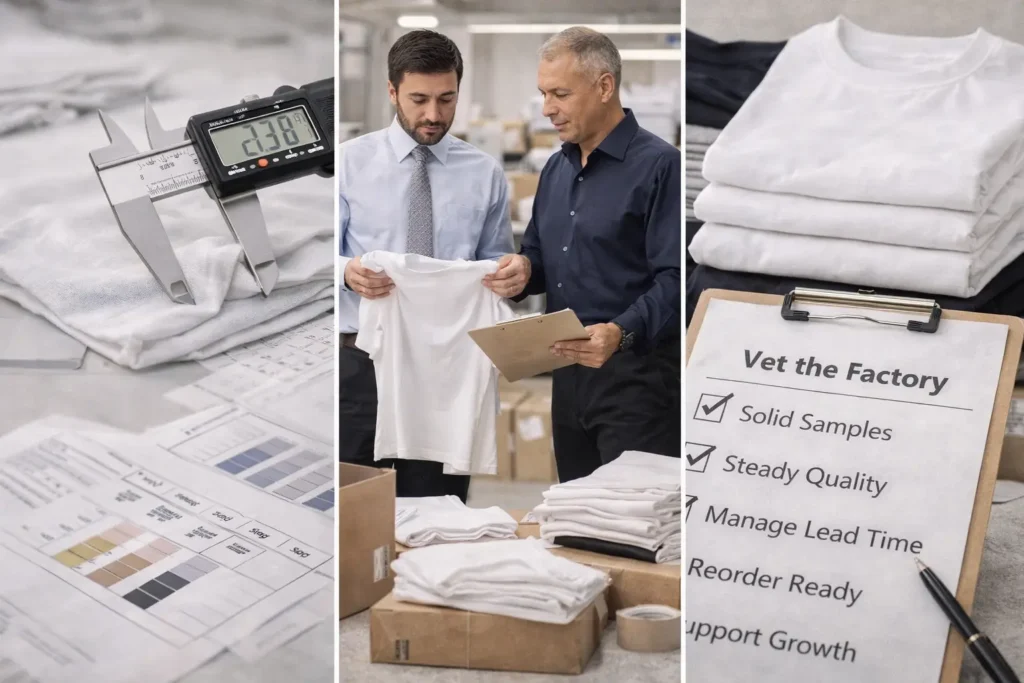
Sourcing a low MOQ T-shirt brand is not simply about finding a factory that agrees to make a small quantity. It is about finding a supplier that can help you move through the full path of product development in a stable way: sample, first test order, repeat order, and later growth. A factory can say yes to a small order and still be the wrong fit if communication is weak, sampling is slow, measurements are unstable, or the second order comes back different from the first.
For a new brand, sourcing is where many expensive mistakes begin. Some founders focus only on the ex-factory price and ignore everything else. Others get impressed by large factory photos or low quoted costs without checking whether the supplier actually understands small-batch brand building. In real business terms, the right supplier should help reduce risk in five areas:
- product development
- quality consistency
- lead time
- reorder stability
- growth capacity
A low MOQ setup only works well when the factory is built for both flexibility and control. If the supplier can make 50 pieces but cannot make the same 50 pieces properly again, the low MOQ advantage disappears very quickly.
Why Sourcing Matters More Than Most New Brands Expect
The first product is not just a design. It is the result of many small supply chain decisions working together:
- fabric selection
- pattern accuracy
- stitching quality
- print or embroidery execution
- washing and shrinkage behavior
- size grading
- finishing consistency
- packing and delivery
When sourcing is weak, even a good design can fail. A T-shirt that looked perfect in a mockup can become disappointing if the fabric feels cheap, the collar loses shape, the body length is off, or the print cracks after washing.
For a startup, a weak supplier relationship usually creates three kinds of cost:
| Type of Cost | What It Looks Like | Why It Hurts |
|---|---|---|
| Direct cost | bad samples, remakes, extra shipping, wasted stock | cash leaves early with little return |
| Hidden cost | delays, slow communication, unclear revisions | launch loses momentum |
| Brand cost | weak fit, poor quality, inconsistent reorders | customers do not come back |
This is why sourcing should be treated as a product decision, not just a purchasing task.
What the Right Supplier Should Actually Be Able to Do
A low MOQ supplier should do more than accept a small order. At a minimum, they should be able to support:
- sample development
- clear communication during revisions
- fabric and trim guidance
- small-batch production
- stable quality control
- repeat orders using the same product base
- scaling later without rebuilding the whole product
That last point is especially important. Many small brands do not fail because the first launch goes badly. They fail because the first launch goes well, but the supply side cannot support what comes next.
A useful supplier for a startup should fit this path:
| Brand Stage | What the Supplier Should Support |
|---|---|
| concept stage | product discussion, sampling advice |
| sample stage | fit review, fabric recommendation, revision feedback |
| first order | small batch with clear lead time |
| reorder stage | same fit, same feel, stable quality |
| growth stage | higher volume without factory switching |
When a factory can support all five stages, the brand has a much stronger chance of building momentum without losing control of the product.
How to Know If a Factory Is a Good Fit
A factory is a good fit when its strengths match your category, your order size, and your growth path.
For example, a low MOQ T-shirt brand usually needs a manufacturer that is already comfortable with:
- knitted basics
- blank tees
- logo tees
- graphic tees
- hoodies and sweatshirts for future expansion
- casual active or lifestyle basics if the brand grows that way
A factory that mainly focuses on large seasonal fashion programs may not be the best fit for a brand built around repeatable T-shirt products.
A founder should check for fit in several practical areas:
| Area | What to Look For |
|---|---|
| Product category | strong experience in tees, hoodies, knitted basics |
| MOQ flexibility | willing to support small test runs |
| Sample speed | can move fast enough for startup timelines |
| Pattern support | can adjust fit and support development |
| Decoration methods | print, embroidery, heat transfer, DTG if needed |
| Quality process | fabric inspection, measurement checks, finishing control |
| Communication | clear answers, realistic timelines, fast follow-up |
| Growth ability | can support bigger orders later |
The point is not to find a perfect factory on paper. It is to find one that is realistic, stable, and aligned with the kind of brand you are building.
What to Ask a Factory Before Sampling
A lot of startup founders ask only one question first: “What is your MOQ?” That question matters, but it is not enough. A better first conversation should cover product, process, timing, and repeatability.
Before starting sampling, ask questions like these:
- What product categories do you work on most often?
- What is your usual sample lead time?
- What fabrics do you already use for T-shirts?
- Can you support 100% cotton and other common blends if needed?
- Can you develop from a sample reference or photo?
- Can you support print, embroidery, heat transfer, or DTG?
- How do you handle shrinkage and wash stability?
- What are your measurement tolerances?
- What is your small-order production lead time?
- Can you keep the same fabric and fit for repeat orders?
- What packaging and labeling options do you support?
- Which shipping methods do you commonly arrange?
These questions quickly reveal whether the factory is experienced or only giving general answers.
Here is a useful comparison:
| Weak Factory Response | Stronger Factory Response |
|---|---|
| “Yes, we can do it.” | “For this kind of oversized cotton tee, we usually sample in 3–5 days and small production takes around 5–10 days depending on color count and print method.” |
| “MOQ depends.” | “For this style, we can support a low test quantity first, then scale once fit and fabric are confirmed.” |
| “Quality is no problem.” | “We check fabric before cutting, confirm measurements after sewing, and inspect print placement before packing.” |
Specific answers are usually a better sign than overly broad confidence.
How to Prepare Before Contacting Suppliers
A supplier conversation becomes much more useful when the founder already has the core information organized. You do not need a full professional tech pack on day one, but you do need a clear starting point.
Before contacting a factory, prepare:
- reference images
- target fit direction
- basic fabric idea
- logo or print idea
- quantity estimate
- preferred size range
- target market
- expected launch timing
If possible, also prepare:
- measurement points
- artwork files
- packaging ideas
- neck label or hangtag needs
- sample comments from prior testing
A startup that sends a clear request usually gets much better guidance.
Here is the difference:
| Weak Inquiry | Better Inquiry |
|---|---|
| “I want custom T-shirts. Can you quote?” | “I want to develop a 100% cotton oversized T-shirt for a low MOQ launch. Starting with sampling, then a 100-piece test order in 3 colors with chest embroidery.” |
The second version gives the factory enough detail to discuss fabric, lead time, MOQ structure, and next steps in a meaningful way.
How Sampling Should Really Work
Sampling is not a formality. It is the stage where the founder checks whether the product is actually worth producing.
A strong sample process should help answer questions like these:
- Does the fabric feel right in hand?
- Does the shirt fit the target customer?
- Is the collar shape correct?
- Does the body length look balanced?
- Is the sleeve opening right?
- Does the print sit in the right position?
- Does the embroidery look clean?
- Does the product still feel right after washing?
A sample should be worn, measured, washed, photographed, and reviewed carefully. A founder should not approve it too quickly just because the first version is “close enough.”
A useful sample review checklist:
| Check Point | What to Review |
|---|---|
| Fabric feel | soft, structured, thin, heavy, smooth, rough |
| Fit | shoulder, chest, body length, sleeve length, opening |
| Collar | shape, tightness, recovery after handling |
| Stitching | clean seams, no puckering, stable construction |
| Decoration | print clarity, embroidery neatness, positioning |
| Wash result | shrinkage, twist, hand feel after wash |
| Overall look | does it match the brand direction |
For a low MOQ brand, a strong sample matters even more because the first production run may be small. If the sample is weak, there is less room to hide problems later.
What Small-Batch Production Should Look Like
Once sampling is approved, the next step is the small production run. This is where the factory has to prove that it can move from one piece to many pieces without losing control.
For a startup T-shirt brand, small-batch production usually works best when:
- color count stays controlled
- size spread is realistic
- decoration methods are not overly mixed
- fit is already confirmed
- fabric source is stable
- production notes are clear
Typical startup-friendly structure:
| Item | Safer Early Setup |
|---|---|
| fits | 1 core fit |
| colors | 2–4 |
| sizes | focused size range |
| print methods | 1 main method |
| quantity | enough to test real demand without overloading inventory |
This kind of setup allows the factory to keep production cleaner and allows the brand to evaluate results more accurately after launch.
How to Judge Lead Time Properly
Lead time is not just about speed. It is about whether the speed fits your business rhythm.
For low MOQ brands, there are usually four separate time blocks to think about:
- sample development
- sample revision if needed
- bulk production
- shipping
A startup founder should ask for realistic ranges, not only the fastest possible promise.
Based on the company details you shared, Modaknits can support:
| Stage | Usual Time |
|---|---|
| sample development | 3–5 days |
| small-order production | 5–10 days |
| express delivery | 3–5 days |
| air shipping | 5–8 days |
| sea shipping | 20–30 days |
These numbers matter because they affect how much stock you need to hold. If sample and reorder cycles are faster, the brand can often start leaner. If everything moves slowly, the brand may feel forced to hold more inventory than it really wants.
That is why lead time should be part of sourcing strategy, not just an afterthought.
How to Check Whether the Factory Can Support Reorders
A first order is not enough. The real value of a supplier shows up when the product needs to be made again.
A reorder-safe factory should be able to keep these things stable:
- same or very similar fabric
- same measurements
- same collar and sewing quality
- same print or embroidery execution
- same packaging and finishing standard
This matters even more for basics brands and blank programs because customers tend to notice inconsistency quickly.
Here is what founders should review before relying on repeat production:
| Reorder Factor | Why It Matters |
|---|---|
| stable fabric source | avoids hand-feel and color inconsistency |
| pattern control | prevents fit drift |
| measurement discipline | keeps sizes reliable |
| decoration consistency | protects brand presentation |
| production recordkeeping | helps future orders match prior ones |
A factory that can only “make something similar” is usually not enough for a brand built around repeat purchases.
Why Many Small Orders Go Wrong
Small orders often fail for reasons that are predictable.
Common problems include:
- the supplier does not care about small clients
- the factory specializes in other product categories
- the founder gives unclear instructions
- the sample is approved too quickly
- too many colors or SKUs are added too early
- timelines are guessed, not planned
- the product is not built for reorder stability
Here is a simple view of what usually causes trouble:
| Common Issue | What Happens |
|---|---|
| vague tech direction | factory fills in the blanks poorly |
| too many options | production gets messy |
| weak fit control | sizes feel inconsistent |
| decoration overload | delays and quality variation increase |
| no reorder planning | second order becomes chaotic |
The good news is that most of these problems can be reduced through clearer sourcing decisions.
What Makes Modaknits Relevant for This Kind of Brand
For a low MOQ T-shirt brand, one of the strongest factory advantages is having both small-order flexibility and larger production structure in the same system.
Based on the company information you shared, Modaknits offers:
- manufacturing base established since 2008
- founding team with nearly 30 years of industry experience
- 4 factories working together
- 18 production lines
- around 5,000 square meters of production space
- monthly capacity of about 100,000 pieces
- another 50,000 to 80,000 pieces of expansion room
- equipment support for DTG, embroidery, heat transfer, shrinkage handling, fabric inspection, and automatic cutting
- 2 sample development rooms
- 7 pattern makers
- 20 sample sewers
- purchasing, business, and follow-up teams to support production flow
For startup and growing brands, that structure matters because it supports a smoother path across different order stages.
A brand may begin with:
- sample development
- 1 to 20 pieces for a test run
- 100-piece small-batch launch
- repeat orders after early sales
- larger orders once the product proves itself
This is useful for brands selling:
- basic T-shirts
- heavyweight blanks
- logo hoodies
- sweatshirts
- casual activewear
- lifestyle essentials
- reorder-focused core products
The real value is not only that the factory can do a small order. The real value is that the same system can continue working when the brand grows.
A Practical Factory Comparison Checklist
Before making a final choice, a founder can compare suppliers using a simple checklist.
| Sourcing Factor | Supplier A | Supplier B | Supplier C |
|---|---|---|---|
| supports low MOQ | |||
| strong in T-shirts | |||
| sample speed | |||
| clear communication | |||
| fit development support | |||
| print/embroidery options | |||
| stable reorder ability | |||
| future scale capacity | |||
| shipping support |
Even a simple table like this can prevent emotional decision-making and keep the sourcing process grounded.
What Good Sourcing Should Feel Like
Good sourcing should make the business easier to run, not harder.
By the time you choose the right supplier, you should feel clear about:
- what product you are making
- how long the sample will take
- what the small-batch timeline looks like
- how quality will be checked
- what can be repeated later
- what the next order might look like if sales go well
That is the real purpose of sourcing in a low MOQ T-shirt brand. It is not just to find someone who can make the first batch. It is to build a manufacturing path that supports the product from first test to future growth without losing consistency, speed, or control.
How to Grow a Low MOQ T-Shirt Brand

Growing a low MOQ T-shirt brand is about turning small, focused launches into repeatable sales and gradual expansion. The goal is to scale without losing the consistency, quality, or customer trust that made the first launch successful. Many brands fail at this stage because they try to grow too quickly, lose control of fit or fabric quality, or expand the product line before understanding what customers really want.
For a low MOQ brand, growth should be deliberate and data-driven. Each new SKU, color, or product addition should be backed by real customer response from the first batch. This allows the brand to expand while minimizing risk, controlling cash flow, and keeping inventory manageable.
The key to growth is not volume alone. It is repeatability: making sure every new order matches the quality, fit, and feel of the previous batch. This creates loyalty, repeat purchases, and a solid reputation from early customers.
Track Customer Response Closely
Customer feedback is your primary growth indicator. After the first launch, track metrics like:
- which colors sell fastest
- which sizes move the most
- which products get repeat orders
- product returns or complaints
- social media or community engagement
A simple data table can help visualize trends:
| SKU | Units Sold | Units Returned | Customer Notes | Next Step |
|---|---|---|---|---|
| Basic Black Tee | 50 | 1 | Fit perfect | Repeat order |
| White Oversized Tee | 40 | 0 | Slightly long | Adjust next batch |
| Logo Tee Gray | 25 | 2 | Print faded | Consider print method change |
This level of tracking lets you know which products to prioritize, which sizes or colors need adjustment, and which designs may be phased out.
Optimize Reorders Efficiently
Reorders are where a low MOQ brand can scale safely. Use first-batch performance to inform the second order:
- Increase quantities only for SKUs with strong sales
- Correct any fit or fabric issues discovered in the first run
- Keep colors and prints that performed well, drop or revise underperforming options
- Adjust size ratios based on real sales patterns
A practical reorder plan example:
| SKU | First Batch | Second Batch | Adjustment Reason |
|---|---|---|---|
| Black Tee | 20 units per size | 30 units per size | High demand |
| White Tee | 20 units per size | 20 units per size | Moderate demand, no change |
| Gray Logo Tee | 20 units per size | 15 units per size | Underperforming |
This approach keeps inventory aligned with demand while maintaining quality and brand perception.
Introduce New Colors or Fits Gradually
Growth does not mean adding everything at once. Introduce new colors, fits, or small product lines incrementally:
- Add 1–2 new colors for the best-selling fits first
- Test 1 new size if customer demand indicates a gap
- Introduce complementary products like hoodies or sweatshirts after initial T-shirt success
Gradual expansion prevents overproduction and keeps the brand focused.
| Stage | Action | Objective |
|---|---|---|
| Stage 1 | Add 1–2 new colors to core T-shirt | Test customer reception |
| Stage 2 | Introduce hoodie in same fabric | Expand product line without breaking consistency |
| Stage 3 | Add graphic tees or logo variations | Offer more choice while using proven base products |
Maintain Quality Control at Scale
One of the biggest challenges when scaling is preserving the same product quality. For low MOQ brands, this is critical:
- Keep the same fabric source
- Maintain the same pattern and fit for each product
- Ensure printing, embroidery, or decoration matches the first batch
- Perform the same QC checks on each new order
Even small inconsistencies can damage a brand’s reputation, especially when initial customers are repeat buyers.
| Quality Check | Recommended Practice |
|---|---|
| Fabric inspection | Before cutting every batch |
| Pattern verification | Ensure sizing matches first run |
| Decoration | Compare first batch prints/embroidery for consistency |
| Sewing quality | Check seams, collars, and sleeves for stability |
| Packing | Keep same labeling, hangtags, and folding |
Consistent quality ensures that repeat buyers remain loyal and reduces returns and complaints.
Expand Marketing Strategically
Marketing should grow alongside products. Use data from the first launch to focus campaigns:
- Promote best-selling products first
- Highlight product quality, fit, and repeatability in communications
- Leverage customer reviews and social proof for credibility
- Target ads and content toward the audience most responsive to the initial launch
Start small and scale outreach gradually as inventory and product stability allow.
Scale Production Without Losing Flexibility
Even when demand increases, a low MOQ brand should keep some flexibility:
- Increase quantities gradually rather than all at once
- Keep 1–2 SKUs in small test batches to continue learning
- Maintain fast turnaround for reorder items
This ensures growth is controlled, cash flow remains healthy, and the brand can respond to market changes without overcommitting.
Track Metrics to Inform Next Steps
Data-driven growth helps maintain focus. Track:
- units sold by SKU, color, size
- reorder velocity
- return rates
- customer satisfaction
- repeat purchase rate
Visualizing performance in tables or dashboards makes it easier to decide:
| Metric | Current Performance | Next Action |
|---|---|---|
| Units sold | Black Tee: 120 | Increase next batch 25% |
| Units returned | Gray Tee: 3 | Check print durability |
| Repeat purchase | 30% of customers | Target email campaign for upsell |
| Customer notes | Fit feedback on oversized tee | Adjust pattern slightly |
Using real data, a low MOQ brand can grow in measured steps without unnecessary risk.
Build a Repeatable Supply Chain
To sustain growth:
- Keep the same factory or production system that supported small batches
- Confirm the factory can scale volume without losing fit or quality
- Plan for future expansions in colors, prints, or adjacent products
- Ensure logistics are capable of supporting more destinations or higher volume
Consistency in the supply chain is one of the most important factors in scaling a low MOQ brand successfully.
Summary of Growth Steps
- Track early sales data and customer feedback carefully
- Reorder proven SKUs first, adjusting quantity or fit as needed
- Add new colors, prints, or fits gradually
- Maintain strict quality control for every batch
- Expand marketing campaigns based on real performance
- Scale production while keeping flexibility for testing and adjustments
- Keep the supply chain consistent to support repeat orders and future expansion
By following these steps, a low MOQ T-shirt brand can move from a small, controlled launch to a sustainable business with repeatable sales and gradual growth, all while minimizing risk and maintaining quality.
How to Grow a Low MOQ T-Shirt Brand
Growing a low MOQ T-shirt brand is about turning small, focused launches into repeatable sales and gradual expansion. The goal is to scale without losing the consistency, quality, or customer trust that made the first launch successful. Many brands fail at this stage because they try to grow too quickly, lose control of fit or fabric quality, or expand the product line before understanding what customers really want.
For a low MOQ brand, growth should be deliberate and data-driven. Each new SKU, color, or product addition should be backed by real customer response from the first batch. This allows the brand to expand while minimizing risk, controlling cash flow, and keeping inventory manageable.
The key to growth is not volume alone. It is repeatability: making sure every new order matches the quality, fit, and feel of the previous batch. This creates loyalty, repeat purchases, and a solid reputation from early customers.
Track Customer Response Closely
Customer feedback is your primary growth indicator. After the first launch, track metrics like:
- which colors sell fastest
- which sizes move the most
- which products get repeat orders
- product returns or complaints
- social media or community engagement
A simple data table can help visualize trends:
| SKU | Units Sold | Units Returned | Customer Notes | Next Step |
|---|---|---|---|---|
| Basic Black Tee | 50 | 1 | Fit perfect | Repeat order |
| White Oversized Tee | 40 | 0 | Slightly long | Adjust next batch |
| Logo Tee Gray | 25 | 2 | Print faded | Consider print method change |
This level of tracking lets you know which products to prioritize, which sizes or colors need adjustment, and which designs may be phased out.
Optimize Reorders Efficiently
Reorders are where a low MOQ brand can scale safely. Use first-batch performance to inform the second order:
- Increase quantities only for SKUs with strong sales
- Correct any fit or fabric issues discovered in the first run
- Keep colors and prints that performed well, drop or revise underperforming options
- Adjust size ratios based on real sales patterns
A practical reorder plan example:
| SKU | First Batch | Second Batch | Adjustment Reason |
|---|---|---|---|
| Black Tee | 20 units per size | 30 units per size | High demand |
| White Tee | 20 units per size | 20 units per size | Moderate demand, no change |
| Gray Logo Tee | 20 units per size | 15 units per size | Underperforming |
This approach keeps inventory aligned with demand while maintaining quality and brand perception.
Introduce New Colors or Fits Gradually
Growth does not mean adding everything at once. Introduce new colors, fits, or small product lines incrementally:
- Add 1–2 new colors for the best-selling fits first
- Test 1 new size if customer demand indicates a gap
- Introduce complementary products like hoodies or sweatshirts after initial T-shirt success
Gradual expansion prevents overproduction and keeps the brand focused.
| Stage | Action | Objective |
|---|---|---|
| Stage 1 | Add 1–2 new colors to core T-shirt | Test customer reception |
| Stage 2 | Introduce hoodie in same fabric | Expand product line without breaking consistency |
| Stage 3 | Add graphic tees or logo variations | Offer more choice while using proven base products |
Maintain Quality Control at Scale
One of the biggest challenges when scaling is preserving the same product quality. For low MOQ brands, this is critical:
- Keep the same fabric source
- Maintain the same pattern and fit for each product
- Ensure printing, embroidery, or decoration matches the first batch
- Perform the same QC checks on each new order
Even small inconsistencies can damage a brand’s reputation, especially when initial customers are repeat buyers.
| Quality Check | Recommended Practice |
|---|---|
| Fabric inspection | Before cutting every batch |
| Pattern verification | Ensure sizing matches first run |
| Decoration | Compare first batch prints/embroidery for consistency |
| Sewing quality | Check seams, collars, and sleeves for stability |
| Packing | Keep same labeling, hangtags, and folding |
Consistent quality ensures that repeat buyers remain loyal and reduces returns and complaints.
Expand Marketing Strategically

Marketing should grow alongside products. Use data from the first launch to focus campaigns:
- Promote best-selling products first
- Highlight product quality, fit, and repeatability in communications
- Leverage customer reviews and social proof for credibility
- Target ads and content toward the audience most responsive to the initial launch
Start small and scale outreach gradually as inventory and product stability allow.
Scale Production Without Losing Flexibility
Even when demand increases, a low MOQ brand should keep some flexibility:
- Increase quantities gradually rather than all at once
- Keep 1–2 SKUs in small test batches to continue learning
- Maintain fast turnaround for reorder items
This ensures growth is controlled, cash flow remains healthy, and the brand can respond to market changes without overcommitting.
Track Metrics to Inform Next Steps
Data-driven growth helps maintain focus. Track:
- units sold by SKU, color, size
- reorder velocity
- return rates
- customer satisfaction
- repeat purchase rate
Visualizing performance in tables or dashboards makes it easier to decide:
| Metric | Current Performance | Next Action |
|---|---|---|
| Units sold | Black Tee: 120 | Increase next batch 25% |
| Units returned | Gray Tee: 3 | Check print durability |
| Repeat purchase | 30% of customers | Target email campaign for upsell |
| Customer notes | Fit feedback on oversized tee | Adjust pattern slightly |
Using real data, a low MOQ brand can grow in measured steps without unnecessary risk.
Build a Repeatable Supply Chain
To sustain growth:
- Keep the same factory or production system that supported small batches
- Confirm the factory can scale volume without losing fit or quality
- Plan for future expansions in colors, prints, or adjacent products
- Ensure logistics are capable of supporting more destinations or higher volume
Consistency in the supply chain is one of the most important factors in scaling a low MOQ brand successfully.
Summary of Growth Steps
- Track early sales data and customer feedback carefully
- Reorder proven SKUs first, adjusting quantity or fit as needed
- Add new colors, prints, or fits gradually
- Maintain strict quality control for every batch
- Expand marketing campaigns based on real performance
- Scale production while keeping flexibility for testing and adjustments
- Keep the supply chain consistent to support repeat orders and future expansion
By following these steps, a low MOQ T-shirt brand can move from a small, controlled launch to a sustainable business with repeatable sales and gradual growth, all while minimizing risk and maintaining quality.