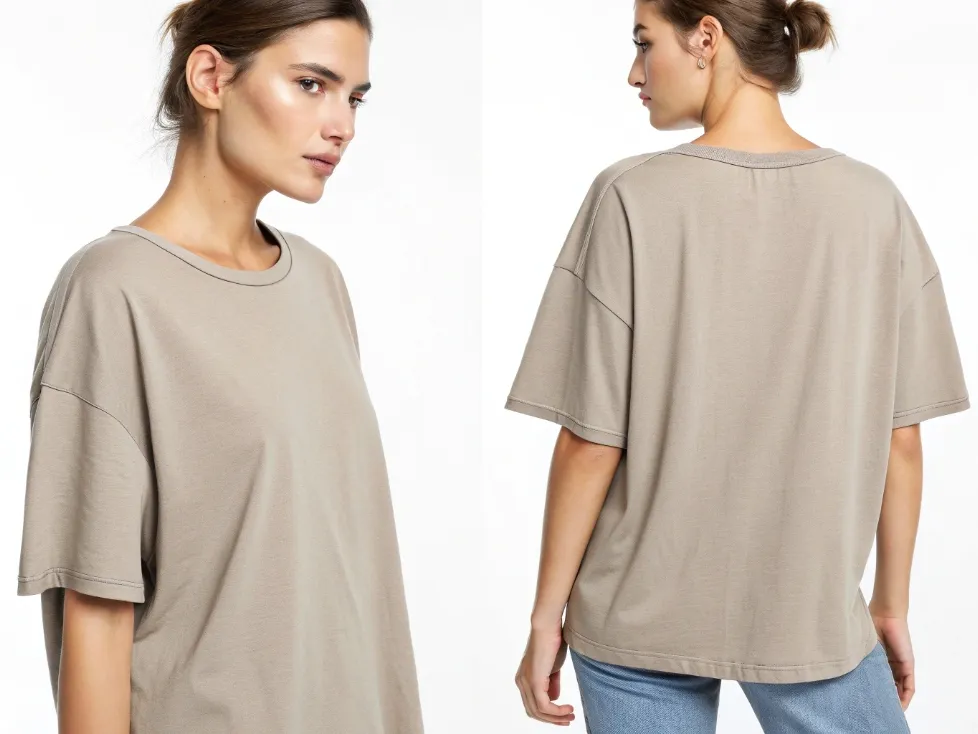
What Defines an Oversized Cotton T-Shirt in Modern Casual Wear
Material Intent, Structural Standards, and Contemporary Judgment Lines
An oversized cotton T-shirt is not simply a larger cotton T-shirt.
Cotton’s softness, weight behavior, and tendency to collapse fundamentally change how oversized designs must be evaluated.
This page serves as the material-specific definition authority, explaining how cotton reshapes the standards of oversized construction, proportion, and visual outcome in modern casual wear.
What Is an Oversized Cotton T-Shirt — and What Is It Not?
Before discussing modern style or comfort, the definition must be precise.
This section establishes the material and structural boundaries of oversized cotton T-shirts.
Oversized cotton T-shirt vs regular cotton T-shirt: core differences
An oversized cotton T-shirt differs from a regular cotton T-shirt by design structure, not by size alone.
Regular cotton T-shirts rely on body contact to maintain shape, while oversized cotton T-shirts must sustain their silhouette with less physical support. This requires deliberate changes in shoulder treatment, body volume distribution, and pattern geometry.
Without these changes, cotton’s natural softness quickly undermines oversized intent.
Why “same cotton, bigger size” does not equal oversized
Using the same cotton fabric and simply increasing size produces distortion, not oversized design.
Cotton fabrics engineered for regular fits depend on tension against the body. When scaled up, they sag, stretch, and lose line clarity.
Oversized cotton demands fabric and pattern adjustments that allow cotton to hold volume independently.
Oversized as a fabric–pattern system, not a sizing shortcut
True oversized cotton T-shirts are built as integrated fabric–pattern systems.
Pattern decisions must compensate for cotton’s softness and gravity response.
Oversized cotton succeeds only when fabric behavior and pattern discipline are aligned from the start.
Cotton behaves differently from synthetic or blended fabrics.
In oversized designs, these differences become decisive.
Cotton’s natural softness, weight, and collapse tendencies
Cotton is inherently soft and flexible, but structurally vulnerable at larger volumes.
Its fibers bend easily under gravity, which makes cotton comfortable but prone to collapse when unsupported.
Oversized designs expose this vulnerability more clearly than fitted garments.
Why oversized silhouettes expose cotton’s weaknesses first
Oversized silhouettes remove the body as a structural support.
With less tension holding the fabric in place, cotton must rely on its own density, construction, and recovery. Any weakness—poor yarn packing, loose knit, or low recovery—becomes immediately visible.
This is why cotton oversized fails faster than many other oversized categories.
Oversized cotton as a higher-requirement category
Oversized cotton should be judged as a higher-requirement category, not an easier one.
Achieving relaxed volume without collapse demands stricter standards than regular cotton T-shirts.
The casual appearance is deceptive; the engineering requirements are higher.
What Structural Conditions Must Be Met
Cotton oversized designs only succeed under specific structural conditions.
These are not optional.
Shoulder and body structure that cotton can sustain
Cotton oversized requires shoulder and body structures that distribute weight evenly.
Overextended shoulders or unsupported chest width create stress points that cotton cannot resist.
Balanced shoulder placement and moderated body width allow cotton to hang cleanly.
Volume distribution that prevents cotton collapse
Volume must be distributed, not concentrated.
Excess fabric pooling in one area accelerates sagging and distortion.
Successful oversized cotton spreads volume across the silhouette to reduce localized stress.
Why cotton oversized relies more on pattern discipline
Cotton oversized depends more on pattern precision than stiffer materials do.
Because cotton does not naturally resist deformation, pattern geometry must do more of the work.
Loose discipline results in rapid visual degradation.
What Level of Softness Is Correct for Oversized Cotton
Softness is central to cotton’s appeal, but it carries risk.
This section defines the correct balance.
Softness that enhances relaxation vs softness that destroys form
Softness is beneficial only when it does not undermine structure.
Moderate softness enhances comfort and casual ease. Excessive softness removes the fabric’s ability to hold line and shape.
Oversized cotton requires controlled softness, not maximum softness.
Why excessive softness reads as sloppy in oversized cotton
In oversized cotton, excessive softness translates visually as disorder.
When fabric collapses, edges blur and proportions drift. What feels comfortable may look unintentional.
This effect is amplified at larger volumes.
The modern balance point between comfort and visual control
Modern oversized cotton sits at a balance point between comfort and clarity.
The fabric should feel relaxed in hand but disciplined in wear.
This balance defines contemporary casual standards.
What Makes an Oversized Cotton T-Shirt Look Relaxed, Not Messy
Users intuitively judge oversized cotton by how it looks, not how it measures.
This section clarifies that judgment line.
Controlled drape vs uncontrolled fall
Controlled drape maintains silhouette while allowing movement.
Uncontrolled fall causes fabric to pool, twist, or cling.
Oversized cotton must drape with intention, not surrender to gravity.
Why cotton exaggerates poor proportional logic
Cotton amplifies proportional mistakes faster than stiffer fabrics.
Too much width, excessive length, or poorly placed volume becomes immediately visible.
Cotton does not hide design errors; it reveals them.
The visual signals of successful oversized cotton design
Successful oversized cotton appears calm, stable, and unforced.
Lines remain readable, volume feels intentional, and the garment settles naturally on the body.
These visual cues signal correct material and structural decisions.
What Makes an Oversized Cotton T-Shirt Feel Modern Today
Oversized cotton has existed for decades, but modern execution differs sharply from past interpretations.
Clean volume vs nostalgic bagginess
Modern oversized cotton favors clean volume over nostalgic bagginess.
It avoids excessive pooling, exaggerated length, and uncontrolled softness.
The result is restraint rather than nostalgia.
Contemporary casual standards vs past streetwear cues
Today’s casual standards emphasize wearability and clarity.
Past oversized references often relied on visual excess.
Modern oversized cotton is quieter and more integrated into daily life.
Why restraint defines modern cotton oversized
Restraint is the defining characteristic of modern oversized cotton.
By limiting extremes, the design remains relevant beyond trend cycles.
This restraint is intentional, not minimalistic by accident.
Why Oversized Cotton T-Shirts Work as Daily Casual Basics
Despite higher requirements, oversized cotton remains a daily staple.
This section explains why.
Familiar material, modern structure
Cotton’s familiarity reduces friction in daily wear.
When paired with modern structure, it delivers comfort without sacrificing appearance.
This combination supports everyday use.
Comfort reliability without visual degradation
Well-designed oversized cotton maintains comfort without collapsing visually.
It performs consistently across repeated wear cycles.
Reliability is key to daily adoption.
Why cotton oversized earns repeat daily use
Oversized cotton earns repeat wear when it remains stable over time.
When shape, drape, and surface quality hold up, the garment becomes dependable.
Dependability defines an essential.
Common Misinterpretations
Why Most “Oversized Cotton T-Shirts” Miss the Mark
Many garments fail not because cotton is unsuitable, but because standards are misunderstood.
Treating cotton oversized as low-effort design
Assuming cotton oversized is easy leads to poor outcomes.
Relaxed appearance is mistaken for relaxed engineering.
This misconception drives failure.
Over-softening without structural compensation
Softening cotton without reinforcing structure accelerates collapse.