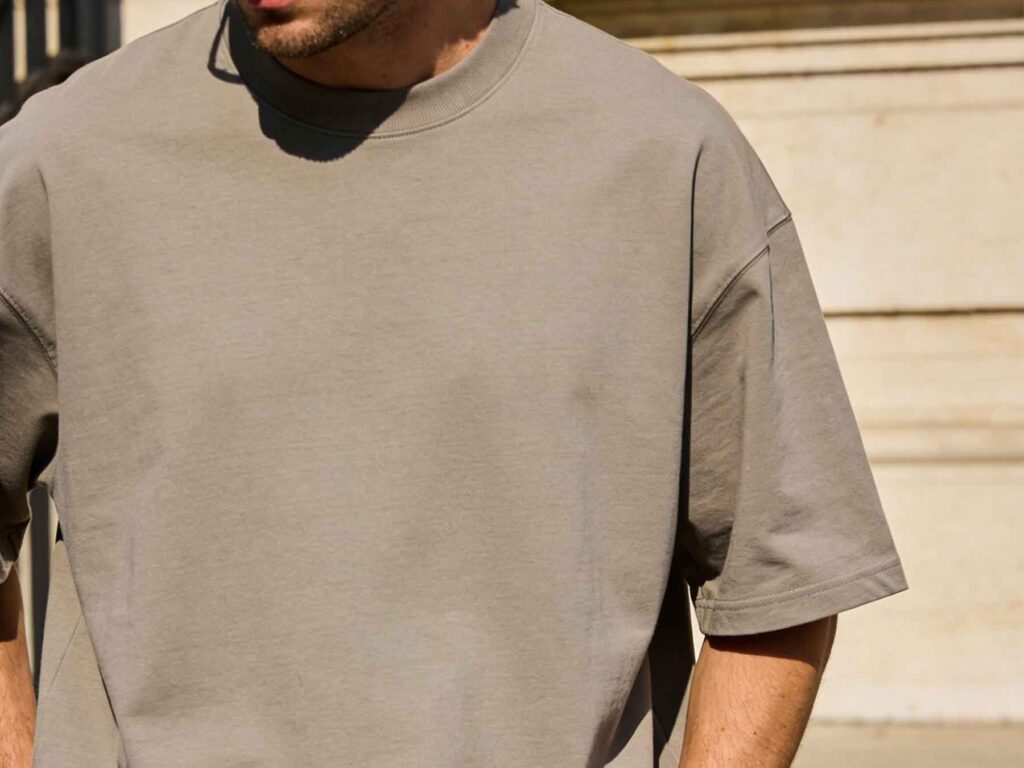
How Oversized Cotton Tees Age, Deform, and Remain Wearable Over Time
Oversized cotton T-shirts rarely fail all at once.
They age gradually, shifting from controlled relaxation to subtle distortion, and eventually to visible collapse.
This page functions as a time-based performance authority, explaining how oversized cotton behaves across weeks, months, and repeated wear—and how to judge when a piece is still valid for daily use.
Durability in oversized cotton is not about survival.

It is about silhouette survival.
Oversized volume exposes cotton weaknesses faster than regular fits.
Greater surface area, longer leverage points, and looser tension allow gravity and movement to act more aggressively on the fabric.
Small weaknesses become visible sooner.
A cotton T-shirt can survive physically while failing visually.
Fibers may remain intact, but proportions drift and outlines soften.
Shape retention, not fabric survival, defines real longevity in oversized cotton.
“Still wearable” does not mean “still visually correct.”
Oversized cotton often remains comfortable long after it has lost structural clarity.
Time-based judgment must focus on silhouette, not comfort alone.
Cotton follows a predictable aging path.
This section maps that progression.
In the early phase, oversized cotton relaxes and settles into its true shape.
Initial stiffness fades, drape improves, and proportions stabilize.
This phase is usually beneficial.
In the mid-life phase, cotton either stabilizes or begins gradual distortion.
Well-constructed pieces hold balance.
Weaker ones show slow shoulder drift, sleeve sag, or length creep.
In the late phase, oversized cotton develops either patina or collapse.
Patina retains outline with softened character.
Collapse loses structure and silhouette control.
Deformation follows repeatable patterns.
This section identifies the highest-risk zones.
The neckline is often the first area to lose shape.
Repeated on–off motion and fabric weight stretch the collar.
Once fatigue sets in, visual failure accelerates.
Shoulders and sleeves drift downward over time.
Oversized weight pulls seams outward and down.
Sleeve sag is a common early warning sign.
Hem elongation causes gradual body length creep.
Gravity acts continuously on the lower edge.
This subtly alters proportions until imbalance becomes obvious.
Washing is a major stress event for oversized cotton.
Its effects compound over time.
Washing causes both fiber relaxation and irreversible stretch.
Early washes release tension; later cycles lock in deformation.
Oversized structures amplify this effect.
Oversized cotton shows wash-related distortion sooner than regular fits.
Extra fabric mass increases stress during agitation and drying.
Small distortions accumulate faster.
Good oversized cotton recovers its outline after washing; poor cotton does not.
Recovery speed is a key quality indicator.
Slow or incomplete recovery signals decline.
Time reveals material truth.
This section explains why.
Stronger fibers resist permanent deformation over repeated stress.
They return closer to original length and alignment.
This resistance is critical in oversized forms.
Higher fabric density improves recovery after stretch.
Dense knits distribute stress more evenly.
Loose structures fail sooner.
Poor cotton collapses earlier when scaled into oversized volume.
What survives in regular fits fails quickly when expanded.
Oversized designs magnify material limits.
Visual cues appear before total failure.
This section defines them.
Uneven drape and blurred outlines signal structural collapse.
The silhouette becomes difficult to read.
This is a primary failure indicator.
Needing frequent adjustment indicates loss of balance.
Cotton clings, twists, or drags unnaturally.
Wear behavior reveals visual decline.
There is a clear point where “broken in” becomes “broken down.”
Softness crosses into instability.
At this point, the piece no longer functions as intended.
Fit scale changes aging dynamics.
This section provides context.
Deformation is more visible in oversized silhouettes because volume exaggerates error.
Small changes are amplified visually.
Regular fits hide damage longer.
Loose fits initially mask wear but eventually reveal it abruptly.
Once collapse passes a threshold, it becomes obvious.
The transition is sudden.
Oversized cotton trades early comfort for stricter long-term limits.
Comfort lasts longer than structure.
Judgment must account for this trade-off.
Most failures are avoidable.
This section explains why they happen.
Treating oversized cotton as low-maintenance accelerates collapse.
Its scale demands more awareness, not less.
Neglect shortens its usable life.
Over-rotation prevents fibers from recovering between wears.
Continuous stress locks in deformation.
Recovery time matters.
Ignoring early distortion allows minor issues to become permanent.
Early intervention preserves shape.
Delay guarantees failure.
Use this framework to decide objectively.
1.Shape retention checkpoint
2.Drape quality and recovery check
3.Ongoing daily-wear suitability check
We’ll get back to you within 24 hours. Attach your logo/design if needed.
💡 1 . Share your logo, fabric, and quantity for T-shirts, hoodies, and more.
📐 2. We’ll prepare samples for your approval.
🚚 3. Bulk production starts after deposit.
✅ We value your privacy. Your information is 100% safe and confidential.
📦 Need help? Chat with us via WhatsApp anytime!
Note: Your email information will be kept strictly confidential.
Request a quote, discuss MOQ, lead time, fabrics & QC.
Visit our brand store: Modaknitswear
Retail orders (and dropshipping options) are available on Modaknitswear.