
 Skip to content
 How Structure, Stitching, and Engineering Determine Long-Term Performance Across Bottom Types
Construction quality is one of the clearest reasons everyday bottoms either remain dependable or decline too quickly.
Fabric matters, but fabric alone does not explain why one garment keeps its shape while another twists, loosens, or loses control after repeated use.
In modern urban wardrobes, durability depends on how seams, panels, stress points, and internal finishing work together as a system.
That focus fits MODAKNITS’ broader product logic around fabric R&D, stable structure, durability, and long-term repeat wear rather than short-term appeal alone.
Everyday bottoms should therefore be judged by long-term structural performance, not only by category, softness, or first impression.
Pants, shorts, and other lower-body garments all face repeated movement, washing, and pressure, but they do not fail in exactly the same way.
What matters most is whether the construction strategy matches the garment’s real use conditions and keeps it stable over time.
Durability matters because bottoms are repeat-use garments.
They are exposed to constant stress through sitting, walking, bending, carrying items, and wash cycles. That makes long-term performance one of the most practical buying standards across all lower-body categories.
The real durability question is not whether a bottom feels good at first, but whether it stays wearable after repeated use.
Some bottoms create a strong first impression through softness, stretch, or lightness, but those early comfort qualities can hide weak construction.
Seams may begin to strain, waistbands may soften too quickly, and the garment may start losing its intended line after only moderate wear. This happens across categories. A short can deform at the seat and hem. A pant can bag at the knees or loosen through the upper block. A softer casual bottom can feel excellent at first and still fail in structural consistency.
That is why durability should not be treated as separate from comfort.
A good everyday bottom should maintain its comfort and structural behavior over time, not just at purchase.


Cost-per-wear is a useful cross-category durability metric because it measures how well a bottom keeps delivering value after real use begins.
A lower price does not guarantee better value if the garment loses shape, weakens at stress zones, or stops feeling reliable after limited wear.
A better-made bottom often offers stronger value density because it remains in rotation longer and continues to work across more daily situations. This matters especially in essentials wardrobes, where repeat use matters more than novelty.
Long-term value is not determined by ticket price alone.
It is determined by whether the garment keeps solving the same daily problem over many wears.
Everyday bottoms must withstand repeated use cycles because repetition is the defining condition of their category.
A bottom cannot be considered essential if it performs well only in protected or occasional use.
Real daily garments face regular wear cycles that combine movement, pressure, laundering, and environmental change. A bottom that looks good when new but declines quickly under these conditions is not truly reliable.
This is especially important for repeat-use wardrobes. A garment earns its place only when it keeps functioning after real use starts.

Construction quality is often misunderstood because users focus on material first.
But fabric is only one part of the garment. Construction is the system that determines how the material is assembled, reinforced, and made stable enough for repeated wear.

Material and construction play different roles in durability, and both are necessary for strong long-term performance.
Fabric determines handfeel, breathability, recovery, and surface behavior. Construction determines whether those fabric qualities can survive repeated movement, stress, and washing.
A strong material can still fail if the seams are weak, if the waistband is underbuilt, or if the pattern creates concentrated strain in the wrong places. The reverse is also true. Good construction cannot fully rescue material that lacks basic stability.
This is why durability should be judged through both fabric and assembly.
One explains what the garment is made of. The other explains whether that material can perform as intended over time.
Construction quality is best understood as a structural system in which multiple components have to work together consistently.
The waistband, seat, crotch, pockets, hems, panels, and seam lines do not operate independently.
They share tension, guide fit, and distribute stress. If one part is weak or misaligned, the rest of the garment often begins to compensate in unstable ways. That is when sagging, twisting, pulling, or gradual loss of form begins.
A durable bottom is therefore not defined by one visible detail.
It is defined by whether the entire structure behaves like a coherent system rather than a set of disconnected parts.

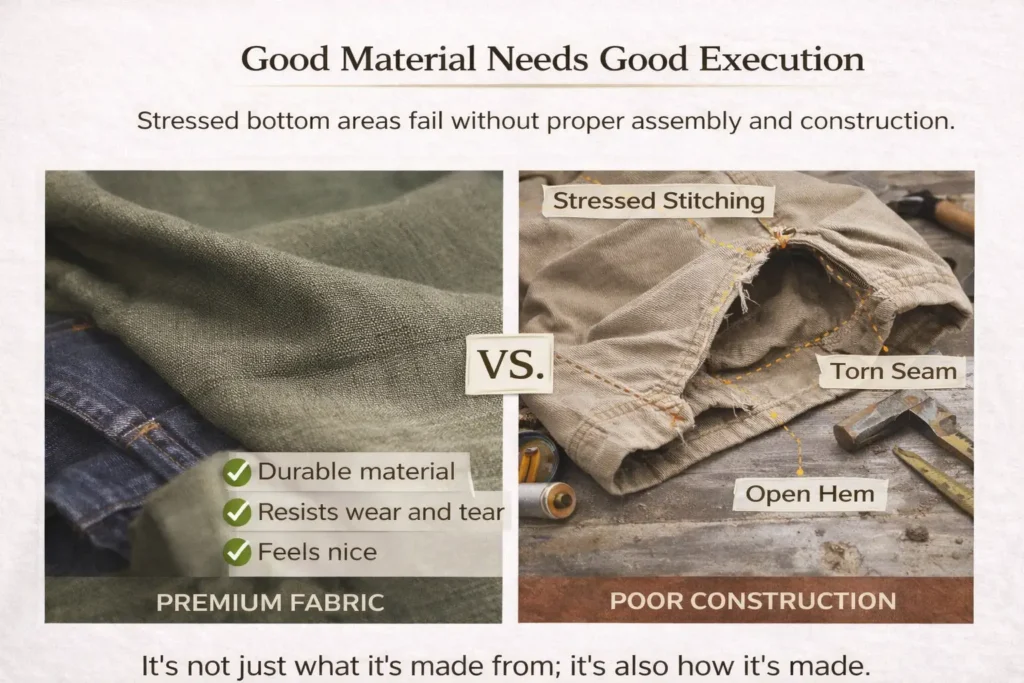
Good fabric fails without proper construction because garments usually break down at stress concentration points, not in untouched areas.
A premium fabric can still disappoint if the stitching is inconsistent, the pattern places too much strain into one zone, or the finishing leaves vulnerable edges unprotected.
In bottoms, this is especially important because the body repeatedly loads the same regions: waistband, seat, crotch, thighs, hems, and pockets. The fabric may still feel good, but the structure around it begins to fail.
That is why material quality alone is not enough.
Construction is what turns fabric potential into durable real-world performance.
Long-lasting bottoms usually depend on ordinary-looking construction details that do important structural work.
The strongest garments often appear simple on the surface, but their durability comes from disciplined stitching, strong reinforcement, and internal control.
Stitch density, seam strength, and reinforcement are among the most important durability details in everyday bottoms.
Stitching should be consistent and secure enough to hold under repeated motion, but not so rigid that it creates unnecessary stiffness or concentrated stress.
Seam strength matters because seams are often the first visible failure point in long-term wear. Reinforcement matters because some parts of the garment experience far more stress than others and need extra support to remain stable.
A good bottom therefore does more than simply connect panels.
It anticipates where stress will occur and strengthens those areas before failure begins.


The main stress zones across bottom categories are the crotch, waistband, pockets, and hems, though their pressure profile changes by garment type.
The crotch and upper block absorb repeated movement. The waistband controls hold and often weakens under long wear if underbuilt. Pockets carry weight and endure repeated hand contact. Hems face abrasion and shape distortion, especially in frequently worn garments.
In pants, knees and longer leg lines add more structural demand. In shorts, exposed hem behavior and seat wear may become more visible sooner.
This is why durable bottoms are rarely uniform in construction.
The best ones are strengthened according to where the garment actually works hardest.
Internal finishing matters because the unseen parts of a bottom often determine how well it survives repeated use.
Binding, protected seam edges, controlled internal clean-up, and any supportive interior structure help reduce fraying, distortion, and stress concentration.
These details may not attract attention in a quick inspection, but they affect whether the garment remains stable after washing and extended wear.
A bottom that is well finished internally usually signals that it was built for continued use rather than only for visual presentation.
That often makes a major difference in long-term reliability.

Durability standards are shared across bottoms, but the construction strategy should still shift by category.
Different lower-body garments experience different coverage patterns, movement zones, and wear behavior. That changes how construction should be prioritized.
Pants require the most comprehensive construction strategy because their full length creates broader stress distribution and higher structural demand.
They must manage waist hold, seat pressure, crotch movement, thigh and knee stress, and hem behavior all at once.
They also tend to stay in wear longer and move through more settings than shorter or more relaxed categories. Because of that, pants usually need stronger shape control, better alignment, and more disciplined tension distribution.
This is one reason poor construction becomes visible quickly in pants.
The garment simply has more structure to maintain over time.
Shorts usually require less full-length structural control, but they still need strong construction where wear is concentrated.
Because shorts end higher on the leg, they are less dependent on long drape and lower-leg alignment.
But that does not make them easier in every durability sense. Their hems are more visible, their seat and upper-block performance remain important, and their more frequent use in warmer or more active settings may expose surface wear and stress differently. Shorts may also be judged more closely by how cleanly the upper block and hem retain shape.
This means reduced length does not eliminate durability concerns.
It simply shifts where the most important construction work happens.
Different bottoms require different construction strategies because they solve different daily problems and therefore experience stress differently.
A full-length pant needs a more complete structural system from waist to hem. A short needs stronger control in the upper block and visible finishing zones. Softer casual bottoms may need better recovery and seam resilience to compensate for lower structural rigidity. Movement-oriented bottoms may need more flexible reinforcement rather than maximum stiffness.
That is why good construction should always be category-aware.
The strategy should follow the garment’s job, not a one-size-fits-all durability formula.
Durability is not only about whether the garment stays physically intact.
It is also about whether the bottom keeps its shape, line, and structural calm after repeated wear. Shape retention is one of the clearest signs that the construction system is working.
Good construction helps prevent sagging, twisting, and distortion by distributing stress more evenly through the garment.
When bottoms are poorly built, repeated motion causes uneven strain. The seat may relax too quickly, the legs may twist, the waistband may start folding, or the garment may lose its intended balance after washing.
These problems often appear before the fabric itself fully breaks down. That is why structural instability should be treated as an early durability failure, not a minor cosmetic issue.
A well-constructed bottom resists this decline by helping each zone recover in a more controlled way.
Pattern engineering and seam alignment are central to structural durability because they determine how the garment hangs and where the stress goes.
A garment can be sewn neatly and still fail if the pattern places pressure in the wrong area or if seam directions do not support the body’s natural movement.
Proper alignment helps the bottom sit correctly, distribute tension more intelligently, and maintain visual stability through repeated wear. Poor alignment, by contrast, often appears later as twisting, pulling, or uneven collapse.
This is why shape retention begins before the first stitch.
It starts with how the garment is engineered to move on the body.
Maintaining silhouette consistency is one of the strongest signs that a bottom has durable structural quality.
The garment should not only survive. It should continue to look like the garment it was designed to be.
If the fit line changes too quickly, if the hem starts behaving unpredictably, or if the upper block loses control, the bottom may still be technically wearable but already structurally compromised.
Everyday staples need a higher standard than that.
For bottoms, long-term appearance is not separate from durability. It is part of it.
Bottoms rarely fail all at once.
Most decline through a sequence of smaller signs that reveal whether the garment is aging normally or beginning to lose integrity too early.
Early structural failure usually appears through seam stress, deformation, and loosening before obvious breakage occurs.
Loose threads, waistband softening, seat distortion, hem instability, mild twisting, or visible seam tension are often the first warnings.
At this stage, the garment may still appear acceptable, but the structure is already becoming less dependable. These signs matter because they often predict faster decline later.
A bottom that begins losing control early usually does not regain it through more wear.
That is why early deformation should be treated as useful evidence, not ignored as harmless settling.
Progressive wear happens because the same stress patterns are applied repeatedly to the same garment zones.
Each cycle of sitting, walking, washing, and carrying items tests the structure again.
Over time, seams may weaken, the upper block may relax, and the garment may stop returning to its intended line. Some change is normal. What matters is how well the construction controls the rate and severity of that change.
Durable bottoms tend to age gradually and predictably.
Weak bottoms move more quickly from minor softening to structural fatigue.
Functional failure begins when structural decline affects wearability, not simply when the garment shows age.
Natural aging may include slight softening, mild wear marks, or a more lived-in handfeel.
Functional failure is different. It means the bottom no longer holds shape reliably, no longer distributes pressure well, or no longer supports the body as intended. At that point, the issue is not just appearance. It is loss of performance.
This distinction matters because not all aging is a defect.
The real durability boundary is crossed when the garment stops doing its job.
Daily movement is one of the main things that tests construction quality.
Bottoms do not need extreme use to show weakness. Normal activity is already enough to reveal whether the structure was built properly.
Sitting, walking, and bending create repeatable stress patterns that test everyday bottoms constantly.
Sitting compresses the seat and waistband. Walking creates cyclical load through the crotch and thigh zones. Bending places extra pressure on the upper block and seam geometry.
These are ordinary actions, but they are the main reason durability matters. A bottom that cannot handle these movements calmly will not remain dependable for long.
This is why long-term construction quality should always be judged against daily life, not against rare edge cases.
Different bottoms have different flex zones, but all durable garments need intelligent tension distribution.
Pants often concentrate flex at the knees, crotch, and upper thigh while maintaining longer structural lines.
Shorts shift more of the visible wear into the seat, hem, and upper block. Softer casual bottoms may need more forgiving seam systems because the fabric itself carries less rigid control.
In every case, the goal is the same: avoid concentrating too much stress into one underbuilt zone.
Good construction makes the tension feel shared. Poor construction makes failure feel inevitable.
Poor construction fails under normal daily use because everyday life already provides enough stress to expose weakness.
The wearer does not need to subject the garment to unusual treatment. Normal movement, public seating, repeated wear, and standard washing are sufficient.
When construction is weak, those ordinary conditions produce seam fatigue, distortion, loosening, or shape loss much sooner than they should.
That is why construction quality is such a practical decision factor.
It predicts whether the garment can handle ordinary life without becoming a recurring problem.
Low-quality construction usually reveals itself through inconsistency.
The problems often appear before major failure happens, which makes them useful warning signs for buyers.
Weak seams, loose threads, and uneven stitching are some of the clearest visible signs of poor construction.
These details usually indicate inconsistency in assembly and lower confidence in how the garment will handle repeated stress.
Uneven stitching weakens seam reliability. Loose threads often suggest unfinished or unstable joining. Weak seams become visible failures faster because they are already underbuilt from the start.
In everyday bottoms, basic workmanship often predicts long-term durability better than styling details do.
Misalignment, twisting, and inconsistent shape often indicate deeper structural problems than users first expect.
If panel lines sit unevenly, if the garment hangs off-balance, or if the leg or hem already looks twisted, the bottom is likely to age poorly even if the fabric feels acceptable.
These problems affect both appearance and movement because the garment is not distributing tension correctly.
That is why shape inconsistency should never be treated as only cosmetic.
It often points to weak engineering underneath.
Rapid deformation after limited wear is one of the strongest warnings that a bottom was not built for everyday repetition.
If the seat relaxes too quickly, the waistband softens early, or the garment visibly loses shape after only a small amount of use, the structure is already underperforming.
This matters because early deformation often appears before visible seam failure. The bottom may still be intact, but it is already losing trustworthiness.
For everyday essentials, that is usually enough to count as a serious durability concern.
Construction quality should not be confused with maximum rigidity.
The strongest everyday bottoms are not the ones that are hardest. They are the ones that balance durability with movement, comfort, and real-life usability.
1.Overly rigid construction vs movement restriction
2.Lightweight construction vs structural compromise
3.Finding balance for everyday bottoms
We’ll get back to you within 24 hours. Attach your logo/design if needed.
💡 1 . Share your logo, fabric, and quantity for T-shirts, hoodies, and more.
📐 2. We’ll prepare samples for your approval.
🚚 3. Bulk production starts after deposit.
✅ We value your privacy. Your information is 100% safe and confidential.
📦 Need help? Chat with us via WhatsApp anytime!

Note: Your email information will be kept strictly confidential.
Note: Your email information will be kept strictly confidential.
Request a quote, discuss MOQ, lead time, fabrics & QC.
Visit our brand store: Modaknitswear

Retail orders (and dropshipping options) are available on Modaknitswear.