 Skip to content
What Defines a Trending T-Shirt in Modern Fashion
Design Signals, Style Direction, and Long-Term Value of Trend-Driven T-Shirts
A trending T-shirt is defined by change, not by permanence. It reflects the current movement of fashion through silhouette, graphic language, surface treatment, or styling relevance.
Unlike a timeless basic, a trending T-shirt is valuable because it captures where visual taste is moving now, even if that direction is temporary.
For MODAKNITS, that distinction matters because the brand is positioned around modern basics, premium essentials, urban functionality, and calm design logic rather than short-lived novelty alone.
What Is a Trending T-Shirt — and How Is It Different from Basic T-Shirts
A trending T-shirt is not simply a popular T-shirt. It is a T-shirt that carries visible signals of current fashion direction. That may come through proportion, graphics, texture, fit, or styling language.
A basic T-shirt, by contrast, is designed for long-term stability, broader compatibility, and repeated use with less dependence on timing.
Definition of “trending” in modern fashion context
A trending T-shirt is a T-shirt whose design reflects current fashion movement rather than long-term neutrality.
In modern fashion, “trending” usually means the garment participates in an active style shift. That shift may be driven by silhouette changes, cultural influence, aesthetic cycles, or a broader visual mood that becomes visible across brands, social media, and city dressing. A trending T-shirt therefore does more than provide coverage or basic layering. It signals timing.
This does not make it superficial. It means its relevance is tied more closely to the present moment. The garment feels current because it aligns with what people are noticing now, not because it has escaped style cycles completely.


Trending vs basic T-shirts: purpose and lifecycle differences
Trending and basic T-shirts serve different purposes because they are built for different wardrobe roles.
A basic T-shirt is usually meant to remain stable across time. It supports repeat wear, low-friction pairing, and long-term use without requiring the wearer to respond to changing style language. A trending T-shirt works differently. It adds direction, variation, and currentness to the wardrobe.
This difference also affects lifecycle. Basics are often chosen for durability and quiet usefulness. Trend pieces are often chosen for freshness, statement value, or a stronger connection to current visual culture. A trending T-shirt may still become a favorite, but its first role is usually to reflect movement, not stability.
Why trends are signals of change, not replacements for basics
Trends are best understood as signals of change, not as replacements for the wardrobe base.
A trend does not erase the need for essentials. It shows where visual preference is moving at a given time. That makes trend pieces useful for adding energy and relevance, but it does not mean they should replace the garments that give the wardrobe consistency.
This is especially important in modern urban dressing, where most people need clothing that can repeat easily across daily life. Trend-driven T-shirts work best when they add variation to that stable foundation rather than trying to become the foundation themselves. That is how they remain useful instead of becoming short-lived clutter.

Which Factors Define a Trending T-Shirt in Modern Fashion
A T-shirt becomes trending when its design captures signals that people associate with the current style moment.
These signals usually come from three areas: broader cultural movement, changes in shape and proportion, and visible surface-level identity. In practice, the trend is rarely one isolated detail. It is usually a combination of cues that make the shirt feel current rather than neutral.
MODAKNITS’ internal framework already treats T-shirts through style, function, quality, scene, and value lenses, which supports this multi-factor reading of why a T-shirt feels relevant now rather than simply wearable in general.

Influence of current fashion cycles and cultural shifts
A T-shirt feels trending when it reflects current fashion cycles and broader cultural shifts.
Fashion does not move randomly. Changes in music, digital culture, youth aesthetics, urban styling, sports influence, nostalgia, and luxury references all affect what kind of T-shirt feels current. Some periods favor oversized volume and graphic boldness. Others move toward restraint, compact shape, or quiet fabric-led value.
A trending T-shirt therefore acts like a signal receiver. It absorbs the current visual mood and translates it into a wearable product. This is why trend relevance often feels obvious even before it is clearly explained. The garment looks like it belongs to the present cycle.
Silhouette, fit, and proportion changes over time
Fit and proportion are among the strongest trend signals because they change visibly across fashion cycles.
A T-shirt may feel current because it is boxier, wider, shorter, longer, more dropped in the shoulder, or more oversized than what came before. These silhouette shifts are often more influential than graphics because they affect the entire outline of the garment.
This matters because shape often marks the era more clearly than print. A plain T-shirt can still look highly trend-driven if the fit is unmistakably current. That is why silhouette is one of the clearest tools in trend definition. It changes how the shirt sits in the outfit and how the wearer is read socially.


Surface design, graphics, and visual identity signals
Surface design makes a T-shirt feel trending when it carries the visual codes of the current moment.
These codes may include typography, washed effects, placement choices, photography, logos, ironic messaging, archival references, or restrained graphic minimalism depending on the cycle. The important point is not whether the shirt has graphics, but whether the graphics feel aligned with current visual language.
This is where trend becomes especially visible. A T-shirt can be technically simple and still trend-driven if its surface treatment clearly reflects current design preferences. In this sense, graphics do not just decorate the shirt. They tell the viewer which style conversation the shirt belongs to.
What Design Details Make a T-Shirt Feel Current
Trending T-shirts usually feel current because several design details point in the same direction. Fit, graphic language, and fabric finish often work together to create that effect.
A single detail can help, but the strongest trend signal usually comes from design consistency rather than one isolated choice.
Fit direction: oversized, boxy, cropped, or extended
Fit direction is one of the clearest indicators that a T-shirt is trend-driven rather than basic.
Oversized and boxy fits often signal modern street-led or fashion-forward dressing because they shift attention away from classic body-following proportion. Cropped or slightly shortened lengths can signal sharper contemporary styling when paired with wider bottoms. Extended lengths can also feel current in certain cycles, though they tend to be more time-specific.
What matters is that the fit does not appear neutral. It clearly participates in a current proportion logic. This makes fit one of the fastest ways a T-shirt can communicate trend relevance without relying on color or graphics alone.


Graphic language: typography, prints, and placement
Graphic language makes a T-shirt feel current when typography, print style, and placement reflect active visual culture.
A trending T-shirt may use oversized back prints, center chest restraint, distressed graphics, small coded logos, sharp text placement, or culturally specific references depending on the cycle. Placement matters as much as content because it changes the rhythm of the shirt visually.
Typography also plays a major role. Clean modern fonts, retro references, aggressive sports cues, art-direction language, or understated luxury signaling can all make the shirt feel tied to a particular moment. The graphic becomes more than decoration. It becomes evidence of style timing.
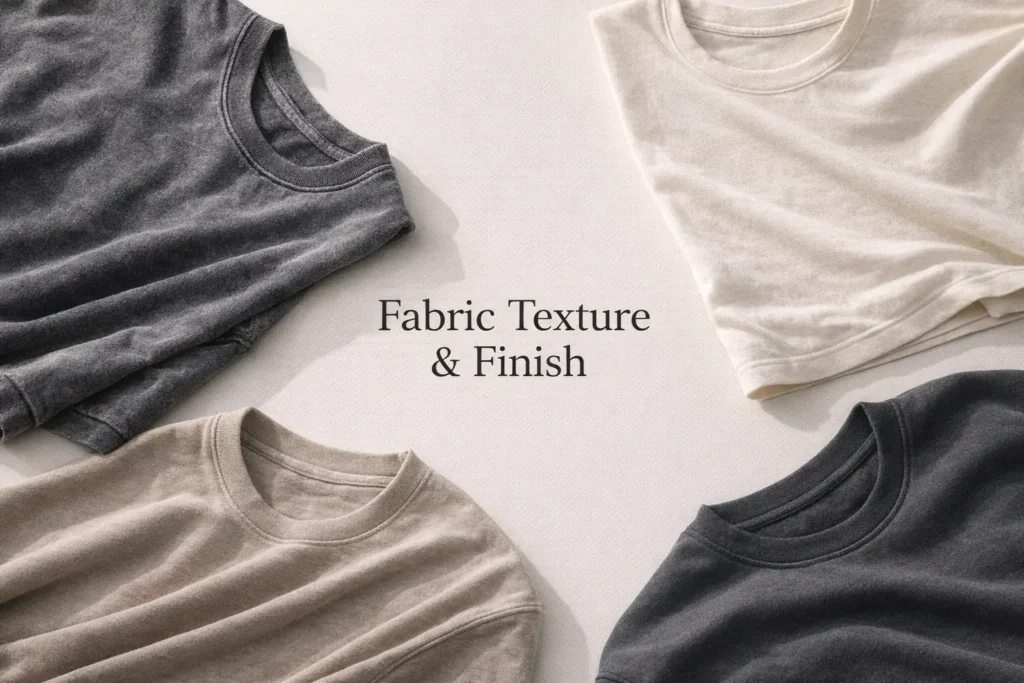
Fabric texture and finish as visual indicators
Fabric texture and finish can make a T-shirt feel current even before the design is fully read.
A washed surface, faded tone, dry handfeel, compact knit, brushed softness, or slightly structured face can all signal different trend directions. In some cycles, a refined premium finish feels current. In others, a worn-in or vintage surface looks more relevant.
This matters because trend does not only appear through shape or print. It also appears through material impression. The finish tells the viewer whether the shirt belongs to a clean minimal lane, a streetwear lane, a heritage lane, or a luxury-casual one. That surface cue often shapes first impression before the rest of the design is fully processed.
How Trending T-Shirts Balance Expression and Usability
Trending T-shirts always operate between two forces: visibility and repeatability.
Their job is to feel current enough to register, but still usable enough to enter real outfits. The tension between those two functions is what makes trend pieces valuable when they work and limiting when they do not.
Statement value vs everyday practicality
A trending T-shirt succeeds when its statement value does not completely destroy everyday practicality.
A shirt can feel current and still remain easy enough to wear in repeated daily outfits. The problem begins when statement value becomes so strong that the garment works only in narrow contexts or only with a highly specific styling system. Then the shirt may still be fashionable, but its practical value drops quickly.
This balance matters because modern wardrobes are not built only for visual impact. They are built for repetition. A worthwhile trend piece usually gives the wearer a noticeable shift in expression without forcing every outfit to become a styling event.
When design enhances vs limits usability
Design enhances usability when it adds direction without creating too many restrictions.
A stronger fit, current graphic, or fresh surface treatment can make a T-shirt more useful by adding energy to otherwise stable outfits. The same design can limit usability when it becomes too loud, too coded, too specific, or too difficult to pair with existing pieces.
That is why trending design should be judged through both excitement and integration. A shirt is stronger when it can change the outfit without breaking the wardrobe. When design only adds difficulty, the trend value becomes expensive in practical terms.
Why trending pieces often prioritize visibility
Trending pieces often prioritize visibility because their main job is to signal currentness clearly.
A basic garment can afford to stay quiet because its value comes from long-term function. A trend-driven garment has to announce its relevance more directly. That usually means more visible changes in fit, surface, or styling language.
This is why trend pieces often feel easier to notice but harder to repeat. Visibility helps them succeed in the moment, but it also increases the risk that they will become tiring or narrower in use. The strongest trend T-shirts manage that visibility without making the garment disposable.
Why Trending T-Shirts Fit into Contemporary Styling Systems
Trending T-shirts remain important because they let wearers update a wardrobe without rebuilding it. In modern urban dressing, they often work as controlled change agents: one current piece can shift the feel of a whole outfit. That role is especially useful in wardrobes otherwise built on stable basics, neutral layers, and repeatable clothing systems.
MODAKNITS’ own framework repeatedly prioritizes modern basics, urban functionality, premium essentials, and scene-based dressing, which makes the role of a trend T-shirt easier to define: it adds variation to a stable system rather than replacing the system itself.
Acting as focal or statement pieces
Trending T-shirts often function best as focal or statement pieces inside otherwise controlled outfits.
They draw the eye through shape, print, finish, or proportion and help establish what the outfit is trying to say first. This makes them useful when the rest of the wardrobe is relatively stable. The shirt becomes the most visible signal of freshness without requiring every other piece to change.
That focal role is one reason trend-driven T-shirts stay relevant in urban wardrobes. They offer high visual effect relative to wardrobe disruption. One shirt can change the tone of an outfit more efficiently than replacing an entire clothing system.
Complementing minimalist or neutral outfits
Trending T-shirts work especially well when they are paired with minimalist or neutral outfits that give them room to lead.
A clean pair of pants, restrained outerwear, and stable footwear can help a current T-shirt read more clearly because the rest of the outfit does not compete with it. This also makes the trend piece easier to wear in daily life. The shirt can hold the freshness while the surrounding pieces protect usability.
This is one of the most practical ways trend enters modern wardrobes. It does not need to dominate the full look. It only needs enough support to feel intentional. Neutral companions make that easier.
Adding variation without rebuilding the wardrobe
Trending T-shirts are useful because they add variation without requiring a full wardrobe reset.
A person with strong basics can change silhouette, energy, or visual relevance quickly by introducing one or two current T-shirts. This is efficient because it allows experimentation at the edge of the wardrobe instead of in the center of it.
That is one reason trend T-shirts remain attractive even to people who otherwise prefer stable clothing. They provide controlled change. When chosen well, they refresh the outfit system without making the existing wardrobe obsolete.
When Trending T-Shirts Work — and When They Don’t
Trending T-shirts are most valuable when their currentness fits the wearer’s life rather than merely the current feed.
They can improve outfits by adding energy and direction, but they can also reduce flexibility when their design becomes too strong or too narrow. This is why trend intensity matters. The more visually specific the shirt is, the more carefully it has to be placed in the wardrobe.
MODAKNITS’ internal segmentation repeatedly emphasizes multi-scene use, comfort, quality, and wardrobe stability, which makes this tension between fresh style and actual usability especially relevant.
Situations where trend pieces enhance outfits
Trend pieces enhance outfits most when the setting allows visible style direction without demanding total neutrality.
Casual social settings, style-conscious urban environments, creative spaces, and everyday outfits built around basics are all situations where a trending T-shirt can add value. In these contexts, the shirt provides freshness and visual interest without feeling out of place.
The trend works because the environment can absorb a stronger signal. The shirt does not need to justify itself through pure practicality alone. It can contribute to expression, currentness, and wardrobe variation in a way that feels natural.
When strong design reduces pairing flexibility
Strong design reduces pairing flexibility when the T-shirt asks too much from the rest of the wardrobe.
An intense graphic, highly specific fit, unusual finish, or strongly coded aesthetic can narrow the types of pants, outerwear, and shoes that work around it. This does not necessarily make the shirt bad. It simply makes it more conditional.
That limitation matters because many buyers mistake visual appeal for versatility. A shirt may look excellent alone and still be hard to integrate repeatedly. Trend T-shirts are strongest when they maintain enough openness to support more than one outfit path.
Why trend intensity affects usability
Trend intensity affects usability because every added signal increases the number of styling decisions the wearer has to solve.
A mildly current T-shirt may offer easy freshness because it changes only one or two visible elements. A highly trend-driven T-shirt may require the rest of the outfit to respond more carefully. That usually lowers repeat use unless the wearer already has a wardrobe built for that level of expression.
This is why moderate trends often outperform extreme ones in real daily life. They give enough currentness to matter, but not so much that the shirt becomes a one-purpose garment.
How Long Trending T-Shirts Stay Relevant
Trend lifespan depends on what part of the design is carrying the trend. Some shifts disappear quickly because they are tied to a narrow cultural moment.
Others last longer because they are attached to broader proportion changes or more stable aesthetic movements. Understanding that difference helps separate disposable trend from transitional relevance.
Short-cycle vs long-cycle trends
Some trends move quickly and some move slowly, and T-shirts can belong to either category.
Short-cycle trends often depend on specific graphics, slogans, internet-coded references, or highly visible novelty. These shirts may feel current very fast and age just as quickly. Long-cycle trends usually emerge through fit, silhouette, restrained surface direction, or material shifts that remain relevant longer because they connect to broader wardrobe change.
This distinction matters because not all trending T-shirts carry the same risk. Some are built for the moment. Others are closer to a transition in how basics themselves are evolving.
Design elements that age quickly vs slowly
Graphics and highly specific visual references usually age faster than proportion and material-led changes.
A back print tied to one cultural meme or a slogan tied to one fashion wave often loses relevance sooner than a well-judged boxy fit or updated surface finish. This does not mean graphics are always disposable. It means their aging curve is often steeper when the design depends heavily on one moment’s attention system.
By contrast, silhouette changes and fabric finishes may age more slowly because they often influence the wardrobe more broadly. They can move from trend signal to normal design language over time.
Why some trends transition into basics
Some trends become basics when their visual logic proves useful beyond the original trend cycle.
A fit that once felt fashion-forward may become normal because people discover it improves comfort, proportion, or styling flexibility. A finish that once felt specific may become standard because it supports a new baseline aesthetic. In these cases, the trend stops being trend-led and becomes part of the basic wardrobe language.
This is one of the most important reasons to judge trends carefully. The best ones often teach the basics something. They do not just decorate the wardrobe temporarily. They help change what the wardrobe expects permanently.
What Makes a Trending T-Shirt Worth Keeping
A trending T-shirt is worth keeping when it continues to earn wear after the first excitement fades.
That usually happens when novelty is balanced with repeatability and when the shirt can integrate into a stable outfit system rather than sitting outside it.
In other words, a worthwhile trend piece does not only look current. It continues to function after the trend signal becomes less urgent.
Balancing novelty with repeatability
A trending T-shirt is strongest when it offers novelty without destroying repeatability.
Novelty matters because trend pieces are supposed to refresh the wardrobe. But if the shirt becomes too memorable, too coded, or too hard to style, its novelty can shorten its useful life instead of extending it. Repeatability is what converts interest into long-term value.
That balance is what separates a good purchase from a one-time reaction. A shirt should feel current enough to matter and stable enough to wear again once the first excitement passes.
Integrating trends into a stable wardrobe system
Trend pieces hold value better when they can integrate into a stable wardrobe system instead of floating outside it.
A T-shirt becomes more worthwhile when it can work with the pants, jackets, and shoes the wearer already owns. This does not mean it must be neutral. It means it should connect to the rest of the wardrobe well enough that it does not require a chain of additional purchases to feel usable.
This is one reason basics remain so important even in trend-led dressing. The system around the trend piece determines whether the trend survives beyond one moment.
Avoiding one-time wear pieces
A worthwhile trending T-shirt should avoid becoming a one-time wear piece whose value ends after one outfit or one season.
The main danger of trend buying is not that the shirt looks current. It is that the shirt has too little repeat path once the initial styling moment is over. This often happens when the design is too narrow, too tied to one reference, or too difficult to combine with ordinary wardrobe pieces.
A stronger choice is the shirt that still feels like it belongs after the first trend wave cools. That is the version more likely to stay useful rather than become dead wardrobe weight.
Why Some Trending T-Shirts Fail in Real Use
Trending T-shirts often fail not because trend is inherently weak, but because people confuse visibility with value.
A shirt can look extremely current and still perform poorly in a real wardrobe if it is hard to pair, too time-specific, or disconnected from how the wearer actually dresses. This is where the biggest mistakes usually happen.
Confusing trend visibility with quality
Trend visibility is not the same as quality.
A T-shirt can be highly noticeable because its fit, print, or design language feels current, but that says very little about fabric quality, construction, comfort, or long-term usefulness. Visibility only tells the viewer that the shirt is active inside the current fashion conversation.
This is an important distinction because users often treat “it looks current” as evidence that the shirt is a strong purchase. In reality, trend relevance and product quality are separate tests. A worthwhile T-shirt should pass both.
Overcommitting to short-lived styles
Trend purchases often fail when the wearer overcommits to styles that are too short-lived to integrate well.
A very specific cut, highly referential graphic, or extremely coded trend may feel exciting precisely because it is intense. But that same intensity often shortens the garment’s use life. Once the trend cools, the shirt can become difficult to wear without feeling dated or overcommitted.
This does not mean all strong trends should be avoided. It means the buyer should know whether they are buying a moment or a more durable design shift.
Ignoring compatibility with existing wardrobe
A trending T-shirt often fails when the buyer ignores whether it actually works with the rest of the wardrobe.
A shirt may be attractive on its own and still create friction once it has to live with existing pants, outerwear, footwear, and personal styling habits. This is one of the most common practical failures in trend buying.
Compatibility matters because trend pieces do not operate in isolation. The more current the shirt, the more important it becomes that the surrounding wardrobe can support it. Without that support, even a visually strong shirt may stay unworn.
How to Identify a Worthwhile Trending T-Shirt
A worthwhile trending T-shirt should pass three tests: it should clearly signal a current direction, fit into the wardrobe without too much friction, and remain wearable after the first wave of novelty passes.
This framework helps separate useful trend pieces from disposable ones.
1.Design signal and trend relevance check
- Start by checking whether the shirt clearly reflects a current design signal rather than looking vaguely different.
- Ask what makes it feel current. Is it the fit, the proportion, the graphic language, the finish, or a specific cultural reference? A strong trend piece usually has a readable reason for feeling relevant now.
- This check matters because not every unusual T-shirt is meaningfully trend-driven. Some are simply inconsistent. A worthwhile trend shirt should feel connected to a real style shift, not random variation.
2.Versatility and integration check
- Next, check whether the shirt can integrate with the rest of the wardrobe without excessive difficulty.
- Look at how it might work with existing outerwear, pants, and footwear. Consider whether it can operate as a focal point in otherwise stable outfits or whether it requires too many supporting changes to make sense.
- A strong trend piece should add direction without creating constant friction. If the shirt is hard to place after the first outfit idea, its practical value is already weaker.
3.Longevity and repeat-wear check
- Finally, check whether the shirt is likely to remain wearable after the first excitement fades.
- Ask whether the trend signal is short-cycle or more durable. Then ask whether the garment still has a repeat path once it is no longer the newest thing in the wardrobe. This is where real value becomes visible.
- A worthwhile trending T-shirt does not need to become a timeless basic. It only needs to remain useful long enough that the purchase feels justified. That is the difference between a good trend buy and a one-time visual reaction.
TL;DR
- A trending T-shirt is defined by current design movement, not by timeless neutrality.
- It differs from a basic T-shirt because it is built more for freshness and direction than for long-term stability alone.
- Trend signals usually come from cultural shifts, fit and proportion changes, graphics, and fabric finish.
- The clearest trend indicators are often silhouette and graphic language.
- A strong trending T-shirt balances statement value with enough wearability to enter real outfits.
- It works best when paired with stable basics and neutral wardrobe pieces.
- Some trends are short-cycle, while others gradually transition into new forms of basics.
- A worthwhile trend piece should still have repeat-wear value after the first excitement fades.
- Common mistakes include confusing visibility with quality and ignoring wardrobe compatibility.
- The best way to judge one is to check trend signal, integration potential, and likely longevity together.

