
 Skip to content
 How Fabric Weight and Airflow Control Daily Comfort Across Bottom Types
Weight and breathability are two of the main reasons bottoms feel easy, tiring, or difficult to wear in daily life.
A garment can look clean and well made, yet still feel too hot, too heavy, or too closed once the wearer moves through commuting, indoor heating, outdoor exposure, and repeated activity.
That is why bottom comfort should be judged as a system, not as a single first-touch impression.
Fabric weight affects movement, fatigue, and how present the garment feels on the body. Breathability affects heat buildup, moisture release, and whether the garment stays manageable across different parts of the day.
Bottom discomfort usually comes from imbalance.
The garment may hold too much heat, carry too much physical weight for the activity level, or restrict airflow enough that ordinary wear becomes tiring.
These problems often appear gradually rather than immediately.
Bottoms usually feel too hot or uncomfortable when the fabric traps heat, resists movement, or carries more physical weight than the day can support.
Overheating often comes from dense or poorly ventilated fabric that keeps body warmth too efficiently.
Stiffness adds discomfort because the material does not settle naturally with the body and begins to feel heavier than its actual weight. Trapped heat becomes especially noticeable during walking, commuting, indoor sitting, and ordinary movement, where the lower body keeps generating warmth without enough release.
These failures are common because many people judge bottoms by handfeel first and actual thermal behavior later.
That is why temperature comfort should never be judged by first touch alone.


Comfort changes because the body, the environment, and the garment keep affecting each other throughout the day.
A bottom that feels fine in a cool room can become warm after walking outside, sitting on transit, or spending several hours indoors.
The same fabric may seem manageable at first and less wearable later as heat, pressure, and moisture accumulate.
This is why real comfort cannot be judged from one moment alone.
It has to be judged across transitions, time, and movement. Daily wear is rarely stable enough for a garment to perform in only one condition and still feel truly versatile.
Weight and airflow are hidden comfort drivers because they shape how the garment behaves after first touch stops mattering.
Users often notice softness first, but weight and ventilation usually determine whether the garment stays easy to wear.
A fabric that is too heavy may increase fatigue and reduce movement ease. A fabric with poor airflow may feel closed and warm even in mild conditions.
These issues are often subtle at first and become more obvious only after longer wear.
That is why real comfort depends less on whether the material feels premium in the hand and more on whether its weight and airflow match actual daily use.
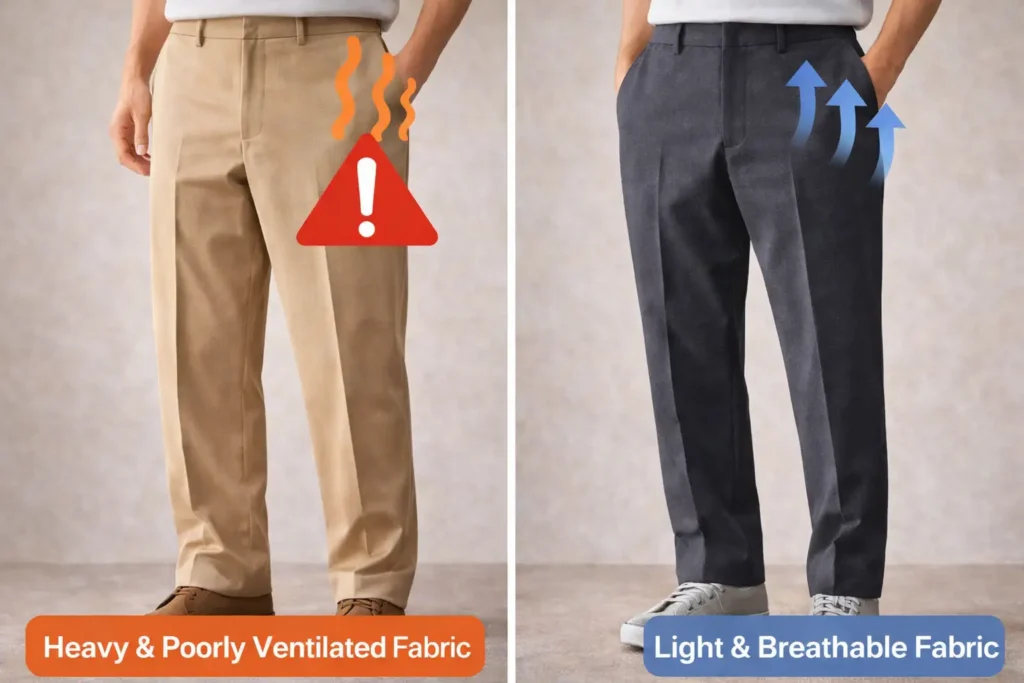
Weight changes how bottoms move, how quickly they create fatigue, and how much heat they tend to retain.
In everyday wear, the best weight is usually not an extreme.
It usually sits in a middle range that supports both structure and all-day manageability.
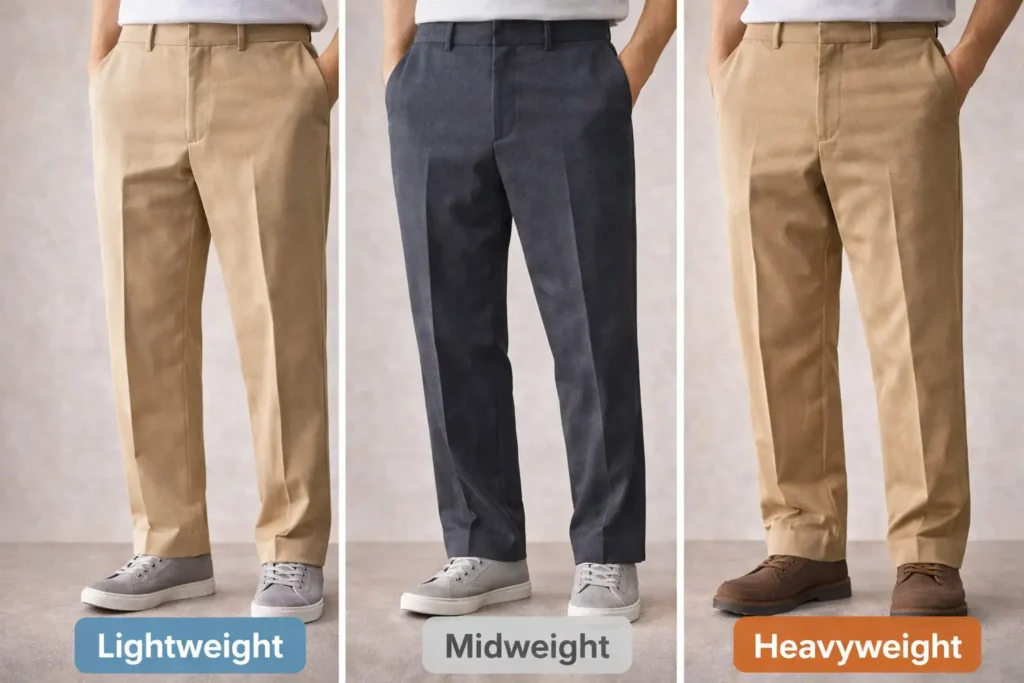
Lightweight, midweight, and heavyweight bottoms create different comfort expectations because each one solves a different balance problem.
Lightweight bottoms usually feel easier to move in and often work well for warm conditions or longer wear.
Midweight bottoms tend to offer the broadest balance between structure, comfort, and versatility. Heavyweight bottoms may feel more substantial and protective, but they are also more likely to hold heat and feel demanding in mixed indoor–outdoor conditions.
The right category depends on use case, but for most daily urban situations, weight should support versatility rather than push the garment into one narrow environment.
Fabric weight affects movement because heavier bottoms usually create more drag, more heat, and more cumulative fatigue over time.
The difference may not feel dramatic in the first few minutes, but it becomes clearer after walking, climbing stairs, sitting for long periods, or moving through several hours of ordinary activity.
Heavy fabrics make the garment feel more present and physically noticeable. Very light fabrics can avoid that burden, but if they become too insubstantial, they may lose shape and feel less dependable.
This is why weight should be judged through duration, not just through handfeel.
Everyday comfort is strongest when the wearer does not feel the bottom becoming heavier as the day continues.


The best urban daily weight is usually a balanced middle range that supports structure without creating unnecessary burden.
Bottoms for city life need enough body to look stable and remain broadly usable in public settings, but not so much body that they become hot, stiff, or tiring indoors.
That middle zone is often the most effective because it can handle commuting, casual public settings, work-adjacent use, and ordinary movement without becoming too specialized.
It also tends to adapt more easily across changing temperatures and activity levels than either very light or very heavy constructions.
That is why balanced weight usually performs better than extremes in daily urban wear.
Breathability should be judged by whether the garment helps the body stay stable through ordinary use, not by whether the fabric sounds technical.
Good airflow often feels quiet.
It reduces heat buildup before the wearer starts noticing the garment too much.
Breathability in bottoms means the fabric can release enough heat and moisture to prevent the garment from becoming stuffy over time.
It does not necessarily mean the fabric feels open or airy in the hand.
In practice, it means the garment remains manageable through commuting, indoor wear, casual walking, and long seated periods without trapping too much warmth.
This matters because lower-body garments cover areas that stay in contact with the body for long hours.
If the fabric cannot release accumulated heat, comfort usually declines even when the weather is not extreme.


Breathability is partly a trade-off between airflow and density because denser fabrics usually bring more control while reducing ventilation.
Dense fabrics often provide stronger visual structure, cleaner drape, and better stability.
But they can also hold heat more easily. More open or lighter structures may improve airflow, but if they go too far, they can lose body, become less adaptable, or feel underprepared for mixed urban conditions.
That is why breathable bottoms should not be chosen by airflow alone.
The better question is whether the fabric allows enough air movement without giving up too much structure and daily usefulness.
Poor ventilation causes discomfort even in mild conditions because the body still produces heat during ordinary movement.
A wearer does not need extreme weather to feel trapped in poorly ventilated bottoms.
Sitting indoors, walking short distances, climbing stairs, or standing in transit are enough to create heat that has to be released.
If the fabric cannot release it, the garment starts feeling warmer, heavier, and more demanding than expected.
That is one reason users often describe some garments as “fine at first” and “annoying later” without always knowing why.

Temperature comfort is not only about staying cool or warm.
It is about how well the garment regulates heat across changing conditions.
In daily wear, that regulation usually matters more than any single seasonal feature.
Thermal comfort depends on balancing heat retention and heat release rather than maximizing either one.
If the bottom retains too much heat, it becomes stuffy indoors and tiring during movement.
If it releases heat too quickly or lacks enough body, it may feel underprepared in cooler outdoor conditions or transitional weather.
Useful daily bottoms usually sit in a moderate middle zone.
They hold enough warmth to remain wearable across normal conditions while still allowing excess heat to escape as the day becomes warmer or more active.
Indoor–outdoor transitions are one of the most useful tests of whether a bottom is thermally balanced.
A garment may feel fine outdoors and then overheat indoors. It may feel calm indoors and become too exposed once the wearer steps outside.
These transitions matter because daily life rarely happens in one stable climate.
The best bottoms stay reasonably usable through transit, office interiors, walking, and casual indoor time without making the wearer feel overdressed or underprepared.
That kind of balance is usually more valuable than high performance in one isolated environment.
Insulation becomes a problem when a bottom is warm enough for one condition but too closed for the rest of the day.
This usually happens when the fabric is chosen for a narrow climate moment instead of for mixed daily use.
In ordinary life, too much retained warmth often becomes more noticeable than too little, especially in transit, office interiors, or long wear windows.
That is why insulation should be judged by total-day behavior, not by one outdoor impression.
If the garment only feels correct in one part of the day, it is usually too specialized to be a strong everyday option.
Thickness influences comfort, but it does not define it by itself.
Some heavier fabrics breathe well, while some lighter fabrics still feel hot and closed.
The real issue is how weight, structure, and airflow behave together.
A heavy fabric can still feel comfortable if it breathes well, while a light fabric can still feel uncomfortable if it traps heat.
This is why thickness alone is an incomplete comfort metric.
Some materials feel substantial but allow enough heat release to remain wearable through long hours. Others feel light in the hand yet become sticky, closed, or airless because their structure does not ventilate well.
In real use, the wearer experiences the full system, not isolated traits.
That is why lighter does not automatically mean cooler, and thicker does not automatically mean too warm.
Fabric structure influences ventilation as much as raw weight does, which is why two fabrics of similar heft can feel very different.
Yarn behavior, knit or weave construction, density, and internal openness all affect how air moves and how heat escapes.
Two bottoms can therefore carry similar weight but feel very different in real wear if the internal structure handles airflow differently.
That is why structure is not a background detail.
It is part of the thermal result. Material performance should be judged in motion and over time rather than by touch alone.
Balance matters more than extremes because daily bottoms have to solve several comfort problems at once.
A useful bottom has to feel manageable indoors, breathable enough during movement, stable enough to look composed, and versatile enough to remain useful across different routines.
Extreme lightness can weaken stability. Extreme density can weaken airflow. Extreme openness can reduce adaptability.
Everyday comfort usually comes from controlled middle-ground performance rather than maximum expression of one feature.
That is why the most dependable daily bottoms are often the ones that stay usable across the widest range of ordinary conditions.
Temperature comfort changes as soon as the body moves.
That is why a bottom that feels acceptable while standing still can become much less comfortable during ordinary daily activity.
Movement reveals how the fabric handles heat, friction, and accumulated body demand.
Walking and commuting increase heat buildup, which makes breathability and weight more important than they first appear.
Even low-level daily movement raises body temperature.
Short walks, stair climbing, standing in transit, and general mobility all add thermal load. If the garment does not release that heat, it begins to feel more noticeable and more tiring as the day develops.
This effect is often strongest in commuting because the wearer moves between motion, waiting, and enclosed environments without much chance for reset.
That is why movement makes hidden comfort weaknesses easier to notice.
Sitting and active movement create different thermal demands, which is why some bottoms feel inconsistent across the day.
While sitting, users often notice pressure, warmth concentration, and whether the fabric feels too closed in one position for too long.
During active movement, they notice airflow, drag, and how quickly heat builds.
A garment that performs well in one state can still fail in the other. A bottom may feel fine while standing and become warm during long sitting, or feel calm in stillness and become stuffy once walking begins.
That is why both conditions matter in evaluation.
Static comfort differs from real-use comfort because the body changes the garment once movement begins.
A bottom can feel soft, light, and acceptable while standing still.
Real comfort is tested when the garment bends, warms, stretches, and responds to repeated action. That is why so many thermal problems appear later rather than immediately.
For everyday wear, dynamic comfort is the more useful standard.
A garment should not only feel calm at rest. It should stay calm after real life starts acting on it.
The same comfort framework applies across bottom types, but the needs still shift by category.
Different garments create different coverage levels, airflow paths, and thermal expectations.
That means weight and breathability should be interpreted relative to garment type, not as universal rules.
Pants usually face greater heat-retention challenges because they cover more of the body for longer periods.
That makes breathability more important and makes overly heavy or overly dense fabrics more noticeable in daily use.
Pants also move through more mixed indoor–outdoor settings, which increases the need for thermal balance rather than one-direction climate performance.
A fabric that feels acceptable in one category may feel too warm in full-length pants simply because the garment holds more heat overall.
Shorts usually have a natural airflow advantage, but that also means they provide less thermal control in mixed environments.
Because more of the leg is exposed, shorts can feel easier in heat even when the fabric itself is not doing as much ventilation work.
But that same openness can reduce comfort in stronger air conditioning, cooler transit environments, or multi-scene days where thermal exposure changes quickly.
This makes shorts strong in simpler warm settings but less universally adaptable than well-balanced full-length bottoms.
Category affects comfort expectations because coverage, movement pattern, and use context all change the meaning of comfort.
A fabric that feels breathable enough in shorts may not be breathable enough in pants.
A weight that feels supportive in full-length bottoms may feel too dense in lighter casual categories.
That is why category matters. The same fabric behavior is experienced differently once the garment type changes.
Good judgment depends on reading the material through the role of the garment, not through one abstract standard.
Temperature discomfort is often the result of predictable decision mistakes.
Many users judge thickness by touch, overvalue structure at the cost of airflow, or choose too specifically for weather instead of for daily use.
These errors usually lead to garments that feel less usable in real life than they seemed at purchase.
Choosing by thickness alone is a common mistake because thickness does not reliably predict temperature comfort.
A fabric that feels substantial may still breathe well. A fabric that feels light may still trap heat.
What matters is how it behaves under movement, body heat, and changing environments, not just how it feels in the hand.
Users who choose by touch alone often misread the real wear experience.
That is why performance should be judged through use logic rather than simple material impression.
Ignoring breathability in favor of structure often produces bottoms that look stable but feel tiring over time.
A clean line and controlled silhouette can be valuable, but if the fabric does not ventilate enough, the garment may become too warm, too closed, or too noticeable through normal daily use.
This trade-off is especially damaging in routines that include indoor wear, public transit, and long seated periods.
Structure matters, but it should not come at the cost of thermal wearability.
The better option is usually fabric that offers both controlled form and enough airflow to remain manageable.
Over-specializing for climate is a mistake when it reduces how well the bottom works through ordinary mixed conditions.
A garment chosen only for heat or only for cold may perform well in that narrow scenario and poorly once the wearer enters normal indoor–outdoor transitions.
Everyday bottoms need a broader range. They should handle ordinary variation without forcing the wearer into one highly specific use case.
Over-specialized fabric often lowers the value of the garment because it reduces repeat usability.
For daily wear, moderate adaptability is usually more useful than climate extremity.
The best way to judge thermal comfort is to evaluate the fabric as a system.
Weight, airflow, and adaptability should be assessed together rather than as isolated claims.
A strong everyday bottom should feel manageable in motion, ventilated enough for daily use, and stable across changing environments.
1.Weight and mobility check
2.Breathability and airflow check
3.Temperature adaptability check
We’ll get back to you within 24 hours. Attach your logo/design if needed.
💡 1 . Share your logo, fabric, and quantity for T-shirts, hoodies, and more.
📐 2. We’ll prepare samples for your approval.
🚚 3. Bulk production starts after deposit.
✅ We value your privacy. Your information is 100% safe and confidential.
📦 Need help? Chat with us via WhatsApp anytime!

Note: Your email information will be kept strictly confidential.
Note: Your email information will be kept strictly confidential.
Request a quote, discuss MOQ, lead time, fabrics & QC.
Visit our brand store: Modaknitswear
Retail orders (and dropshipping options) are available on Modaknitswear.