
 Skip to content
 Categories, Standards, and Long-Term Value of Everyday Bottom Wear
In modern everyday wear, “bottoms” are not just lower-body garments.
They are the foundation pieces that determine comfort, movement, practicality, and how easily a wardrobe functions across daily life.
For MODAKNITS, this matters because the brand is positioned around fabric research, urban knit engineering, multi-scene adaptability, and durable modern basics rather than single-purpose fashion items.
Everyday bottoms qualify as foundational pieces when they can support repeated wear, stay comfortable across mixed settings, and reduce wardrobe friction through versatility and stability.
That is why bottoms should be judged not only by category, but by whether they work as dependable urban essentials over time.
“Bottoms” is a broad category, but everyday bottoms are a more specific functional group.
The difference matters because not every lower-body garment belongs in an everyday essentials wardrobe.
The useful question is not only what counts as bottoms, but which bottoms remain practical, repeatable, and adaptable in daily use.
In modern apparel, bottoms are garments designed for the lower half of the body, built to provide coverage, movement support, and visual structure.
This category includes garments that define the lower silhouette and influence how the body moves, sits, and appears in daily life.
In modern wardrobes, bottoms are not only practical layers. They are also structural pieces that shape how outfits function across commuting, leisure, public settings, and repeated wear.
That is why bottoms are one of the most important categories in any everyday clothing system.


The main everyday bottom categories are pants, shorts, and other casual lower-body garments, but they do not serve the same role equally well.
Pants are usually the broadest everyday category because they combine coverage, structure, and versatility across mixed settings.
Shorts are more situational, often strongest in warmer conditions or simpler casual use. Softer or more specialized lower-body garments may add ease or airflow, but they often reduce social adaptability or cross-scene wearability.
That is why bottoms are best understood as a layered category rather than a single product type.
Bottoms are most usefully classified by function first and style second.
A stylistic label can describe how a bottom looks, but functional classification explains what it can actually do in daily life.
Some bottoms are built for commuting and long wear. Some are better for heat and airflow. Some are designed for light activity, while others are better suited to cleaner social use.
That is why functional context is the more useful classification system for everyday wardrobes.

Everyday essentials are defined by repeat use, not by category alone.
A bottom becomes essential when it can handle ordinary routines with low friction in comfort, maintenance, and styling.
That is why versatility is the central test of everyday suitability.

Everyday bottoms differ from occasion-specific garments because they are built for repetition across ordinary life, not one narrow use case.
Occasion-specific garments may perform strongly in a limited setting, but everyday bottoms have to stay useful across more than one condition.
They should work in daily movement, casual public life, and ordinary transitions without demanding special styling or environmental conditions.
In a modern urban wardrobe, that repeatable usefulness is what separates essentials from pieces that are only situationally good.
Versatility defines everyday suitability because daily life rarely stays inside one fixed scenario.
People move between home, transit, work-adjacent spaces, social settings, indoor environments, and light outdoor exposure.
A bottom that only works in one narrow condition adds wardrobe friction. By contrast, a versatile bottom supports more of the day without demanding a change in logic.
That is why versatility remains one of the clearest standards for everyday wardrobe value.


Bottoms support daily repeat wear when they stay comfortable, easy to pair, and structurally stable across repeated use.
A useful everyday bottom should not feel difficult to maintain or hard to integrate into normal dressing.
It should survive movement, washing, and routine wear without becoming unreliable too quickly.
Repeatability is not a secondary value. It is one of the clearest markers of an everyday essential.
Everyday bottoms are practical when they support movement, adapt to different settings, and remain easy to wear repeatedly.
Function matters because lower-body garments are exposed to constant stress through walking, sitting, commuting, and long-duration wear.
A good everyday bottom must stay useful through all of these ordinary demands.
Everyday bottoms must support comfort and mobility because daily wear includes constant low-level movement.
Walking, sitting, climbing stairs, commuting, and changing posture all test whether a bottom allows the body to move naturally.
If the garment feels restrictive, unstable, or tiring after ordinary use, it loses value quickly.
That is why mobility and comfort are core requirements, not optional upgrades.


Practical everyday bottoms should adapt across different environments and activity levels without becoming unreliable.
A bottom that works only for stillness, only for heat, or only for highly casual conditions is less useful than one that can move between indoor and outdoor spaces, light activity, and ordinary public settings.
Real value comes from multi-condition wearability rather than narrow optimization.
This is one reason everyday bottoms need broader performance logic than specialized garments.
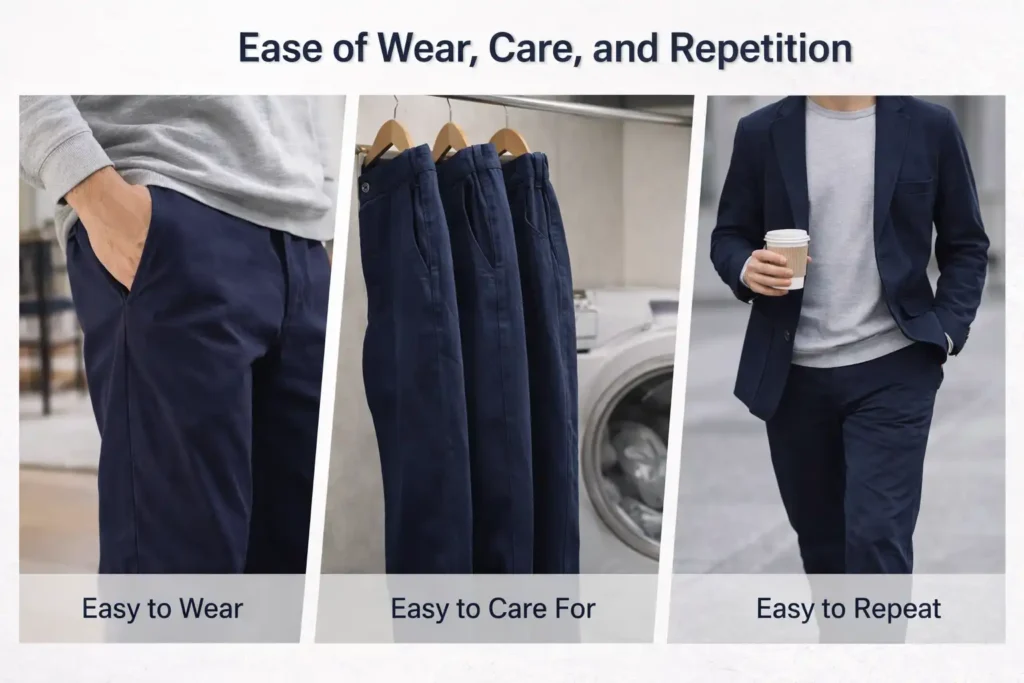
A strong everyday bottom should be easy to wear, easy to care for, and easy to repeat.
This means the garment should not create unnecessary maintenance burden, styling burden, or reliability problems after a few wears.
If it wrinkles too easily, loses shape too fast, or becomes hard to pair, its practical value drops even if it looked good at first.
Ease of repetition is a functional requirement because everyday clothing only becomes valuable when it stays easy to live with.
High-quality bottoms are defined by how they perform over time, not by surface appearance alone.
Fabric behavior, construction integrity, and long-term shape retention all matter because everyday use exposes weaknesses quickly.
A bottom is high quality when it stays comfortable, stable, and reliable after repetition, not only at first wear.
High-quality bottoms begin with fabric that balances durability, breathability, and recovery.
Durability matters because everyday garments face frequent washing and repeated pressure.
Breathability matters because long wear and mixed environments can quickly expose trapped heat and poor airflow. Recovery matters because the garment must return from sitting, walking, and movement without bagging out or losing control.
These three factors work together. If one is weak, long-term daily performance usually drops.
Construction quality matters because fabric can only perform well if the garment is assembled to support it.
Seams, stress-point reinforcement, waistband behavior, and overall structural balance determine whether the bottom stays coherent through normal use.
Weak construction can cause twisting, loosening, or premature decline even when the fabric itself feels good.
That is why durability should always be judged as a whole-garment issue, not a fabric-only issue.
Long-term wear behavior is one of the clearest indicators of whether a bottom is truly high quality.
A strong everyday piece should not only fit well when new. It should continue to hold its shape, recover from stress, and remain visually controlled after repeated wear and washing.
Shape retention matters because a garment that collapses too quickly becomes less comfortable and less useful even before it is fully damaged.
That is the difference between short-term appeal and true wardrobe quality.
Practical design elements matter because small construction decisions often determine whether a bottom remains easy or annoying in real daily use.
Waist behavior, pockets, and fit structure all shape whether the garment feels supportive across movement and ordinary routines.
Good design reduces friction without drawing attention to itself.
Waist construction matters because it controls whether the garment stays secure and comfortable through long wear.
A useful everyday bottom should stay in place without digging, slipping, or requiring constant adjustment.
Weak waist construction often causes the whole garment to feel less reliable because the upper block stops supporting the rest of the fit properly.
In daily use, waist stability is one of the clearest signs that the design has been built for repetition rather than only for first impression.
Pocket design improves everyday usability when it supports carrying needs without distorting the garment.
Good pocket placement adds practical value because daily life often includes phones, keys, transit items, and small essentials.
But pocket utility must be balanced with structural control. If the layout is weak or the storage zones distort the shape too easily, the bottom becomes less stable and less useful.
Practical storage works best when it remains integrated and visually quiet.
Fit structure improves usability when it allows movement without adding excess bulk or instability.
Everyday bottoms should give enough room for sitting, walking, and repeated motion while still keeping the silhouette controlled enough for public wear.
This is why fit should be judged through balance rather than by labels such as slim or relaxed alone.
The strongest fit is the one that supports body movement and visual stability at the same time.
Everyday bottoms do not need to look formal, but they do need to feel socially usable.
The strongest options are the ones that appear clean, neutral, and calm enough to work across ordinary public interactions without looking careless or overly refined.
This balance is especially important in modern urban wardrobes built around repeated casual use.
Everyday bottoms should look clean and composed without becoming too formal for ordinary life.
A clean appearance improves range because the garment can move more easily between errands, commuting, social settings, and work-adjacent environments.
But if the bottom becomes too tailored or too dress-driven, it may lose the easy repeatability that defines true essentials.
The strongest everyday pieces usually sit in the middle: presentable without stiffness, relaxed without collapse.
Neutral design improves everyday usefulness because it widens pairing range across the wardrobe.
A bottom that avoids excessive pattern, aggressive color, or overly specific design language usually works with more tops, more footwear, and more outer layers.
This matters because daily versatility depends on how easily a garment enters useful outfits.
Neutral design does not mean boring. It means the garment stays cooperative.
The strongest everyday bottoms balance relaxed comfort with presentable structure.
If they lean too far toward softness or exposure, they may lose social range. If they lean too far toward refinement, they may become harder to repeat casually.
The useful middle ground is what allows the garment to work across ordinary public life without forcing the wearer into either overstatement or overcorrection.
That balance is central to modern urban essentials dressing.
Versatility is not a bonus in everyday bottoms.
It is one of the category’s main requirements. Lower-body garments become foundational when they can move across daily life with minimal friction in comfort, function, and social appropriateness.
This is especially true in urban wardrobes, where routines are fast, mixed, and often unpredictable.
Everyday bottoms should work across commuting, daily routines, and ordinary social interaction without feeling misplaced.
That does not mean every bottom has to perform equally in every scene.
It means the strongest ones remain usable and believable across the most common ones. Commuting demands movement and comfort. Daily wear demands ease and repeatability. Casual interaction demands enough visual control to feel socially usable.
A true essential should solve all three reasonably well.
Indoor–outdoor adaptability matters because modern daily life rarely stays in one environment.
People move between streets, transit, offices, cafés, homes, and stores.
A bottom that only feels right in one temperature or one exposure level is less useful than one that can stay stable across those changes.
Environmental flexibility is therefore a central standard for everyday bottoms, not a niche benefit.
Multi-scene usability is a core requirement because modern wardrobes are expected to do more with fewer pieces.
Customers increasingly value garments that can switch between commuting, leisure, light activity, and casual public use without requiring a separate category for each need.
A bottom that works only inside one narrow lane may still be good, but it is less likely to become a true everyday foundation.
That is why multi-scene performance is one of the clearest tests of wardrobe value.
Reliable wardrobe staples earn their place through repeat use and long-term usefulness.
Everyday bottoms should not only work now. They should remain relevant, easy to style, and worth keeping in regular rotation over time.
That is what turns category presence into actual wardrobe value.
Strong everyday bottoms create value because they are easy to repeat without high styling or maintenance cost.
A useful staple is one that reduces decision fatigue rather than adding to it.
If the garment pairs easily, wears comfortably, and stays reliable through normal life, it naturally remains in rotation.
Low-friction repeatability is one of the clearest signals that the garment belongs in an essential wardrobe system.
Timeless functionality usually creates more long-term value than trend-driven design.
Trend-led bottoms may gain attention quickly, but they often narrow pairing range or become harder to repeat once novelty fades.
Everyday staples usually work better when they avoid excessive specificity and focus on calm utility, balanced design, and broad usability.
That is why long-term wardrobe value usually comes from stable function rather than short-cycle visual impact.
Cost-per-wear improves when bottoms combine durability, versatility, and repeat use over time.
A bottom offers higher long-term value when it survives ordinary wear, keeps working across multiple scenarios, and remains easy to wear often.
That is what gives the garment value density. The user is not only paying for one look or one occasion. They are paying for long-term stability across many wears.
Longevity matters because repeated usefulness is what makes a staple a staple.
Many bottoms are labeled as casual or daily options but fail when exposed to real-life repetition.
The most common reasons are over-specialization, imbalance between comfort and structure, and lack of attention to long-term performance.
Understanding these mistakes helps define what true everyday essentials actually are.
1.Over-specialization limiting versatility
2.Comfort without structure (or vice versa)
3.Ignoring long-term wear performance
We’ll get back to you within 24 hours. Attach your logo/design if needed.
💡 1 . Share your logo, fabric, and quantity for T-shirts, hoodies, and more.
📐 2. We’ll prepare samples for your approval.
🚚 3. Bulk production starts after deposit.
✅ We value your privacy. Your information is 100% safe and confidential.
📦 Need help? Chat with us via WhatsApp anytime!

Note: Your email information will be kept strictly confidential.
Note: Your email information will be kept strictly confidential.
Request a quote, discuss MOQ, lead time, fabrics & QC.
Visit our brand store: Modaknitswear
Retail orders (and dropshipping options) are available on Modaknitswear.