
 Skip to content
How to Achieve Relaxed Structure Without Shapeless Collapse
Cotton oversized T-shirts require stricter proportion control than heavyweight versions.
Cotton’s natural softness increases drape and flexibility, reducing structural forgiveness.
This page defines the measurable proportion rules that allow relaxed structure without visual collapse.
Why Cotton Changes Oversized Proportion Rules
Cotton behaves differently from dense heavyweight fabrics.
Its softness increases movement and collapse risk.
Oversized proportion must compensate for that flexibility.
Cotton’s softness reduces structural resistance.
Heavyweight fabrics naturally hold shape due to density. Standard cotton, especially midweight or soft-knit cotton, falls more freely. This increased drape narrows the acceptable oversized range.
If expansion is too aggressive, cotton collapses rather than frames the body. To judge correctly, observe how the shirt behaves when stationary. If it maintains outline without stiff resistance, proportion is controlled. If it folds inward and loses shape, volume exceeds fabric capacity.


Cotton oversized silhouettes tolerate less exaggeration.
Because cotton lacks the structural firmness of heavier textiles, excessive width or drop shoulders quickly appear shapeless. What looks controlled in heavyweight can look careless in cotton.
Evaluate proportion from a distance. If looseness reads intentional rather than accidental, the tolerance window has not been exceeded. Cotton demands moderation.
Volume must be distributed strategically.
In cotton, oversized design should emphasize balanced width expansion and moderate shoulder extension rather than extreme proportions. Structure must be visually implied through proportion logic rather than fabric rigidity.
If looseness appears evenly distributed and stable during movement, volume is compensating correctly for flexibility.

How a Cotton Oversized T-Shirt Should Sit on the Shoulders
The shoulder seam is the structural anchor of oversized fit.
In cotton garments, shoulder control prevents collapse.
Excessive drop destabilizes the silhouette.

A controlled shoulder drop appears deliberate.
The seam should extend slightly beyond the natural shoulder point while maintaining sleeve angle alignment. In cotton, excessive drop causes sleeves to rotate forward or collapse inward.
Raise your arms slightly. If the shirt shifts dramatically or the shoulder seam drifts unpredictably, drop is excessive. Stability indicates correct proportion.
Extension should be moderate and proportional.
A slight displacement creates relaxed presence. An extreme drop elongates the upper body visually and increases fabric pooling under the arm.
Observe seam placement relative to the upper arm. If extension remains within a visually balanced range without pulling fabric downward, proportion remains controlled.
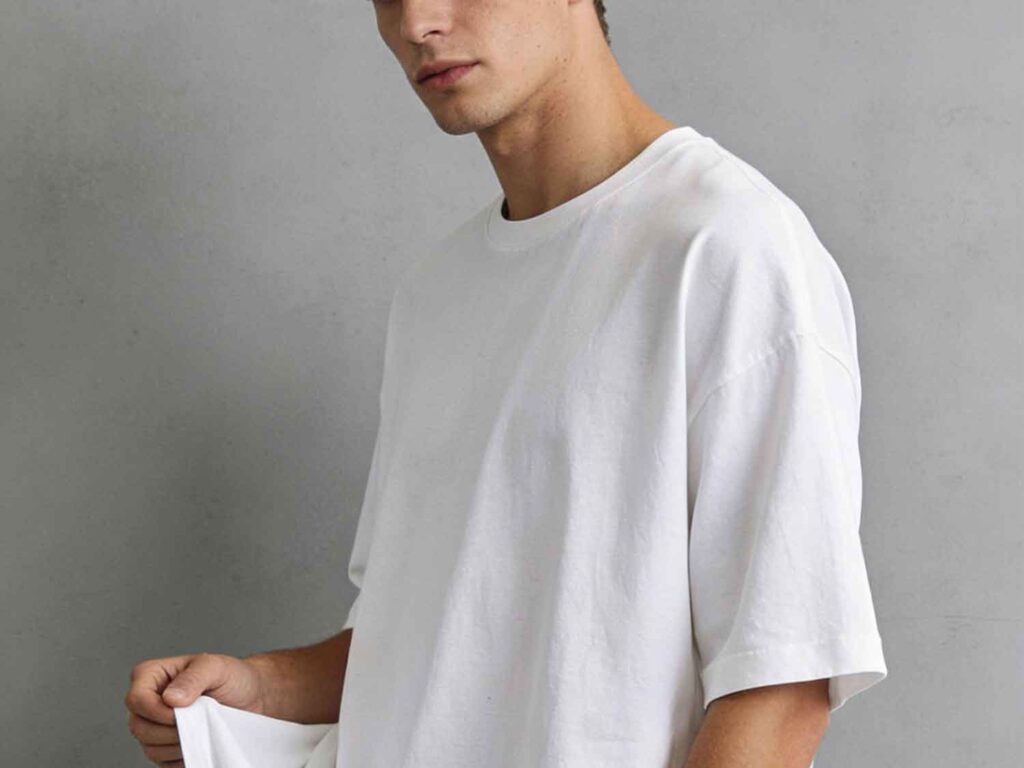

Too much shoulder extension removes structural anchor.
In soft cotton, gravity exaggerates seam displacement. This creates sloping lines and distorted sleeve hang.
If shoulder lines appear rounded or sagging rather than clean, drop exceeds structural support. Cotton requires tighter shoulder discipline than heavyweight fabrics.
How Loose Should the Upper Body Be?
Upper body width defines oversized identity.
In cotton, expansion must allow space without ballooning.
Horizontal spread is the primary risk.
Width should create separation, not inflation.
Cotton drapes inward more easily than rigid fabrics. Excessive width can create balloon-like curvature at the sides.
Observe side seams at rest. If they fall vertically with slight distance from the torso, allowance is correct. If they arc outward prominently, ballooning is occurring.


Side-line fall reveals proportion balance.
Soft cotton should fall straight downward. If width is excessive, fabric may gather at the waist or cling unevenly.
Check side profile. Clean vertical fall indicates structural alignment. Uneven collapse suggests imbalance.
Horizontal expansion widens the frame visually.
In cotton oversized fits, too much chest width increases lateral emphasis without structural counterbalance.
If the silhouette appears wider than shoulder intention, reduce width expansion. Cotton demands narrower expansion than heavyweight alternatives.

Why Proportion Balance Matters More Than Absolute Size
Oversized fit is governed by ratio, not dimension alone.
Length must support width logically.
Imbalance exaggerates looseness.
Length should complement width expansion.
When width increases moderately, length should extend proportionally but not excessively. This preserves vertical clarity.
If hem placement aligns with mid-hip while width remains controlled, ratio is stable.
Excessive length amplifies shapelessness.
Long cotton tees combined with expanded width create elongated blocks lacking structure.
If the shirt extends far below hip level relative to shoulder drop, looseness appears exaggerated rather than modern.
The visual center should remain balanced.
Oversized silhouettes should not shift visual weight downward. Balanced proportion maintains mid-torso focus.
If the lower half dominates visually, ratio adjustment may be necessary.
How to Choose the Right Size for Cotton Oversized
Size choice is structural judgment.
Oversized design should be built into the garment.
Sizing up is rarely the correct solution.
Designed oversized fits recalibrate proportion.
Simply choosing a larger size increases length and width uniformly, often destabilizing cotton drape.
If shoulder displacement and sleeve volume remain unchanged, the garment is upsized, not engineered oversized.
Size charts reveal proportional intent.
Compare shoulder width, chest width, and length ratios rather than relying on labeled size.
If measurements increase evenly without structural differentiation, reconsider selection.
Excess sizing removes structural anchor.
In cotton, overly large sizing increases pooling and drape collapse.
If fabric gathers excessively at the waist or hem, size exceeds stability threshold.
How to Keep Cotton Oversized from Looking Collapsed
Shapelessness occurs when looseness lacks control.
Edge clarity and balanced distribution prevent collapse.
Cotton requires visible structure cues.
Edges define silhouette.
Sleeves should retain subtle firmness. Hems should remain clean rather than curling excessively.
If sleeve openings flare outward dramatically or collapse inward, structure is compromised.
Looseness should be evenly distributed.
If one area (such as chest or hem) dominates, silhouette becomes uneven.
Observe the garment frontally. Balanced space around torso indicates controlled looseness.
Pooling signals over-expansion.
Fabric should not bunch excessively at the waist or underarm.
If folds accumulate disproportionately, proportion exceeds cotton’s drape capacity.
When Cotton Oversized Becomes Too Loose
Upper limits must be respected.
Exceeding cotton’s structural capacity results in collapse.
Modern urban fit favors controlled looseness.
If shoulder seams drop excessively, silhouette weakens.
Excess drop causes rounding and instability in soft fabrics.
Clean horizontal alignment indicates acceptable range.
Width must align with fabric strength.
If cotton cannot hold the expanded outline, it collapses inward.
When vertical lines distort into curved arcs, width exceeds tolerance.
Vertical clarity maintains authority.
Oversized cotton should elongate subtly without appearing sagged.
If vertical flow disappears into shapeless folds, proportion boundary is crossed.
How Proportion Tolerance Differs by Fabric Weight
Fabric weight changes acceptable proportion.
Cotton offers flexibility but less structural forgiveness.
Heavyweight allows broader expansion.
Cotton adapts quickly to movement.
This flexibility enhances comfort but narrows tolerance for exaggerated width or drop.
Controlled moderation preserves clarity.
Heavyweight fabrics hold outline independently.
They tolerate wider expansions without immediate collapse.
This explains why identical proportions behave differently across fabric types.
Cotton depends on proportional logic for structure.
Without fabric rigidity, silhouette must rely on drafting balance.
Therefore, cotton oversized requires tighter structural discipline than heavyweight equivalents.
How to Judge If a Cotton Oversized T-Shirt Fits Correctly
Fit evaluation requires systematic checks.
Each dimension must align with fabric behavior.
Proportion stability defines legitimacy.
1.Shoulder alignment check
2.Width containment check
3.Length balance check
4.Silhouette stability check
Cotton oversized fit requires stricter proportion control than heavyweight versions.
Softness reduces structural forgiveness.
Correct fit depends on moderated shoulder drop, controlled width, balanced length, and stable silhouette behavior.
We’ll get back to you within 24 hours. Attach your logo/design if needed.
💡 1 . Share your logo, fabric, and quantity for T-shirts, hoodies, and more.
📐 2. We’ll prepare samples for your approval.
🚚 3. Bulk production starts after deposit.
✅ We value your privacy. Your information is 100% safe and confidential.
📦 Need help? Chat with us via WhatsApp anytime!

Note: Your email information will be kept strictly confidential.
Note: Your email information will be kept strictly confidential.
Request a quote, discuss MOQ, lead time, fabrics & QC.
Visit our brand store: Modaknitswear

Retail orders (and dropshipping options) are available on Modaknitswear.