
 Skip to content
 Where Drop Shoulder T-Shirts Sit Inside a Complete Outfit System
Drop shoulder T-shirts are not neutral building blocks. They actively reshape an outfit’s silhouette, balance, and layering logic.
This page explains how drop shoulder T-shirts function inside an outfit system, and how to integrate them without visual or structural conflict.
Outfit integration is not about matching items but assigning roles.
Drop shoulder T-shirts change proportions and hierarchy the moment they are worn.
This section reframes integration from pairing pieces to defining structural function.
Drop shoulder T-shirts alter the shoulder line, which reshapes the entire upper-body silhouette.
By lowering the seam, visual width shifts outward and downward. This affects how jackets sit, how layers stack, and how volume is perceived.
To judge integration, observe whether the shoulder drop becomes the dominant visual feature. If it does, the T-shirt is no longer neutral—it is shaping the outfit.
Any surrounding layers must respond to that change rather than ignore it.


Relaxed shoulders reduce structural reference points.
Traditional layering relies on fixed shoulder seams to align garments. Drop shoulder construction removes that anchor, making outer layers more sensitive to fabric stiffness, cut, and length.
To integrate successfully, check whether the outer layer can impose structure without fighting the looseness beneath. If both layers lack definition, the outfit loses hierarchy and appears unresolved.
Outfits function as systems, not collections.
Evaluating each piece independently ignores how silhouettes interact. Drop shoulder T-shirts demand system-level thinking because they influence how all other items behave.
Judge integration by stepping back: does the outfit read as one coherent shape, or as competing volumes? Integration succeeds when the drop shoulder has a clear, intentional role within the whole.

Drop shoulder T-shirts most often function as base layers, not interchangeable fillers.
Their silhouette impact is strongest when layered under more defined pieces.
This section clarifies where they belong in the outfit hierarchy.
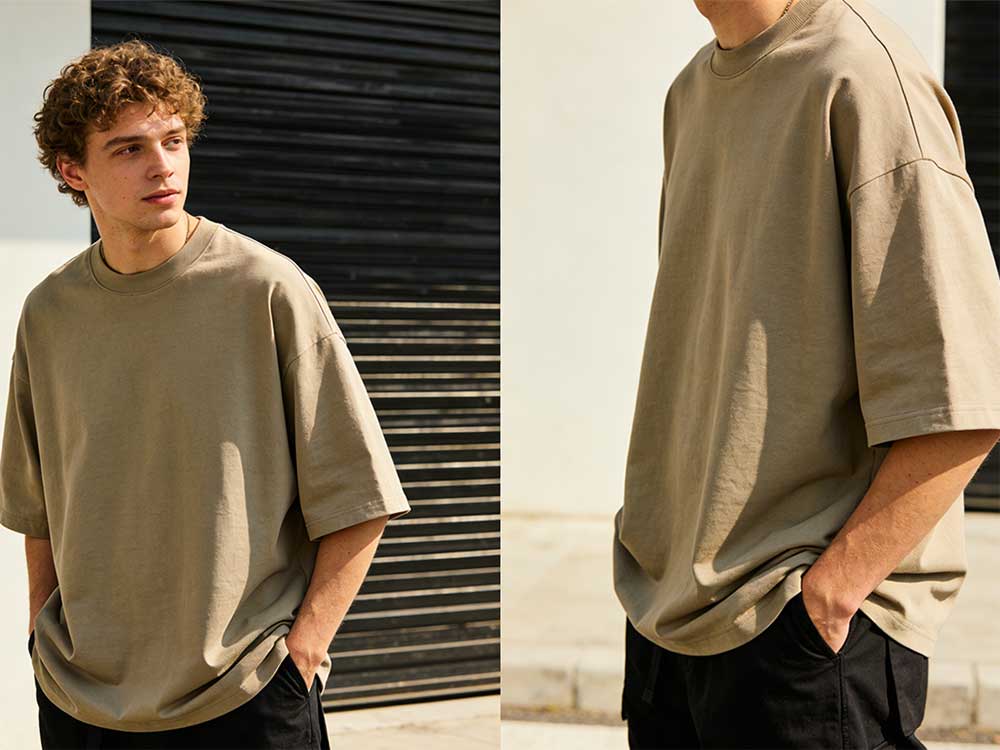
Layering compatibility begins at the seam.
Because the shoulder seam sits lower, outerwear must accommodate excess fabric at the armhole. Structured jackets with narrow armholes often conflict with this.
To judge compatibility, test whether the outer layer pulls, creases, or shifts when worn over the T-shirt. Smooth drape indicates alignment; resistance signals structural mismatch.
Drop shoulder T-shirts establish tone, not neutrality.
As a base, they set a relaxed foundation that outer layers can refine. As a filler, they introduce uncontrolled looseness that disrupts the outfit.
Evaluate whether the T-shirt is clearly defining the outfit’s direction. If other pieces appear to “correct” it, the role is wrong.


Disruption occurs when looseness exceeds tolerance.
Outerwear designed around clean lines can collapse visually when placed over relaxed shoulders.
Judge by checking whether the jacket maintains its intended shape. If it loses sharpness or rides backward, the drop shoulder is overpowering the system.
Successful layering depends on clear hierarchy.
Drop shoulder T-shirts require stronger rules than regular fits.
This section defines those rules without prescribing specific garments.
Hierarchy works when structure sits outside looseness.
A relaxed inner layer paired with a defined outer layer creates containment.
Judge by contrast: if the outer layer clearly frames the T-shirt, hierarchy exists.
If both layers are equally soft, the system collapses.
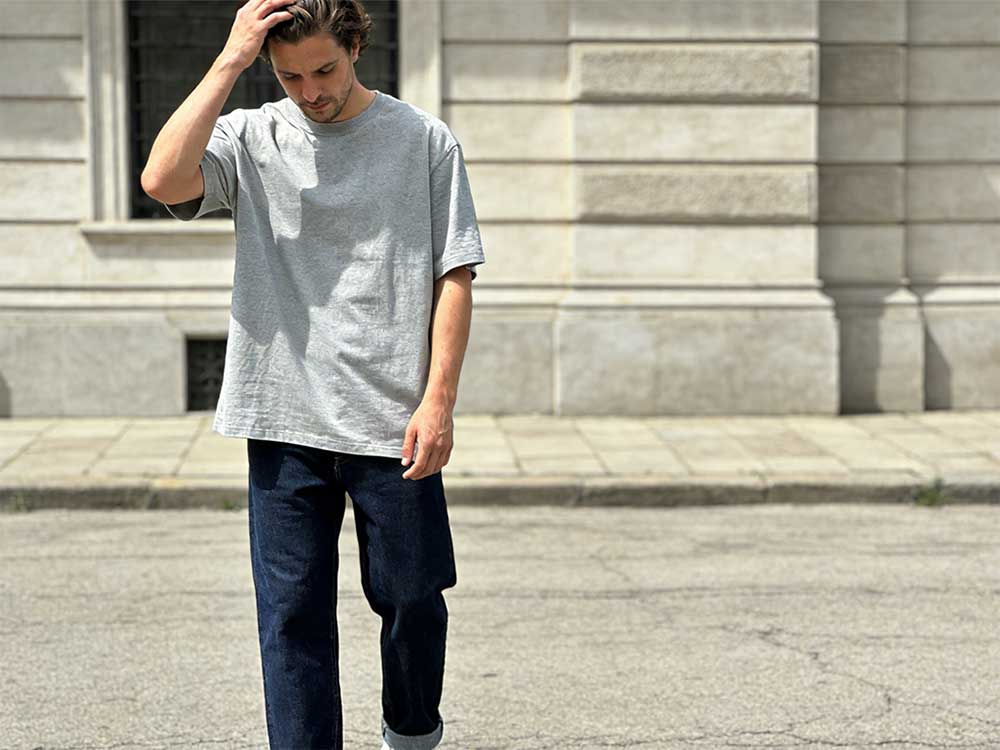

Soft-on-soft removes all visual control.
When both inner and outer layers lack structure, there is no dominant form.
Drop shoulders amplify this problem by widening the upper body.
To avoid failure, ensure at least one layer introduces firmness, shape, or directional lines.
Framing guides the eye; stacking confuses it.
Drop shoulder T-shirts need framing—clear edges, hems, or seams that define where volume begins and ends.
Judge by whether your eye can trace a clean outline. If volume piles without boundary, integration has failed.

Lower-body choices carry more responsibility when upper structure is relaxed.
Drop shoulder T-shirts shift visual weight downward.
This section explains how bottoms restore balance.
Relaxed shoulders reduce upper-body definition.
Without compensation, the outfit appears top-heavy or unfocused. Structured bottoms counterbalance this effect.
Judge whether the pants provide clear lines at the waist, hip, or leg. If not, the outfit lacks grounding.
Balance requires contrast, not repetition.
Pairing drop shoulder T-shirts with equally loose bottoms often creates volume competition.
To judge, assess whether looseness is concentrated or evenly distributed. Concentration reads intentional; competition reads careless.
Lowered shoulders widen the upper silhouette.
This pushes visual emphasis toward the lower half.
Effective integration anchors this shift with stable footwear and defined pant shapes. If the lower half feels weak, the outfit tilts visually.
Proportion is the silent logic of integration.
Drop shoulder T-shirts disrupt default proportions.
This section explains how to reestablish balance.
Softness requires counterweight.
A relaxed upper body must be met with clarity below.
Judge by contrast: if both halves feel equally soft, the outfit lacks hierarchy.
Drop shoulders introduce horizontal breaks.
These breaks shorten the perceived torso if unmanaged.
To judge continuity, check whether the outfit maintains a clear vertical flow through color, length, or structure. Fragmentation signals imbalance.
Drop shoulder T-shirts cannot anchor an outfit alone.
They remove tension rather than create it.
Successful outfits reintroduce anchoring through pants, outerwear, or footwear.
Without this, the system floats without direction.
Minimalism magnifies structural decisions.
Drop shoulder T-shirts can work—but only deliberately.
This section defines the conditions.
In minimalism, every deviation is visible.
Drop shoulders become a focal choice rather than a background one.
Judge whether the silhouette change is intentional. If it feels accidental, minimalism will expose it.
Minimalist systems tolerate fewer variables.
With drop shoulders, reduce changes elsewhere: color, texture, and volume should stay controlled.
Integration succeeds when only one element is doing the talking.
Fewer elements mean less camouflage.
Poor hierarchy or imbalance cannot hide.
Use minimalism as a test: if the outfit still reads coherent, integration is correct.
Not every role suits every fit.
Drop shoulder T-shirts perform best in specific positions.
This section defines those roles.
Drop shoulder T-shirts work best as relaxed anchors.
They set mood and proportion.
As secondary layers, they lack structural contribution and often confuse hierarchy.
Supporting pieces should be quiet.
Drop shoulders are visually active.
Judge by visibility: if the T-shirt draws attention, it should lead, not support.
Intentional use aligns role with outfit goal.
Ask what the T-shirt is doing for the system. If there is no answer, remove it.
Most integration failures follow patterns.
They are structural, not aesthetic.
This section names them clearly.
Assuming neutrality causes mismatch.
Drop shoulders demand adjustment elsewhere.
If nothing else changes, integration fails.
Relaxation without order becomes noise.
Multiple soft elements compete for space.
Hierarchy must be reintroduced deliberately.
Weight always shifts.
Drop shoulders move it upward and outward.
If the rest of the outfit does not respond, imbalance is inevitable.
A repeatable check prevents trial-and-error.
Use this framework before committing to the outfit.
It focuses on role, hierarchy, and balance.
1.Silhouette role check
2.Layering hierarchy check
3.Balance and visual weight check
The T-shirt has a defined role in the outfit
Outer layers provide structure or framing
Looseness is limited to one primary area
Lower body offers stability or definition
Visual weight feels anchored
Proportions remain intentional
The silhouette reads as one system, not parts
Drop shoulder T-shirts are silhouette drivers, not neutrals
They work best as relaxed anchors, not fillers
Layering requires clear hierarchy and structure
Lower-body definition restores balance
Minimalist systems demand higher precision
Integration succeeds when every piece responds to the shoulder drop
We’ll get back to you within 24 hours. Attach your logo/design if needed.
💡 1 . Share your logo, fabric, and quantity for T-shirts, hoodies, and more.
📐 2. We’ll prepare samples for your approval.
🚚 3. Bulk production starts after deposit.
✅ We value your privacy. Your information is 100% safe and confidential.
📦 Need help? Chat with us via WhatsApp anytime!

Note: Your email information will be kept strictly confidential.
Note: Your email information will be kept strictly confidential.
Request a quote, discuss MOQ, lead time, fabrics & QC.
Visit our brand store: Modaknitswear

Retail orders (and dropshipping options) are available on Modaknitswear.