
 Skip to content
 Why Proportion — Not Softness — Determines Whether Cotton Oversized Works
Oversized cotton T-shirts are often judged by how soft they feel.
In reality, softness is not the deciding factor—proportion is.
This page serves as the fit and proportion authority for oversized cotton T-shirts, explaining why cotton requires tighter structural and proportional control than blended or synthetic materials.
Cotton’s comfort can be misleading.
This section resets the assumption that softness equals success in oversized cotton design.
Cotton’s natural softness often disguises structural weakness in oversized fits.
Because cotton feels comfortable immediately, poor proportions can go unnoticed at first. However, softness does not prevent sagging, distortion, or silhouette collapse over time.
This false security is one of the main reasons oversized cotton T-shirts fail in real wear.


Softness without structure causes oversized cotton to lose shape quickly.
When fabric lacks sufficient proportional control, cotton yields to gravity and movement. Edges blur, volume drifts, and the garment begins to look careless rather than relaxed.
In oversized cotton, structure must lead and softness must follow.
Proportion is the only dependable way to control oversized cotton silhouettes.
Unlike stiffer fabrics, cotton cannot resist deformation on its own. Balanced shoulder placement, controlled width, and disciplined length are what maintain visual order.
Without proportion, softness becomes a liability.
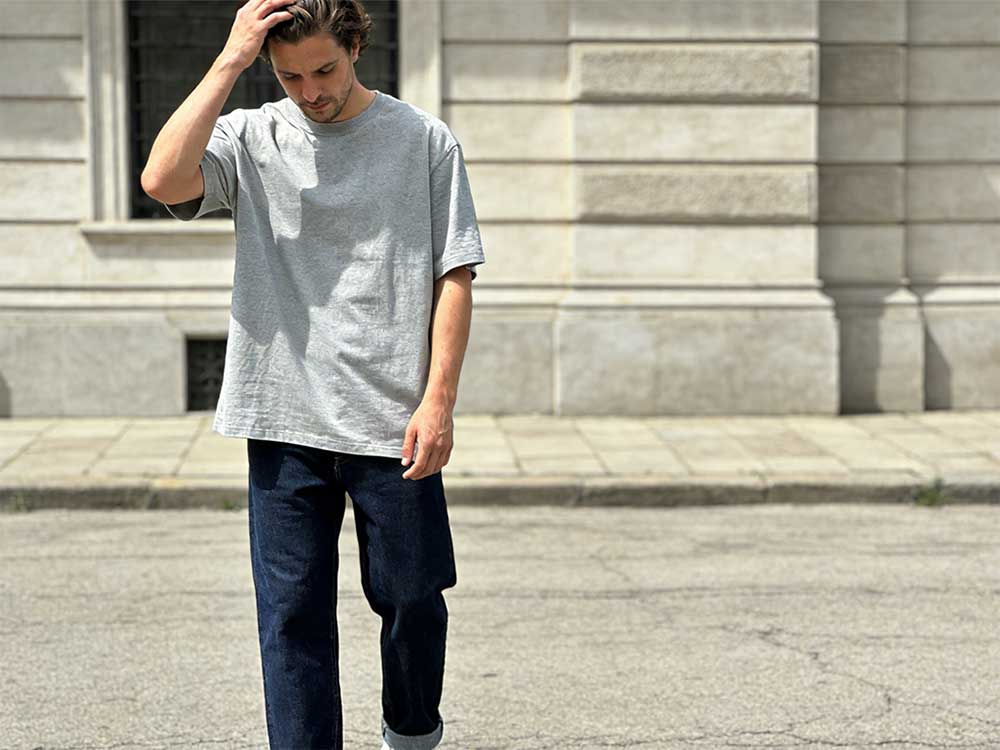
In cotton oversized designs, the upper body carries most of the structural responsibility.
If shoulder and chest proportions fail, the entire silhouette collapses.

In cotton oversized T-shirts, shoulders must support volume rather than abandon it.
Extended or gently dropped shoulders can work when they maintain a stable frame. Excessively dropped shoulders, however, remove support and cause cotton to collapse downward.
Cotton requires shoulders that distribute weight, not release it.
Oversized cotton needs chest allowance, not hollow space.
The chest should feel relaxed but visually anchored. When volume becomes empty or balloon-like, cotton exaggerates the lack of structure.
Effective chest fit allows air without creating voids.


Cotton reveals upper-body proportion errors faster than firmer fabrics.
Sagging shoulders, excessive chest width, or unsupported sleeves quickly distort the silhouette.
What might remain subtle in blended fabrics becomes obvious in cotton.
Cotton oversized has a narrower functional range than many expect.
This section defines that safe window.
Cotton supports functional looseness but not uncontrolled expansion.
A moderate increase in volume improves comfort and ease. Beyond that point, cotton begins to lose its ability to hold line and proportion.
Oversized cotton must stop short of shape loss.


Cotton tolerates less excess volume than blended fabrics.
Blends often recover shape through elasticity or structural reinforcement. Cotton relies almost entirely on proportion.
As a result, cotton oversized has a tighter margin for error.
Once looseness exceeds cotton’s support capacity, collapse is inevitable.
Sleeves drop, hems drift, and width becomes visually heavy.
The correct oversized point is where ease is visible but structure remains intact.
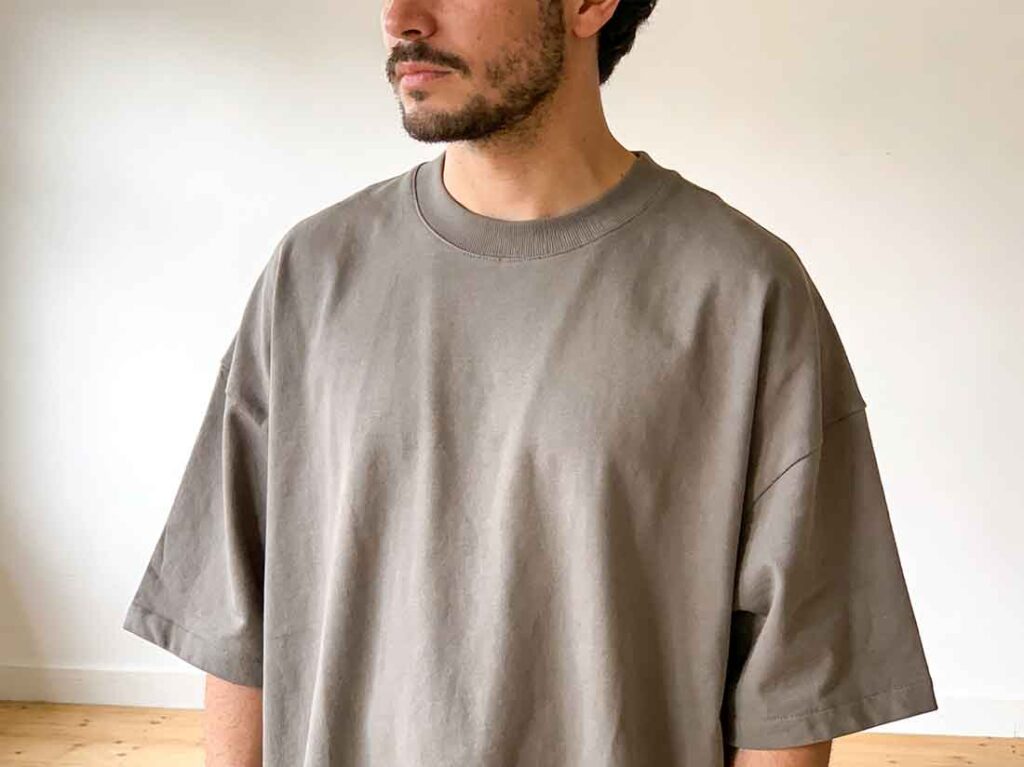
Sizing logic that works for other materials often fails with cotton.
This section explains why.
Increasing size alone does not produce a valid oversized cotton fit.
Size escalation adds length and width unevenly, overwhelming cotton’s limited structural resistance.
Without pattern-level adjustment, sizing up leads to distortion.
Pattern-led oversized builds proportion in; size-led oversized relies on chance.
True oversized cotton T-shirts are engineered from the pattern stage to manage volume.
Size-led approaches ignore cotton’s material limits.
Sizing up creates shapelessness when cotton cannot redistribute added volume.
Excess length drags downward, excess width spreads outward, and no element stabilizes the silhouette.
This is the most common oversized cotton failure mode.
Dimensional discipline is critical in cotton.
This section explains why.
Expanding width without controlling length destabilizes cotton silhouettes.
Wide and long combinations accelerate sagging and visual heaviness.
Cotton requires width and length to be scaled together with restraint.
Cotton immediately exposes imbalance because it lacks resistance.
Where stiffer fabrics hold form, cotton follows gravity.
Any proportional error becomes visually amplified.
Modern oversized cotton distributes volume evenly rather than concentrating it.
Balanced volume reduces stress points and preserves calm silhouettes.
This distribution is a defining modern standard.
Cotton oversized alters how the body is perceived.
This section helps predict those changes.
Cotton oversized tends to increase perceived width before height.
Without careful proportioning, the silhouette becomes broader and shorter.
Correct balance restores vertical continuity.
Bulk appears when cotton volume lacks clear boundaries.
Soft fabric spreads rather than stacks, producing visual mass instead of structure.
This is why cotton oversized often looks heavier than it is.
Correct proportion reintroduces visual calm to cotton oversized.
Balanced shoulders, moderated width, and disciplined length allow the fabric to settle.
The result is relaxed rather than bulky.
Cotton is less forgiving, not more.
This section reinforces the page’s core thesis.
Cotton offers little resistance to over-extension.
Once volume exceeds its support capacity, recovery is limited.
Precision becomes essential.
Fit in cotton oversized refers to structural alignment, not snugness.
A garment can be loose and still fit correctly.
Structure defines success.
Relaxed cotton is proportioned; sloppy cotton is not.
Both may feel soft, but only one maintains visual integrity.
The difference is deliberate control.
Most failures follow repeatable patterns.
This section defines them clearly.
Excess softness accelerates shape loss in oversized cotton.
Comfort improves briefly; structure disappears quickly.
This combination is high risk.
Width without shoulder support causes downward collapse.
Cotton cannot suspend volume without a frame.
Shoulders must carry the load.
Cotton tends to lengthen over time if proportions are not controlled.
Repeated wear and washing reveal this drift.
Length stability is critical.
Use this framework for quick, repeatable evaluation.
1.Upper-body structure check
2.Width–length balance check
3.Shape retention and silhouette check
We’ll get back to you within 24 hours. Attach your logo/design if needed.
💡 1 . Share your logo, fabric, and quantity for T-shirts, hoodies, and more.
📐 2. We’ll prepare samples for your approval.
🚚 3. Bulk production starts after deposit.
✅ We value your privacy. Your information is 100% safe and confidential.
📦 Need help? Chat with us via WhatsApp anytime!

Note: Your email information will be kept strictly confidential.
Note: Your email information will be kept strictly confidential.
Request a quote, discuss MOQ, lead time, fabrics & QC.
Visit our brand store: Modaknitswear

Retail orders (and dropshipping options) are available on Modaknitswear.