
 Skip to content
 How to Build Balance and Control in Oversized Outfits
Oversized T-shirts do not operate as standalone pieces.
As upper-body volume increases, visual balance shifts to the rest of the outfit, making coordination essential rather than optional.
This page serves as the coordination authority, explaining how bottoms, sleeves, and proportional details determine whether oversized outfits feel controlled or collapse into imbalance.
Oversized silhouettes change where responsibility for balance lies.
This section reframes oversized as a system-dependent garment, not a self-sufficient one.
When the top becomes oversized, balance must be created elsewhere.
In regular fits, the body naturally anchors proportion. In oversized fits, that anchor weakens, and visual stability must come from bottoms, sleeves, and details.
Oversized redistributes responsibility across the outfit.


Without anchors, oversized volume drifts visually.
Anchors are elements that stop expansion and give the eye a reference point. When they are missing, the silhouette feels unresolved.
Oversized requires anchors to remain readable.
Coordination organizes volume; decoration only adds noise.
Modern urban style relies less on expressive details and more on proportional control. Oversized outfits succeed when pieces relate structurally, not ornamentally.
Control replaces embellishment.

Bottoms carry the greatest balancing responsibility in oversized outfits.
This section explains why.

Pants act as the counterweight that stabilizes upper-body volume.
They ground the silhouette and prevent the top from dominating the visual field.
Without adequate lower-body presence, oversized tops appear top-heavy.
Pants do not need to be tight, but they must be defined.
Some structure—through shape, fabric, or cut—is required to counter oversized tops.
Total looseness above and below removes hierarchy.


The eye locates balance through the lower half of the outfit.
When pants provide visual weight and clarity, the outfit feels stable.
Bottoms determine where the silhouette settles.
Not all pants interact with oversized tops equally.
This section defines compatible and risky silhouettes.
Straight and relaxed-straight pants provide the most reliable balance.
They offer enough width to relate to oversized tops without compounding volume.
This makes them the most stable pairing option.


Tapered pants reintroduce definition without sharp contrast.
They narrow the lower silhouette gradually, anchoring oversized tops while maintaining ease.
Tapering is a moderation tool.
Wide-leg pants only work when volume is clearly organized.
If both top and bottom expand without differentiation, the silhouette collapses.
Wide legs require strict control elsewhere to succeed.

Sleeves are often overlooked, yet they strongly influence balance.
This section isolates their role.
Sleeve length directly affects perceived upper-body mass.
Short sleeves emphasize width; mid-length sleeves balance volume; extended sleeves risk heaviness.
Choosing sleeve length is a proportional decision.
Sleeve length must be evaluated relative to shoulder placement.
Dropped shoulders require careful sleeve calibration to avoid overextension.
Ignoring this relationship leads to exaggerated bulk.
Sleeves can either contain volume or amplify it.
Well-proportioned sleeves frame the torso; poorly proportioned sleeves add uncontrolled mass.
Sleeves are stabilizers, not afterthoughts.
Sleeve width shapes the outline of the entire upper body.
This section explains how.
Controlled sleeve openings maintain silhouette clarity.
Excessively flared sleeves blur edges and magnify looseness.
Control at the opening preserves definition.
Sleeve volume determines where visual density concentrates.
Balanced sleeves distribute weight evenly; overbuilt sleeves overload the upper frame.
Density must be managed deliberately.
Excess sleeve volume disrupts visual flow.
The eye loses its path across the outfit, and balance breaks.
Sleeves should support rhythm, not interrupt it.
Length ratios are one of the most common failure points.
This section defines critical relationships.
Oversized T-shirt length must stop before it competes with pants structure.
When the top drops too low, it erases lower-body definition.
Length should frame, not obscure.
Pants rise determines how oversized length is perceived.
Higher rises tolerate more top length; lower rises require stricter control.
Ignoring rise leads to imbalance.
Poor length ratios remove hierarchy.
When the eye cannot distinguish top from bottom, the outfit loses order.
Sloppiness is often a ratio problem, not a styling one.
Details matter more as silhouettes loosen.
This section explains why.
The neckline anchors the entire upper silhouette.
A stable collar signals intent and control.
Instability here undermines everything else.
Clean hems and aligned seams maintain clarity.
They define edges and prevent visual drift.
Finish quality becomes more visible at larger scale.
Clean details compensate for relaxed volume.
They reassure the eye that looseness is deliberate.
Control lives in the details.
Most failures repeat the same patterns.
This section makes them explicit.
Uncontrolled volume stacking removes visual hierarchy.
Without contrast or structure, the silhouette collapses.
Balance requires differentiation.
Sleeves and length are often neglected until failure is obvious.
By then, imbalance is already baked in.
Early proportion checks prevent this.
Relaxation must be selective, not universal.
When everything is relaxed, nothing is controlled.
Selectivity defines modern oversized coordination.
This framework replaces guesswork with repeatable checks.
1.Top–bottom proportion check
2.Sleeve and shoulder balance check
3.Detail and structure check
Oversized requires proportional support
Bottoms are the primary balance anchor
Sleeves strongly influence upper-body control
Length ratios define clarity or sloppiness
Details add intent to relaxed volume
Oversized succeeds through coordination, not decoration
We’ll get back to you within 24 hours. Attach your logo/design if needed.
💡 1 . Share your logo, fabric, and quantity for T-shirts, hoodies, and more.
📐 2. We’ll prepare samples for your approval.
🚚 3. Bulk production starts after deposit.
✅ We value your privacy. Your information is 100% safe and confidential.
📦 Need help? Chat with us via WhatsApp anytime!
Note: Your email information will be kept strictly confidential.
Note: Your email information will be kept strictly confidential.
Request a quote, discuss MOQ, lead time, fabrics & QC.
Visit our brand store: Modaknitswear
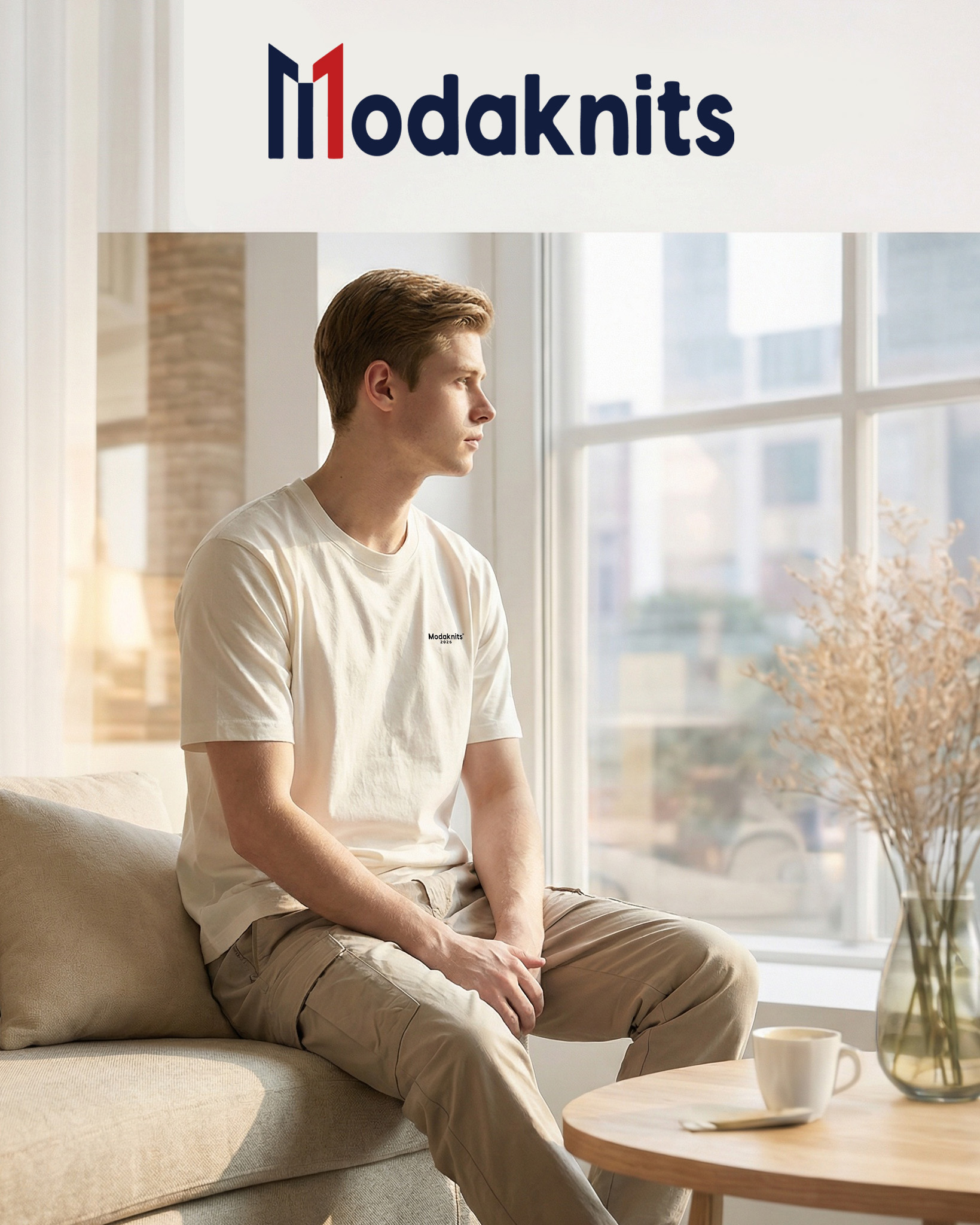
Retail orders (and dropshipping options) are available on Modaknitswear.